Thứ Năm, 23 tháng 11, 2006

Hold the Revision: Marie Antoinette (1938)

Certain cultural moments leave the Siren scratching her head, and the greeting accorded Sofia Coppola's Marie Antoinette is one. Not because the Siren dislikes the movie--she hasn't seen it and isn't enough of a Sofia fan to drop the newborn and rush out to remedy that--but because all the critics keep telling her it's based on a "revisionist" view of the doomed queen, an analysis that doesn't paint the woman as heartless, extravagant and silly.

To which the Siren replies, just what in the sam hill is so all-fired revisionist about that? Has any American film ever portrayed the French queen as anything other than sympathetic? Okay, the Siren can think of one: Start the Revolution Without Me, a breathlessly silly 1970 comedy the Siren loves. In it, Billie Whitelaw plays MA as a scheming nymphomaniac, a characterization the Revolutionary pamphleteers would have recognized and relished. Otherwise, l'Autrichienne gets sweetheart press over here, and always has. Prime example: the 1938 biopic starring MGM's Queen of the Lot, Norma Shearer.

No European film could ever be quite as royalist as this one. As hagiography, it makes Ivan the Terrible Part I look like Scarface. Marie is a victim of history, a good-hearted woman with a strong sense of duty, too noble to act on her passion for Count Axel von Fersen (Tyrone Power, barely there) after Louis XVI gets his (delicately unmentioned) phimosis cured. The revolution, it's suggested, wouldn't have been necessary if that nasty Joseph Schildkraut, playing the Duc d'Orleans, hadn't kept stirring things up. Starving peasants? Overtaxed middle class? ruinous wars? Geez, it wasn't Marie's fault that she didn't know how to stop a bread riot. She was just trying to be the best darn Queen of France she could be.

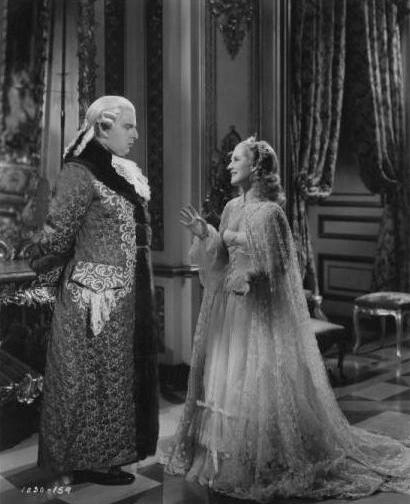
Still, I defy anyone with a love of classic film to view Marie Antoinette without, at minimum, getting some pleasure out of Cedric Gibbons' art direction. You could say MGM was unable to use Versailles, but the real answer is why bother, when they had the back lot? Gibbons worked not to recreate the world's most famous palace, but to suggest and, finally, outdo it as only MGM could. The spaces are bigger and bolder than in real life, full of laquered staircases, blazing klieg-light candelabra, and furniture and tapestries brought back by buyers rummaging through France. When the studio recreated the Hall of Mirrors for a ball sequence, they made it twice as big as the original. That's a pretty good metaphor for MGM's entire aesthetic, right there.

Adrian's costumes were equally over the top--check out this marvelously detailed site for a complete rundown of each costume. The site also has color snapshots of those costumes which have survived to the present day, and the gowns may be more lavish than anything the real Marie ever wore. Irving Thalberg was planning this vehicle for wife Shearer when he died in 1936, and at first it was planned as a Technicolor feature. It is a crying shame that money considerations meant it was filmed in black-and-white. One fur was even sent abroad to be dyed the color of Norma's eyes.

Shearer was a fascinating person, as Gavin Lambert demonstrated in his 1990 biography, but the Siren has a hard time warming to her performances. She had a marvelous voice, elegant posture and one of the most beautiful profiles in screen history, but she was very mannered, a back-of-the-hand-to-the-forehead kind of dramatic actress. Marie Antoinette, however, definitely ranks with The Women and Idiot's Delight as one of Shearer's best talkie performances. Shearer spent hours learning to move gracefully under the heavy costumes, and her carriage is always aristocratic. That physical focus frees up Shearer's face and gestures, and her emotions flow much more organically than usual. The movie was a personal favorite of the actress. (In later years Shearer owned prints of only two of her movies--Romeo and Juliet and Marie Antoinette.)

And Shearer's greater believability as Marie Antoinette also probably had something to do with a wee bit of identification. Thalberg had been dead two years, and Shearer's power as Queen of the Lot was ebbing away. She had wanted old pal Sidney Franklin to direct, but an underhanded maneuver (did he make any other kind?) by studio chief Louis B. Mayer resulted in Franklin being replaced with W.S. "One-Take Woody" Van Dyke. The replacement probably helped the picture (Van Dyke, of Thin Man fame, was a better director), but such a thing would never have happened when Norma ruled at the Boy King Thalberg's side. When filming stopped, she was only four years and five movies from retirement.

The 1938 Marie Antoinette puts suffering Shearer front and center throughout, but it is the kings who stand out. John Barrymore seems more dissipated than even his role as Louis XV requires. But the Siren's favorite, and the real reason she would watch the movie again, is Robert Morley as Louis XVI. The Siren is an ardent small-r republican, prone to point out irritably that tearjerking scenes of Marie separated from her children obscure the question of the sufferings of France's less privileged children. But Morley, spending his last night alive lovingly repairing his son's toy soldier, manages to make her feel sorry for a Bourbon. Touché, MGM.

Thứ Tư, 22 tháng 11, 2006

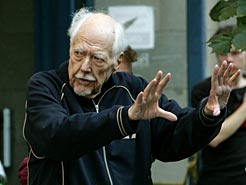
Robert Altman 1925 - 2006


Griffin: It lacked certain elements that we need to market a film successfully.
June: What elements?
Griffin: Suspense, laughter, violence. Hope, heart, nudity, sex. Happy endings. Mainly happy endings.


The Siren bids hail and farewell to the great Robert Altman.

Thứ Tư, 8 tháng 11, 2006

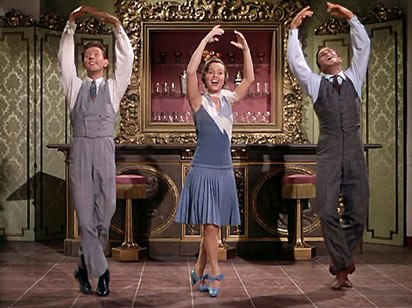
GOOD MORNIN'


Donald, Debbie and Gene demonstrate the mood at the Siren's house. Hoping my patient readers are well and happy, too!

Thứ Ba, 24 tháng 10, 2006

The Family Campaspe Celebrates the First Weekend ...


of Abraham Ben, born Oct. 19, 2006, at 4:41 pm, in New York. While he thus far refuses interviews, sources close to the new arrival state he made his debut at 8 pounds, 8 ounces, 20 inches in length. So far the raves are unanimous. Publicists are currently deciding which paparazzi shot of Ben, or Bibou as his fans call him, is the most flattering for release to the public. Meanwhile, groggy best wishes, and the Siren will be back soon, she promises.

Thứ Hai, 2 tháng 10, 2006

Stanley, Tony and The Defiant Ones


If Libertas insisted on calling Red-Blue Film Teams, the Siren is pretty sure Team Blue could call Stanley Kramer without comment. His name is a byword for earnest, uninspired liberal filmmaking. That's liberal and by no means left-wing, as this excellent assessment in a socialist periodical points out.

You don't disagree with Kramer because he stacks the deck. He's so reasonable he can cross over into irritating. The Siren likes Inherit the Wind a lot, but cringes every time Spencer Tracy walks out with a copy of Darwin AND the Bible under his arm. As someone who grew up surrounded by That Old-Time Religion, let's just say that wasn't the ending she was rooting for.

It's a Mad, Mad, Mad, Mad World is too cumbersome to be funny, Judgment at Nuremberg has been supplanted by finer films on the Holocaust. Guess Who's Coming to Dinner? is worth watching nowadays only for Sidney's Poitier general gorgeousness, since the man wasn't given an actual character to play, and for Katharine Houghton, a lovely presence whose later career played out mostly on stage.

So the Siren settled in to watch the The Defiant Ones expecting, well, not much. Who knew that would really make the film worth watching would be a bigoted Southern convict, played by Bernie Schwartz from the Bronx?

Tony Curtis gives a really good performance, and because his character isn't freighted with the same symbolic baggage as that of his costar, even Sidney Poitier's formidable talent doesn't make quite as large an impression. Curtis is entirely credible as Joker Jackson, the convict who escapes from a prison work gang still chained to Noah Cullen (Poitier). The two men make their way across the rural South, encountering--well, the sort of stuff you'd expect a black man chained to a white man to encounter in the rural South circa 1958. Hostility, in a word. And a few standout character actors, including Lon Chaney Jr. and Claude Akins. Curtis and Poitier are pursued by reluctant and humane sheriff Theodore Bikel, who is prodded in turn by his captain, Charles McGraw in merciless mode. (If you want a complete plot rundown, or have seen the movie already, do check out this great piece at PrisonFlicks.com, a genre site that is the Siren's latest discovery.)

If the 1960s became the age of the Beautiful British Actor, in the 1950s it was the Americans who seemed to line up dazzling male beauties, one after the other--Marlon Brando, James Dean, Montgomery Clift, Rock Hudson, Burt Lancaster. Tony Curtis could hold his own in the looks department against any of them, so much so that he has a prosthetic on his nose in this movie in an attempt to damp his appeal. How well that works (basically, it doesn't) can be judged from the still above. But Curtis's amazing looks help believability late in the film, when a lonely, frustrated grass widow takes one look at him, chains and all, and starts fixing his supper.

In terms of camera work, the film isn't very engaging. The images themselves are often beautiful (and won an Oscar for cinematographer Sam Leavitt) it's just that the film language tends to be pedestrian. Example: a long and very well-played monologue, delivered in bed by an ailing Tony to the grass widow. About midway through his speech the camera tracks back to an overhead shot, and lingers there, and oh look it is lit like a CHURCH, just like CONFESSION, and then descends again. You get a lot of stuff like that. Subtlety was in no way Kramer's strong suit.

Guiding actors, on the other hand, was. Kramer films are full of good acting. Here Curtis holds his own against all odds, even to a passable Southern accent. (He concentrates on the vowels and all but ignores the consonants, and so avoids that exaggerated drawl that kills many imitation Southern accents.) He gets the best character arc in the movie, but in the end it is an open question whether Joker has come anywhere close to overcoming his prejudice. Where Curtis succeeds is in showing how this convict is able to move beyond a criminal's strongest trait, his absolute selfishness.

A general Curtis postscript: Last year I read his 1993 autobiography, cowritten with the excellent biographer Barry Paris. It is a strange book indeed. Curtis vaults beyond arrogance, into a territory where your self-love is so enveloping you have no idea how you sound to other people. (For instance, when Curtis describes how he decided to quit visiting his pathetic, institutionalized schizophrenic younger brother.) The frank selfishness is so consistent that after a while, amazingly, it gets to be kind of endearing. The man lets it all hang out. And once you have read the book, it isn't surprising that The Defiant Ones has something in common with other great Curtis performances in Sweet Smell of Success and The Boston Strangler. He isn't afraid to be disliked, which the Siren would call a mark of any real actor, as opposed to a matinee idol. It is a shame that Curtis's career, with a few bright exceptions, petered out in the 60s in a series of silly farces--jobs taken in part to make child support payments for his six kids from various marriages.

Chủ Nhật, 24 tháng 9, 2006

The Gym Class School of Film Criticism

Like most bloggers, the Siren likes to look at other blogs. A while back she discovered Libertas. The writers there do not exactly share her own political philosophy, but it's healthy to read opposing opinions, and they cover a lot of old movies, so the Siren still checks in every once in a while.

There are times when the Siren simply disagrees with Libertas (you can see her objecting in the comments section to this post on The Searchers), times when she thinks hmm, interesting and other times when she's just flummoxed. Like this post on Flags of Our Fathers. The film hasn't been released yet, so blog editor Jason Apuzzo is critiquing the trailer, which strikes the Siren as a mighty perilous approach. Trailers are the reason she went to The Crying Game expecting The Informer, for example, and thought the worst thing that could happen in Million-Dollar Baby was that Hilary Swank might lose the big fight. Anyway, here is the trailer. Please do take a look before you continue.

What did you see? The Siren saw a preview for a movie about some very brave soldiers, who saw some bad things during a terrible and hard-fought battle, came home and found themselves catapulted into unexpected fame, were dragooned into war-bond drives they found embarrassing and crass, and wound up wracked with self-doubt because they didn't consider themselves heroic in comparison to the men killed in battle.


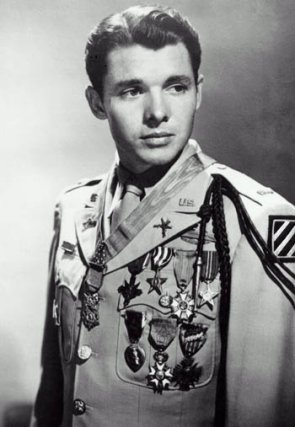
The Audie Murphy story in triplicate, in other words.


What she did not see was a commentary on the Iraq war, the insinuation that World War II was unjust or that the men who raised the flag on Iwo Jima were frauds or war criminals.

What the hell? That trailer is nothing. You want a cynical, politicized WW II movie, the Siren'll give you a cynical, politicized WW II movie. How about Attack, the 1956 film that shows a soldier dying as horrible a combat death as you've ever seen--and dying that way, mind you, due to the cowardice of an American officer promoted solely because of his rich daddy's connections. (The Siren is convinced that sequence must have influenced Steven Spielberg when he was creating one of Saving Private Ryan's most memorable death scenes--but the Siren also says Attack is the better movie.)

Or let's talk about a movie with enough derring-do to satisfy even Libertas, The Bridge on the River Kwai.
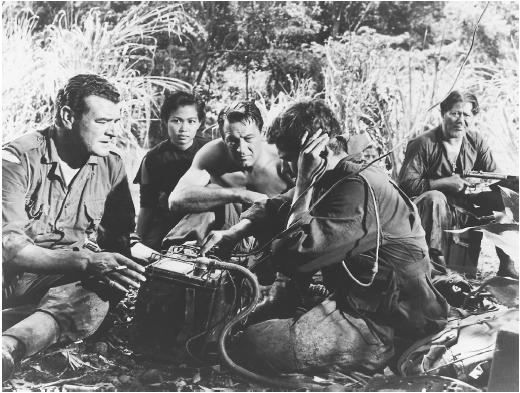
Even in that one, you want moral equivalence? Take a look at the none-too-subtle parallels between Sessue Hayakawa's camp commander and Alec Guinness's POW. And ruthlessness to spare, with Jack Hawkins as the British commando ready to sacrifice not only himself, but William Holden and every other man he brought with him. The Siren's favorite shot in that splendid movie shows the young women bearers recoiling from Hawkins--they know what he is, no matter what cause he's pursuing. The primary characters in Bridge are, with the qualified exception of Holden, utterly focused on winning their narrowly defined parts of the war game, to the point that they are barely thinking about the larger issues at stake. That is what happens in a war, Carl Foreman, Michael Wilson and David Lean are telling us.

Or how about The Best Years of Our Lives. Homer, the returning GI with hooks for hands, finds himself in a drugstore being queried by a customer who obviously never saw combat.

Customer: You got plenty of guts. It's terrible when you see a guy like you that had to sacrifice himself - and for what?
Homer: And for what? I don't getcha Mister?
Customer: ...We let ourselves get sold down the river. We were pushed into war.
Homer: Sure, by the Japs and the Nazis so we had...
Customer: No, the Germans and the Japs had nothing against us. They just wanted to fight the limeys and the reds. And they would have whipped 'em too, if we didn't get deceived into it by a bunch of radicals in Washington.
Homer: What are you talkin' about?
Customer: We fought the wrong people, that's all. (Pointing at his newspaper, with headlines: "SENATOR WARNS OF NEW WAR") Just read the facts, my friend. Find out for yourself why you had to lose your hands. And then go out and do something about it.


That customer says he is espousing "plain, old-fashioned Americanism." He's an accurate depiction of post-war sentiment in certain quarters. But if such a character pops up in Flags of Our Fathers, Mr. Apuzzo will probably have apoplexy.

The Siren adores Best Years, and without hesitation would cite it as the greatest celebration of true American values ever made. But part of its greatness lies in the filmmakers' willingness to include a character like that drugstore customer, or the people overheard making snide remarks about veterans flooding the job market. Conflict, you see. Nuance. Dramatic shading. A movie that has those qualities has a shot at greatness, or at least watchability. A movie that doesn't have them will be Little Tokyo, USA or at best Conan the Barbarian.

Why this bizarre insistence that any attempt to show any World War II leaders as less than stainless somehow represents an insidious left-wing all-American-wars-are-imperialist agenda? After seeing a trailer, for heaven's sake. Well, Mr. Apuzzo pretty much tells you what he is basing his assumptions on--screenwriter Paul Haggis. Haggis, you see, is a liberal, and that's enough: "My concern was that Haggis would try to smuggle his politics into Eastwood's Iwo Jima melodrama, and it appears that my concerns were justified."

There's a whopping big assumption in that sentence, that Haggis could somehow work in his agenda without Eastwood, a meticulous director and one tough hombre to boot, either noticing or saying "Hey Haggis, what is this pantywaist crap you're putting in my movie, punk?" But no matter. Haggis is vocally liberal, therefore he will always try to make a certain type of movie, even to the point of trying to hoodwink Eastwood, whose politics skew conservative.

The Siren calls this approach to evaluating a movie The Gym Class School of Film Criticism. Lance Mannion periodically tracks the flowering of this approach. The Gym Class School imagines art as a dodgeball game, with critics, cinephiles and Hollywood observers of various sorts as the self-appointed team captains. Actors, directors, screenwriters etc. are the potential Team Players. Death doesn't disqualify a player, in fact it can increase the squabbling when teams are selected. So it works something like:

Team Red Captain: I call Cecil B. DeMille.
Team Blue Captain: I call John Huston.
Red C: Sam Wood.
Blue C: Charlie Chaplin
Except, it rapidly deteriorates into:

Red C: John Ford.
Blue C: Says who? He was a New Dealer--
Red C: But then he went Republican. And he was always fervently anti-Communist. And then he--
Blue C: All right then, smartypants. Joseph Mankiewicz.
Red C: What?? Mankiewicz was a Republican!
Blue C: But he was a liberal Republican.
Red C: Then I call Frank Capra.

As biographical critique, it doesn't work very well. As film criticism, it doesn't work at all. Whose politics dominate a movie--the director, the actors, the screenwriter, the cinematographer, the best boy? And it is apparent to all but the most hidebound minds that an artist's politics may or may not have anything to do with his work. William Holden was a Republican, and two of the best movies he ever made were for a liberal director and a couple of blacklisted screenwriters. Flipping it around, if I know that Henry Fonda was a lifelong Democrat, that tells me exactly what about Advise and Consent, a film from a book by a noted conservative?

Gym class was a time of horror for the Siren, and she has no intention of revisiting it for Flags of Our Fathers or the next Gary Oldman flick. The Siren is not an optimist by nature, but she tries to give serious filmmakers (defined as those with some aspirations beyond the grosses) a fair shake with each new movie. You can get a great performance out of granite-ribbed reactionary Adolphe Menjou in the bitingly subversive Paths of Glory, or a beautiful elegy for the ruling class like The Leopard out of avowed Marxist Luchino Visconti. In the words of the great Fats Waller, one never knows, do one?

Thứ Sáu, 1 tháng 9, 2006

Anecdote of the Week


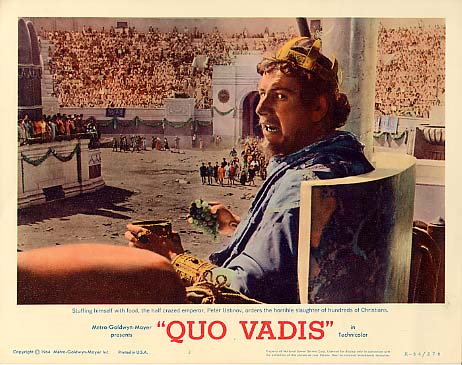
"The film was a great success all over the world and brought Peter a recognition that was not always to his liking. He was in New York for the opening and climbed into a cab, but before he could state his destination the driver enquired, 'Quo vadis, Mr. Ustinov?'"

--From Peter Ustinov: The Gift of Laughter, by John Miller.