Thứ Tư, 10 tháng 8, 2005
No Room at the Inn
The Siren suspects a lot of people buy this DVD thinking "Great! a Hitchcock I've never seen!" But Jamaica Inn (1939) is far more Laughton's movie, featuring a performance that makes the other characters shrink toward the edge of the frame whenever he's around. Like diners who know the waiter sees them, but despair of luring him back to their table, actors make vague gestures in Laughton's direction but don't seem to have any real hope of engaging him. Since the cliche about acting being reacting is quite true, I can't label this a great Laughton performance. I do recommend the movie, though, because flawed as it and Laughton are, Jamaica Inn has its good points.
I have read the Daphne DuMaurier novel the film is taken from, and like most adaptations of the period the book has been hacked to pieces. Novel and movie concern a band of wreckers on the Cornwall coast. The gang lures ships with false guiding lights, and when the ships founder, they loot the cargo and kill all survivors. The movie opens with just such a scene, and it offers one of the few moments of real fright in the film. (I especially like playwright/actor Emlyn Williams as the most heartless wrecker in this bad lot.) Maureen O'Hara says the opening and a later shipwreck scene were the only parts Alfred Hitchcock seemed to enjoy shooting. Otherwise, he was phoning it in, waiting to finish the thing and go to America to make his fortune (this was his last movie in Britain).
O'Hara plays Mary Yellan, whose parents have died and who is being sent to live with her aunt. The aunt is married to the sinister proprietor of the inn. When we first see Mary, she is in a coach headed for the inn, and this is where the film itself starts to lurch. The coachman, terrified at the mere mention of Jamaica Inn, whips his horses so they race past, tossing Mary around the carriage and delivering her several miles beyond her destination. Fatally, this is played for slapstick laughs, and the mood built up so nicely in the earlier scene shrivels and dies. From here on, very little of DuMaurier's atmosphere and sense of danger is retained.
Mary fetches up instead at Sir Humphrey Pengallan's place. This squire (we learn rapidly) actually leads the wreckers, running this criminal enterprise to maintain his life of luxury. In the novel, the leader is an albino vicar, which reads a lot scarier than it sounds. But it was 1939, there was censorship in Britain as well as the U.S., and an evil mass-murdering clergyman would never make it past the Pecksniffs. So Laughton, who O'Hara says was all for playing an albino vicar, was stuck playing a sinister squire. And play it he did, for all it was worth, apparently working even the redoubtable Hitchcock into a state of "Fine, Charles, do it your way."
Laughton's way creates a monster of the English gentry, convinced that his privilege is divine will, and that his appreciation of the finest objects and food justifies anything he may do to keep up a steady supply. One of the best things about Jamaica Inn is watching Sir Humphrey enjoy his private jokes at others' expense. They're nothing to him, just ants; the squire is another Harry Lime, moved back some generations and up a few rungs on the social ladder. Like Welles, Laughton had a face perfect for conveying sensuous depravity, with that overlarge lower lip doing half the work for him. When Maureen O'Hara walks in, you believe he wants her, but not in bed. O'Hara's beauty makes her another object to be acquired and handled, protected from the peons who won't appreciate her properly.
One reason Laughton overwhelms Jamaica Inn is that the actors he shares the screen with, including Robert Newton as the good guy, can't hold their own. Maybe they didn't have the chops, maybe Laughton's vision of his character never gave them the chance. Despite the fun to be had in watching Laughton, you wish his director had taken enough interest to rein him in a little and build the sense of menace. The suspense doesn't build again until a second shipwreck scene, far later in the movie, and by then it's too late. And Sir Humphrey's last, desperate maneuvers are fantastically over-the-top.
Definitely one for the Laughton fans. Look for his best work in something like Hobson's Choice or Witness for the Prosecution. Think of Jamaica Inn as what might have happened if Captain Bligh had directed Mutiny on the Bounty.
Chủ Nhật, 7 tháng 8, 2005
Resquiescat in Pacem, Once Again

Some sort of publicity shot for How to Marry a Millionaire, the Siren's personal favorite among Marilyn Monroe's performances.
Annie over at Blogdorf Goodman has drawn my attention to the latest story about Monroe's death. An 86-year-old gentleman has come forward, forty years after her death, to proffer a transcript of a tape he says Monroe made for her psychiatrist. Alas, this gentleman is the only living person who heard it, and the tapes were destroyed. But aren't we the lucky ducks, because in that transcript Monroe just happens to discuss every rumor about her. Yep, addressed every one of them, right on down to the old queries about whether Joan Crawford made a pass at her. And while she was at it, she told the shrink her views on Freud and James Joyce, because shrinks love that sort of stuff.
The Siren wonders when, precisely, the journalistic response to "Because I said so" became "Really? Okay, let's run the story then!" She suspects--suspects, mind you--that it might have been around the same time Paula Jones poked her proboscis into the nightly news. Call the Siren a fussy old cynic, but this alleged transcript reads like Harold Robbins circa The Carpetbaggers..
Since nobody else, from the UK Daily Telegraph to the Los Angeles Times, has bothered to look at whether the style of expression seems to match Marilyn's, the Siren would like to point out something for her small audience. One thing we do know about the actress is that she had a lively sense of humor. Her best work was in comedies, and the record (the substantiated record, that is) is full of her snappy, even witty remarks. There's no real humor in this thing at all. When the subject is sexual, the "transcript" is deadly earnest in its prurience. At other times it's just stuffy. It is good to know that Monroe took pains to remind people that the line about "hell hath no fury" is Congreve, not Shakespeare.
And, of course, it's perfectly logical that if Monroe were making a tape for the purposes of getting her mind straightened out, she'd want to tell the doctor about how great Clark Gable was in Gone with the Wind and not dwell on trivia like her miscarriage after Some Like It Hot.
Question for the Los Angeles Times, which broke this news: Did no one think to call a reputable Monroe biographer like Barbara Leaming or Donald Spoto, and ask whether the transcript passes the smell test? Spoto's biography neatly debunked the "Kennedys killed Marilyn" tripe by tracing that rumor to its source, Norman Mailer. Mailer has confessed that he hadn't a single concrete reason to float that idea, other than the knowledge that it would sell books and help him make his alimony payments.
More even than her supposed paramour John F. Kennedy, Monroe and her tragic end attract the credulous. See them lined up to buy this latest bit of gold-plated rubbish. The Siren finds it all about as appetizing as watching people dig through Monroe's lingerie drawers.
Marilyn Monroe made some excellent movies, all of which are available on DVD. An evening spent with even the least of these would be far more constructive than exhuming her corpse for one last peepshow.
[Note: This post has been edited with additional material to accomodate the Siren's growing indignation.]
Thứ Sáu, 5 tháng 8, 2005
'Tis Exhausting
Maureen O'Hara was not a great actress, but the Siren seldom realizes it when caught by her charm. She had marvelous presence and arresting beauty, and in many of her films that was all it took.
Despite her wondrous looks she has never been a pin-up icon, perhaps because her greatest pictures, with only one or two exceptions, were costumers. She lives in the Caribbean, and last year she published her memoirs. She has much to say about co-stars and directors. Briefly: They were out to get her, but she wouldn't let them.
The Siren has read a lot of Hollywood memoirs, but none weirder than this one. Usually when you read a star's autobiography, it all sounds pretty plausible until you fact-check. Even someone like Errol Flynn presents difficulties only when you must figure out which picture he was filming by seeing who he was getting drunk with that year.
With O'Hara, you wonder about your narrator's reliability by page 4, when she recounts a grievance against two teachers who must have been dead since De Valera was Taoiseach. OK, the Siren thought, I can still remember plenty of schoolroom slights. But that sets the tone. O'Hara was beset, plotted against, undermined, and eventually she emerged triumphant, having either forgiven her tormentor or exposed his perfidy or, on a good day, both. It's exhausting, and it's why it has taken me so long to write this one post.
Always the classic man's woman, O'Hara had a "boys will be boys" attitude that can be endearing at times, infuriating at others. Tyrone Power tricked her into telling dirty jokes to director Henry King during the making of The Black Swan, but Ty was a good guy. Errol Flynn amused himself one night by whispering disgusting innuendos to her at a formal function, but during Against All Flags, she "respected him professionally and was quite fond of him personally." In that scene in The Quiet Man where she is half-marched, half-dragged home, John Wayne and John Ford arranged to cover the hill in sheep dung. She had the warmest feelings for Wayne until the day he died.
If you're a John Ford hater (I know you're out there, probably socializing with the Mozart haters), buy this book. She depicts him as a lying, posing, bullying creep, and that's before the director punches her in the face at a dinner party. O'Hara also thinks Ford was in the closet; at point she catches him kissing a big-time (and unnamed) Hollywood actor. Ford, who spoke almost no Gaelic, would murmur gibberish into O'Hara's ear at public events to pretend they were both conversing in the language of the old country. Did I mention his alcoholism?
The picture of Ford is so monstrous that several reviewers have wondered about its accuracy. I've read enough about him to think much of what she says is true. His humiliation of Wayne, for example, has been well documented. Though she doesn't say so outright, it's easy to surmise that O'Hara's friendship with Wayne had roots in their both surviving Ford's displeasure on set, which she refers to as being "in the barrel."
Long after the reader has decided actors must have worked with Ford to convince themselves Otto Preminger was actually a pussycat, our Maureen insists she considered Ford a good friend. Odd, but consistent with her lifelong habit of excusing male nastiness. She is less believable when she says Ford destroyed the acting career of her brother Jimmy after the young man failed to show up for a meeting, or when she accuses Ford of single-handedly scuttling her chances for an Oscar nomination for The Quiet Man.
O'Hara had a long break with the director after a dismal experience shooting The Long Gray Line and after Ford directed some racial insults at the Mexican man she was dating at the time. But she still went to see the director in his last illness, and the book shows her straining to reconcile the rather loathsome man with his talent. She goes into great detail about the filming of The Quiet Man , and publishes some love letters she received from Ford while he was writing the script for that classic. O'Hara says he never spoke to her about the letters nor acted on his love for her, if love it was. She thinks he loved her character of Mary Kate Danaher, whatever sexuality he may have been repressing.
Throughout the book O'Hara refers to herself as a strong woman, feisty and wilful, one to brook nonsense from no man. The self-portrait goes nicely with her screen image but, as they say in first-year screenwriting class, what you tell and what you show are two different things.
Tis Herself shows us the first marriage, which O'Hara claims happened because, naive and fearful of giving offense, she didn't have the heart to tell the man to buzz off. Well, O'Hara was very young. But then she marries Will Price.
Price is a type anyone who's ever leafed through an actress bio could recognize at fifty paces in the dimmest-lit bar in Los Angeles. Good-looking in a vacuous sort of way. Knows a bunch of celebrities. Hard-drinking. In desultory pursuit of a career. Wants his famous wife to help him out. Needs all kinds of material goods to keep up their golden image. By the time Price showed up with a "financial consultant" and convinced O'Hara to give the goon complete control of her money, the Siren was ready to throw the book down, but didn't. Not even after the night when O'Hara, days from delivering her daughter Bronwyn, got punched in the stomach by her alcohol-fueled mate.
No, the Siren hurled the book when O'Hara stayed with Price, who later tried (so she says) to con her into having an unnecessary and highly dangerous operation. Attempted murder, in other words. And even when she finally divorced the slob--are you ready for this?--she kept the "financial consultant." And was really surprised when years afterward it turned out that all her money was gone.
Strong, feisty woman? You tell me. Those qualities show up more when she's settling accounts with enemies, which she does with a relish that may explain her support for Richard Nixon. Out comes the old story about Rex Harrison's role in Carole Landis's death. (The gossip is that it was a suicide pact that only Landis bothered to go through with.) Walt Disney gets thumped not for his anti-Semitism or other celebrated flaws, but for billing her second to Hayley Mills in The Parent Trap. Jimmy Stewart was a good actor, but not a generous one, and he saw to it that one of her best scenes was written out of The Rare Breed. Later on, O'Hara had a happy marriage to pilot Charlie Blair that ended with his death in a plane crash. The NTSA ruled it was pilot error. Would it surprise you to learn that she thinks it was a conspiracy linked to hubby's CIA activity?
Ordinarily it gladdens me to see frank talk about gay life in Hollywood, as this is the post-Stonewall era, and if your favorite star was or is gay you need to drag yourself into the 21st century and freaking well get over it. Tis Herself has an unpleasant pattern, though: The people who treated O'Hara badly were gay. That means John Ford, second husband Will Price, and Peter Lawford and Richard Boone. O'Hara says she rescued those last two from some bad publicity Down Under when they were caught in a brothel full of beautiful boys.
But Tyrone Power? He spoke to her often about the kids he wanted to have. Roddy McDowall? No mention of his love life. Charles Laughton? He wanted kids too. When Elsa Lanchester wrote they didn't have any because Laughton was gay, O'Hara says that was "rubbish...whether or not Laughton was homosexual." Lanchester couldn't get pregnant due to a botched abortion.
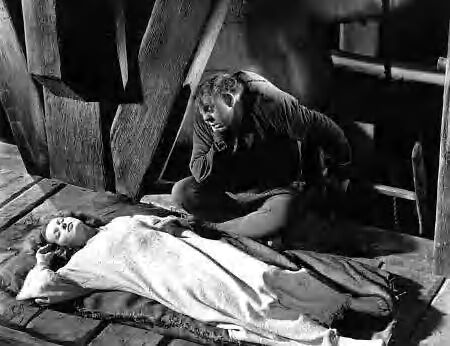
O'Hara has nothing but praise for Laughton, who started her career by casting her in Jamaica Inn. She describes Laughton, in full Quasimodo costume, reciting the Gettysburg Address on the set of Hunchback of Notre Dame the day Germany invaded Poland. I'm not saying I don't believe her, but wasn't that scene in Ruggles of Red Gap? Still, O'Hara's loyalty to Laughton, and clear-eyed observations about his talent, make you love her as you did in her movies. There isn't enough of that in this book.
When you're done with a star's memoirs, no matter what warts were revealed, you can always go back to the pictures. The Siren wants to go back to a shot of O'Hara in Hunchback. As she is carried off by celebrating Parisians, she turns to look up at Quasimodo for the last time. In that instant, she will always be beautiful, always be kindhearted, always be sympathetic.
Despite her wondrous looks she has never been a pin-up icon, perhaps because her greatest pictures, with only one or two exceptions, were costumers. She lives in the Caribbean, and last year she published her memoirs. She has much to say about co-stars and directors. Briefly: They were out to get her, but she wouldn't let them.
The Siren has read a lot of Hollywood memoirs, but none weirder than this one. Usually when you read a star's autobiography, it all sounds pretty plausible until you fact-check. Even someone like Errol Flynn presents difficulties only when you must figure out which picture he was filming by seeing who he was getting drunk with that year.
With O'Hara, you wonder about your narrator's reliability by page 4, when she recounts a grievance against two teachers who must have been dead since De Valera was Taoiseach. OK, the Siren thought, I can still remember plenty of schoolroom slights. But that sets the tone. O'Hara was beset, plotted against, undermined, and eventually she emerged triumphant, having either forgiven her tormentor or exposed his perfidy or, on a good day, both. It's exhausting, and it's why it has taken me so long to write this one post.
Always the classic man's woman, O'Hara had a "boys will be boys" attitude that can be endearing at times, infuriating at others. Tyrone Power tricked her into telling dirty jokes to director Henry King during the making of The Black Swan, but Ty was a good guy. Errol Flynn amused himself one night by whispering disgusting innuendos to her at a formal function, but during Against All Flags, she "respected him professionally and was quite fond of him personally." In that scene in The Quiet Man where she is half-marched, half-dragged home, John Wayne and John Ford arranged to cover the hill in sheep dung. She had the warmest feelings for Wayne until the day he died.
If you're a John Ford hater (I know you're out there, probably socializing with the Mozart haters), buy this book. She depicts him as a lying, posing, bullying creep, and that's before the director punches her in the face at a dinner party. O'Hara also thinks Ford was in the closet; at point she catches him kissing a big-time (and unnamed) Hollywood actor. Ford, who spoke almost no Gaelic, would murmur gibberish into O'Hara's ear at public events to pretend they were both conversing in the language of the old country. Did I mention his alcoholism?
The picture of Ford is so monstrous that several reviewers have wondered about its accuracy. I've read enough about him to think much of what she says is true. His humiliation of Wayne, for example, has been well documented. Though she doesn't say so outright, it's easy to surmise that O'Hara's friendship with Wayne had roots in their both surviving Ford's displeasure on set, which she refers to as being "in the barrel."
Long after the reader has decided actors must have worked with Ford to convince themselves Otto Preminger was actually a pussycat, our Maureen insists she considered Ford a good friend. Odd, but consistent with her lifelong habit of excusing male nastiness. She is less believable when she says Ford destroyed the acting career of her brother Jimmy after the young man failed to show up for a meeting, or when she accuses Ford of single-handedly scuttling her chances for an Oscar nomination for The Quiet Man.
O'Hara had a long break with the director after a dismal experience shooting The Long Gray Line and after Ford directed some racial insults at the Mexican man she was dating at the time. But she still went to see the director in his last illness, and the book shows her straining to reconcile the rather loathsome man with his talent. She goes into great detail about the filming of The Quiet Man , and publishes some love letters she received from Ford while he was writing the script for that classic. O'Hara says he never spoke to her about the letters nor acted on his love for her, if love it was. She thinks he loved her character of Mary Kate Danaher, whatever sexuality he may have been repressing.
Throughout the book O'Hara refers to herself as a strong woman, feisty and wilful, one to brook nonsense from no man. The self-portrait goes nicely with her screen image but, as they say in first-year screenwriting class, what you tell and what you show are two different things.
Tis Herself shows us the first marriage, which O'Hara claims happened because, naive and fearful of giving offense, she didn't have the heart to tell the man to buzz off. Well, O'Hara was very young. But then she marries Will Price.
Price is a type anyone who's ever leafed through an actress bio could recognize at fifty paces in the dimmest-lit bar in Los Angeles. Good-looking in a vacuous sort of way. Knows a bunch of celebrities. Hard-drinking. In desultory pursuit of a career. Wants his famous wife to help him out. Needs all kinds of material goods to keep up their golden image. By the time Price showed up with a "financial consultant" and convinced O'Hara to give the goon complete control of her money, the Siren was ready to throw the book down, but didn't. Not even after the night when O'Hara, days from delivering her daughter Bronwyn, got punched in the stomach by her alcohol-fueled mate.
No, the Siren hurled the book when O'Hara stayed with Price, who later tried (so she says) to con her into having an unnecessary and highly dangerous operation. Attempted murder, in other words. And even when she finally divorced the slob--are you ready for this?--she kept the "financial consultant." And was really surprised when years afterward it turned out that all her money was gone.
Strong, feisty woman? You tell me. Those qualities show up more when she's settling accounts with enemies, which she does with a relish that may explain her support for Richard Nixon. Out comes the old story about Rex Harrison's role in Carole Landis's death. (The gossip is that it was a suicide pact that only Landis bothered to go through with.) Walt Disney gets thumped not for his anti-Semitism or other celebrated flaws, but for billing her second to Hayley Mills in The Parent Trap. Jimmy Stewart was a good actor, but not a generous one, and he saw to it that one of her best scenes was written out of The Rare Breed. Later on, O'Hara had a happy marriage to pilot Charlie Blair that ended with his death in a plane crash. The NTSA ruled it was pilot error. Would it surprise you to learn that she thinks it was a conspiracy linked to hubby's CIA activity?
Ordinarily it gladdens me to see frank talk about gay life in Hollywood, as this is the post-Stonewall era, and if your favorite star was or is gay you need to drag yourself into the 21st century and freaking well get over it. Tis Herself has an unpleasant pattern, though: The people who treated O'Hara badly were gay. That means John Ford, second husband Will Price, and Peter Lawford and Richard Boone. O'Hara says she rescued those last two from some bad publicity Down Under when they were caught in a brothel full of beautiful boys.
But Tyrone Power? He spoke to her often about the kids he wanted to have. Roddy McDowall? No mention of his love life. Charles Laughton? He wanted kids too. When Elsa Lanchester wrote they didn't have any because Laughton was gay, O'Hara says that was "rubbish...whether or not Laughton was homosexual." Lanchester couldn't get pregnant due to a botched abortion.
O'Hara has nothing but praise for Laughton, who started her career by casting her in Jamaica Inn. She describes Laughton, in full Quasimodo costume, reciting the Gettysburg Address on the set of Hunchback of Notre Dame the day Germany invaded Poland. I'm not saying I don't believe her, but wasn't that scene in Ruggles of Red Gap? Still, O'Hara's loyalty to Laughton, and clear-eyed observations about his talent, make you love her as you did in her movies. There isn't enough of that in this book.
When you're done with a star's memoirs, no matter what warts were revealed, you can always go back to the pictures. The Siren wants to go back to a shot of O'Hara in Hunchback. As she is carried off by celebrating Parisians, she turns to look up at Quasimodo for the last time. In that instant, she will always be beautiful, always be kindhearted, always be sympathetic.
Thứ Năm, 4 tháng 8, 2005
Baghdad and Boobs
No, this isn't a political post. It is a digression on a Hollywood genre. One IMDB reviewer calls these movies "Grecianized Near-Easterns," others call them sand-and-sandals. The Siren calls them Baghdad-and-boobs.
I have a big soft spot for these cinematic baubles, and Maureen O'Hara is one reason. A fair-skinned redhead myself, flicks like Sinbad the Sailor (1947) assured me that if I pursued an acting career I need not fear typecasting. I envisioned myself at casting calls for a "Scheherazade type." I could even bring my own chiffon, to audition with that cute little see-through square that passed for the veil in these movies.
O'Hara's autobiography dispenses with Sinbad in one line, and the Siren thinks this unfair. It's a most enjoyable movie, with a delicious framing device. There is a lighthearted, almost spoof-like aspect to it that works well. Douglas Fairbanks Jr. has the requisite dash, but unlike his dad he had a certain fey quality that hindered him as an action hero. Sinbad turns this into an advantage by emphasizing the title character's braggadocio. Is he a real hero, or a loudmouth con artist? You find out at the end, after plenty of sparring with O'Hara's trademark feisty princess.
As a girl I also enjoyed Son of Ali Baba with Tony Curtis and Piper Laurie. My memory has faded, but even watching that one on the Turner Superstation in the 1970s I think I realized Curtis was a lot more Brooklyn than Baghdad. They changed the ending of the old story, possibly because someone realized that in 1952, seven years after World War II, mass murder of forty thieves might not play in Peoria.
Piper Laurie even made another Baghdad-and-boobs flick in 1953, The Golden Blade, with Rock Hudson (stop giggling. No, I haven't seen it). Something about redheads seems to have made studio execs think, "Now where did I put that heavily edited edition of the Arabian Nights?" Rita Hayworth got the girdle-and-veil treatment, with a Biblical twist, in Salome. And while it isn't part of the genre, I still crack up when I see Shirley MacLaine as an Indian princess in Around the World in 80 Days. If you look closely you can see her freckles in a couple of close-ups. Wonder why they never got around to Moira Shearer?
Hollywood churned these things out by the urnful in the 1940s (often with poor, doomed Maria Montez) and into the 1950s, with occasional forays even after that, such as The Golden Voyage of Sinbad in 1974.
The only Baghdad-and-boobs saga that the Siren (and possibly anyone else) can consider a masterpiece is the 1940 Thief of Baghdad. Among its advantages were the brilliant Michael Powell, an uncredited William Cameron Menzies (six directors worked on the movie, all told), and dialogue by Miles Malleson that actually managed to evoke some cadences of a Khayyam translation without sounding ridiculous. It had the exacting Alexander Korda who, legend has it, looked at the Baghdad set and ordered, "Tear it down, build it three feet higher, and paint it pink." Finally, it gave us Sabu, a gifted and charismatic child actor who had the rare ability to react without mugging.
In case you're wondering, yes, the Siren does realize these films resemble true Arabic culture about as much as Mamie Van Doren resembles Marie Curie. But she cut her cinephile teeth on Busby Berkley musicals and figures realism is overrated anyway. These are fairy tales. If they teem with appalling Middle Eastern stereotypes (and boy do they), at least the heros are allegedly Arab or Persian too, albeit played by toothy Westerners. Talents like Turhan Bey and Sabu usually had to content themselves with supporting roles. Whereas today, of course, they'd be getting ... supporting roles.
Sabu's career was sadly limited by the typecasting of his time. When the Siren looks at something like The Mummy, however, she has to question whether he would have fared much better today. Perhaps he'd have found a place with independent filmmakers, but there wouldn't be much for him in the standard big-budget offering. The old days gave us patronizing Orientalism, but in the Siren's view, mainstream Hollywood manages to grow worse with age.
I have a big soft spot for these cinematic baubles, and Maureen O'Hara is one reason. A fair-skinned redhead myself, flicks like Sinbad the Sailor (1947) assured me that if I pursued an acting career I need not fear typecasting. I envisioned myself at casting calls for a "Scheherazade type." I could even bring my own chiffon, to audition with that cute little see-through square that passed for the veil in these movies.
O'Hara's autobiography dispenses with Sinbad in one line, and the Siren thinks this unfair. It's a most enjoyable movie, with a delicious framing device. There is a lighthearted, almost spoof-like aspect to it that works well. Douglas Fairbanks Jr. has the requisite dash, but unlike his dad he had a certain fey quality that hindered him as an action hero. Sinbad turns this into an advantage by emphasizing the title character's braggadocio. Is he a real hero, or a loudmouth con artist? You find out at the end, after plenty of sparring with O'Hara's trademark feisty princess.
As a girl I also enjoyed Son of Ali Baba with Tony Curtis and Piper Laurie. My memory has faded, but even watching that one on the Turner Superstation in the 1970s I think I realized Curtis was a lot more Brooklyn than Baghdad. They changed the ending of the old story, possibly because someone realized that in 1952, seven years after World War II, mass murder of forty thieves might not play in Peoria.
Piper Laurie even made another Baghdad-and-boobs flick in 1953, The Golden Blade, with Rock Hudson (stop giggling. No, I haven't seen it). Something about redheads seems to have made studio execs think, "Now where did I put that heavily edited edition of the Arabian Nights?" Rita Hayworth got the girdle-and-veil treatment, with a Biblical twist, in Salome. And while it isn't part of the genre, I still crack up when I see Shirley MacLaine as an Indian princess in Around the World in 80 Days. If you look closely you can see her freckles in a couple of close-ups. Wonder why they never got around to Moira Shearer?
Hollywood churned these things out by the urnful in the 1940s (often with poor, doomed Maria Montez) and into the 1950s, with occasional forays even after that, such as The Golden Voyage of Sinbad in 1974.
The only Baghdad-and-boobs saga that the Siren (and possibly anyone else) can consider a masterpiece is the 1940 Thief of Baghdad. Among its advantages were the brilliant Michael Powell, an uncredited William Cameron Menzies (six directors worked on the movie, all told), and dialogue by Miles Malleson that actually managed to evoke some cadences of a Khayyam translation without sounding ridiculous. It had the exacting Alexander Korda who, legend has it, looked at the Baghdad set and ordered, "Tear it down, build it three feet higher, and paint it pink." Finally, it gave us Sabu, a gifted and charismatic child actor who had the rare ability to react without mugging.
In case you're wondering, yes, the Siren does realize these films resemble true Arabic culture about as much as Mamie Van Doren resembles Marie Curie. But she cut her cinephile teeth on Busby Berkley musicals and figures realism is overrated anyway. These are fairy tales. If they teem with appalling Middle Eastern stereotypes (and boy do they), at least the heros are allegedly Arab or Persian too, albeit played by toothy Westerners. Talents like Turhan Bey and Sabu usually had to content themselves with supporting roles. Whereas today, of course, they'd be getting ... supporting roles.
Sabu's career was sadly limited by the typecasting of his time. When the Siren looks at something like The Mummy, however, she has to question whether he would have fared much better today. Perhaps he'd have found a place with independent filmmakers, but there wouldn't be much for him in the standard big-budget offering. The old days gave us patronizing Orientalism, but in the Siren's view, mainstream Hollywood manages to grow worse with age.
Thứ Hai, 1 tháng 8, 2005
Which Man Has the Gun?
One pleasure the Siren has discovered since starting her blog is A Girl and a Gun. George writes about movies as art--the ones that achieve that distinction, the ones that miss it, the ones that never even try. He knows how to start a good discussion, too, and recently provoked one with a post about his ten favorite Westerns. Rather than clog up his comments section, I decided to make my own post. And all right, I admit it, I am happy for an excuse to write about Westerns.
First, the Siren does not believe that the deepest theme of a true Western is the end of the frontier, despite George's eloquent arguments for that view. On the most basic level Westerns are, always and without exception, about manhood. They ask, Who's the man here?* Is it me? How do I make it me? If John Wayne is in the movie, he's the man, but can I still be the other man? If the movie is The Wild Bunch or McCabe and Mrs. Miller, is there any reason why anyone anywhere should even want to be a man?
Since the Siren has never worried about whether or not she's the man, she can afford to be flip. Her womanly insecurities are needled by something like Vertigo (must a woman change utterly to win a man's love?) or Mr. Skeffington (is concern with my appearance sucking out my soul?). But she never tires of watching men work out their own dark nights of the cinematic soul. And a good Western brings many other matters into the complicated business of male worthiness.
Ten favorite Westerns, in no order at all:
1. Stagecoach. One of the few Westerns to tackle class issues.
2. My Darling Clementine. A perfect illustration of the "end of the frontier" idea (but it's still really about manhood).
3. The Man Who Shot Liberty Valance. History as a bunch of stories told by people who weren't there, a theme Faulkner knew well. Do we ever revere the right men for the right reasons?
4. Unforgiven. See above.
5. Red River.
6. The Ox-Bow Incident. Superb direction from William Wellman, a well-written script and brilliant performances. The Siren has never considered a heartfelt liberal message to be an automatic demerit for a film.
7. The Searchers.
8. McCabe and Mrs. Miller. Of all the Westerns ever made, this is the one to make a viewer say, "My God. It probably did look exactly like that."
9. The Gunfighter. The Siren would pick this, and not To Kill a Mockingbird, as the late Gregory Peck's best performance.
10. Butch Cassidy and the Sundance Kid. Sheer entertainment. Heir to raucous man-fests like The Sons of Katie Elder, Rio Bravo and True Grit.
*Since we're on the topic (sort of) do check out this fascinating post, from the harrylimetheme blog out of Singapore, about the origin of the phrase "Who's your Daddy?".
First, the Siren does not believe that the deepest theme of a true Western is the end of the frontier, despite George's eloquent arguments for that view. On the most basic level Westerns are, always and without exception, about manhood. They ask, Who's the man here?* Is it me? How do I make it me? If John Wayne is in the movie, he's the man, but can I still be the other man? If the movie is The Wild Bunch or McCabe and Mrs. Miller, is there any reason why anyone anywhere should even want to be a man?
Since the Siren has never worried about whether or not she's the man, she can afford to be flip. Her womanly insecurities are needled by something like Vertigo (must a woman change utterly to win a man's love?) or Mr. Skeffington (is concern with my appearance sucking out my soul?). But she never tires of watching men work out their own dark nights of the cinematic soul. And a good Western brings many other matters into the complicated business of male worthiness.
Ten favorite Westerns, in no order at all:
1. Stagecoach. One of the few Westerns to tackle class issues.
2. My Darling Clementine. A perfect illustration of the "end of the frontier" idea (but it's still really about manhood).
3. The Man Who Shot Liberty Valance. History as a bunch of stories told by people who weren't there, a theme Faulkner knew well. Do we ever revere the right men for the right reasons?
4. Unforgiven. See above.
5. Red River.
6. The Ox-Bow Incident. Superb direction from William Wellman, a well-written script and brilliant performances. The Siren has never considered a heartfelt liberal message to be an automatic demerit for a film.
7. The Searchers.
8. McCabe and Mrs. Miller. Of all the Westerns ever made, this is the one to make a viewer say, "My God. It probably did look exactly like that."
9. The Gunfighter. The Siren would pick this, and not To Kill a Mockingbird, as the late Gregory Peck's best performance.
10. Butch Cassidy and the Sundance Kid. Sheer entertainment. Heir to raucous man-fests like The Sons of Katie Elder, Rio Bravo and True Grit.
*Since we're on the topic (sort of) do check out this fascinating post, from the harrylimetheme blog out of Singapore, about the origin of the phrase "Who's your Daddy?".
Đăng ký:
Bài đăng (Atom)