Hiển thị các bài đăng có nhãn Maureen O'Hara. Hiển thị tất cả bài đăng

Thứ Tư, 18 tháng 4, 2012

You're Much Too Modest

It is a complicated business, and we are very insecure, we actors. We all feel--and fear--we are going to be found out at any moment. Someone is going to point and say, 'You are really not very good, are you?'
--Julie Christie

The Siren, as she's often said, likes and admires actors, more perhaps than some of the profession's members like themselves. Like all artists, the good ones usually have an accurate sense of their own work. But over her years of obsessive reading, the Siren has seen cases where something throws off the radar.

Not always, of course. Katharine Hepburn rued the reception of Sylvia Scarlet but was clear-headed enough to tell people, much later, that the film was simply ahead of its time. Peter Ustinov acknowledged the reverence accorded Lola Montes, but added in Dear Me that "there were precious few signs of this destiny during filming." Joan Fontaine had a lousy time making Rebecca but has said more than once that she knows it will always be her most celebrated role. Others, like Barbara Stanwyck, were too coolly professional to run down their own work.

Now and again, though, you'll come across an actor dismissing something that was good to great. The Siren is fascinated by these instances, not from smug hindsight, but because it goes against the common perception of stars as egomaniacs. You can speculate about the reasons, beyond genuine variance in taste, why an actor might be too hard on his own work. Maybe the actor hated making the movie. Maybe the movie was a box-office bomb, and the actor figured the public and the critics at the time were the best judge. Maybe the movie didn't fit with the image the actor wanted to project. Some, like Norma Shearer, never warmed to a great film (in her case, The Women, an unhappy experience for her) and instead venerated a lesser one; Shearer was fond of her performance in Romeo and Juliet, an opinion not widely shared these days.

And sometimes the actor just had, or learned to have, contempt for the entire business.

Here's a small collection, then, of actors being more critical of themselves and their movies than the Siren, and in most cases plenty of others, would say is warranted.


According to the reference books which consider it worthwhile collating such trivia, I have made about seventy films. Glancing down the list, I find I made things like Action in Arabia, Lured, and The Scarlet Coat. I can only assume that I was paid handsomely for them, but I am at a complete loss as to what action there was in Arabia, or who was lured where, and why. As to the scarlet coat, did I wear it, and if not who did?

George Sanders, in Memoirs of a Professional Cad, shrugging off Lured, an excellent thriller from the great Douglas Sirk that features our man George at his rakish best. The other two the Siren hasn't seen. The Scarlet Coat--a drama about Benedict Arnold in which Sanders, by some dreadful misjudgment, was NOT cast as the infamous traitor--was directed by John Sturges, and the Siren is willing to bet it's better than the actor says. Action in Arabia--well, he may have us there, but look at the synopsis and tell me you're not intrigued.


The worst picture, bar none, that I ever made.

Mary Pickford's tribute to Rosita in Sunshine and Shadow. While the collaboration with Ernst Lubitsch seems to have been happy at the time, Pickford later claimed the film gave her no end of trouble. She carried a grudge against Rosita for the rest of her life, not including it in the films she later handed over for preservation. It was extremely well-reviewed, however, and Scott Eyman has good words for it in his Lubitsch bio. The Siren hasn't seen Rosita (hard to track down) but come on, it's Lubitsch. How bad can it be?


She was in the middle of complaining about what a piece of crap the film was, and how lucky Rita Hayworth was because she turned it down…

Ava Gardner encounters Farley Granger in Rome during the filming of The Barefoot Contessa, as told in Granger's Include Me Out. Gardner, bless her, had little good to say about her entire career, as can be seen in her famous interview with Rex Reed. True, not everyone feels the love for The Barefoot Contessa, but the Siren has some heavyweights on her side.


You liked that?

Bette Davis' incredulous response to Whitney Stine's praise for Beyond the Forest. Davis spent years telling everyone the picture stank. The Siren says this King Vidor is a lot better than Duel in the Sun. Molly Haskell called it Davis' "wildest and most uncompromising film;' Kim Morgan admires it, too.


Kitsch.

In Maximilian Schell's documentary, that's Marlene Dietrich's word for most of her Hollywood work, including the glorious execution scene in Josef von Sternberg's Dishonored and, if memory serves, The Blue Angel. Whether or not Dietrich, at that point in her life, truly believed it was all mostly kitsch is an open question, but say it she did, with the full force of the German pronunciation.


Movies bore me, especially my own.

Robert Mitchum discusses his career. In contrast to Dietrich, the Siren believes Mitchum meant this, to the extent that he ever meant anything he said. Although Mitchum always did have good things to say about The Night of the Hunter. Which brings us to...


I played in the movie, which was about the battle between good and evil. Parts of the film were excellent, but it was not fully sustained because Mr. Laughton did not want to 'ruin' Robert Mitchum's image by having him a play a thoroughly wicked man. In the earlier days of films, it would have been considered a triumph to play evil convincingly.

That, along with a terse paragraph about Charles Laughton's admiration for D.W. Griffith, constitutes Lillian Gish's entire tribute to The Night of the Hunter in The Movies, Mr. Griffith and Me. She did express similar thoughts to her director during filming, but Laughton biographer Simon Callow maintains that Laughton's allusion to Mitchum's image was basically a joke. Gish's curt assessment, and weird critique of Mitchum's seductively chilling work, may have owed something to dissatisfaction with her billing. The Bad and the Beautiful: Hollywood in the Fifties quotes her agent as saying that when Gish saw the movie poster, with only Mitchum and Shelley Winters advertised, she "blew her top."


Ridiculous. I made the picture because I couldn't afford a suspension--not with a daughter, a husband and a household to support.

Maureen O'Hara's verdict on Sinbad the Sailor, maybe not a pinnacle of art but an absolutely corking movie the Siren has adored since childhood. For the record, O'Hara is delightful in it. O'Hara also disliked Forbidden Street, another one the Siren thought quite fine. This Land Is Mine gets passing reference in two sentences, neither of which mention the director. Then again, good movies that actors neglect in their memoirs could be a whole different post. E.g.…


The four pictures I made at Warner Brothers were not great pictures, but they were very good pictures and excellent entertainment. In their category I do not see their like being as well made today.
The Siren's perennial crush, Basil Rathbone, gives backhanded praise to Tovarich, Captain Blood, The Adventures of Robin Hood, and The Dawn Patrol. Those four movies, all of them lovable and three of them eternal classics, take up just under two (2) pages of Rathbone's charmingly off-topic autobiography. Rathbone allows as how Errol Flynn was "monstrously lazy and self-indulgent," albeit genial, and Olivia de Havilland was very pretty. On the other hand, you do get quite a bit about Rathbone's dogs.


For its time, Side Street was a good-looking, well-made film that was not able to rise above the banality of its story.

Farley Granger again. The Siren says Granger, a smart man, underrated this excellent Anthony Mann noir. At least Granger gave himself credit for Strangers on a Train and Senso. Another actor with the same last name was much more cutting about his own career.


I've never done a film that I'm proud of.

Stewart Granger's oft-quoted line wasn't strictly true, as he did admit liking a few roles, such as Saraband for Dead Lovers, but he never thought much of his own abilities.


I don't want to be a silly temptress. I cannot see any sense in getting dressed up and doing nothing but tempting men in pictures.

Greta Garbo. Of course. When the Siren first encountered that remark she thought Garbo kind of had a point, until she found out the star was talking about the splendid Flesh and the Devil.


Mediocre.

Montgomery Clift's summation of his work as Matt Garth in Red River. He was no huge fan of the overall film, either, particularly the end, and on that aspect he has some critical company. But when Clift watched it in a cinema, he knew Red River would make him a star. And so, according to biographer Patricia Bosworth, Clift went on one last pre-fame drinking binge, applying himself to the task with such intensity that he wound up in a New Orleans jail.


A crock of shit.

Humphrey Bogart offers his opinion of Billy Wilder's beloved Sabrina to a reporter on set. If he ever revised that evaluation, the Siren has not located where.


I did things like Shampoo and Heaven Can Wait. I don't know what those films were about. The women I played in them were not very empowered.

Julie Christie. We can debate Heaven Can Wait--the Siren enjoys it--but surely most of us hope she's changed her mind about Shampoo.


The picture was a big hit in spite of my wooden performance. I have only kept one review during my life. It is of Dodsworth and appeared in the Detroit Free Press. 'In this picture we were privileged to see the great Samuel Goldwyn's latest discovery--all we can say about this actor? Is that he is tall, dark and not the slightest bit handsome.' It has the place of honor in my lavatory.

Thanks to William Wyler's unvarnished manner and multiple takes, David Niven hated making Dodsworth. But he's very good, better than he was as Edgar Linton in Wuthering Heights, during which shoot William Wyler made Niven equally miserable a few years later.


There was the first of several visits to Italy to act for various aspiring Fellinis and Antonionis, among them Dario Argento, in Profondo Rosso, a.k.a. Deep Red; Deep Red Hatchet Murders; Dripping Deep Red; The Hatchet Murders and (why?) The Sabre Tooth Tiger. It could be said that there is often a connection between the absence of quality in a film and the number of its aliases.

David Hemmings on one of his more famous movies, from his 2004 memoirs. The Siren adds that when Glenn Kenny encountered Hemmings in Toronto just after 9/11, the actor was not so harsh.


Well, that wasn't much.
Joan Bennett, overheard as she left a 1981 tribute screening of The Reckless Moment. Given the present-day reputation of Max Ophuls' film, and Bennett's superlative performance, this is probably the biggest jaw-dropper of the bunch. It was not an opinion Bennett reached only in crotchety old age; Brian Kellow's biography records her saying years before that The Reckless Moment was "nothing exceptional…not like The Woman in the Window or Scarlet Street." Argento fans can also take note of Kellow's observation, about Suspiria's later cult status, that "it is unlikely that Joan knew or cared."

Chủ Nhật, 20 tháng 6, 2010

Repost: Father's Day with John Ford


A fellow blogger recently requested that the Siren send a link to her favorite post. After three years, there was still no question--this is it. She reposts it now, and wishes her readers a happy Father's Day.

My father was a constant reader, a wicked prankster and something of a film buff. His film tastes were pretty eclectic--we went together to see The Pope of Greenwich Village, for example--but his real reverence was for the classics. I remember his description of a scene in The Gold Rush, to give his small daughter a flavor of it in those pre-VCR days when anything silent was hard to come by: "...and then he looks up at the clock, and he realizes, she's not coming. And just like that, you go from slapstick to sad..."

For Dad one filmmaker towered above all others, however, and that was John Ford.

One spring Saturday when I was in my early teens, Dad was talking to his adult nephews on the phone. A film recommendation from Dad was something to be taken seriously, and that Sunday morning the Superstation's Academy Award Theater was showing How Green Was My Valley. Our main phone line was in the kitchen and I could hear Dad's end of the conversation. "You should see this one...John Ford, Wales...Maureen O'Hara too...gorgeous...You'll get a kick out of it."

The conversation ended and I caught Dad's eye over whatever he was reading at the kitchen table.

"Get a kick out of it?" I repeated, incredulous.

"Sure," said Dad, affably. "Good movie, isn't it?" As he went back to his book, I swear I heard him chuckle.

Sometime after noon on Sunday our phone rang. It was Cousin R., and he sounded like he was coming down with a cold. "Put that father of yours on the phone," he snapped. I handed the phone to Dad, he put down the New York Times crossword puzzle, and as I leaned across the kitchen table my cousin's voice rose to a volume that carried it well beyond the receiver, especially when my father pulled the phone away from his ear to avoid hearing damage.

"...coal miners...strike...and they go to America...falls in the water...gets sick...accident...the other two leave...won't marry her...ANOTHER accident...goddamnit, I'm gonna get you for this one."

"But it was a good movie, right?" said my father, looking pleased with himself.

"...GREAT movie...I'm going to GET DRUNK."

The conversation ended. Dad returned to his crossword puzzle. "Where's he gonna get a drink?" asked my sister, who had heard the whole thing too. A shrug from Dad.

"He's in a dry county," I reminded Dad.

"It's SUNDAY," added my sister.

The phone rang again. It was another, older cousin, the football coach, who seemed to have caught his brother's cold. "Tell your father we're sending him the liquor tab," he barked.

I hung up and looked at Dad. "You totally tricked them into seeing that movie," I said.

His eyes didn't move from the crossword. "They'll thank me for it later."

Funny that this memory of my father should concern How Green Was My Valley, which has Donald Crisp, 180 degrees from his terrifying drunk in Broken Blossoms, playing one of the most lovable fathers in screen history. Not until Gregory Peck tucked Mary Badham into bed in To Kill a Mockingbird would there be an equally noble, and touching, portrait of fatherhood.

How Green Was My Valley ends with Crisp's death at the bottom of a mine shaft. Ford's camera focuses on the lift bringing other miners to safety. One platform of exhausted men passes us by, and then we see the one we are waiting for, Donald Crisp's head barely at the edge of the frame, cradled by his youngest son. That son, Roddy McDowall, stares past the camera, his beautiful face a bleak mask that reflects every child who ever faced a future without a parent. I've been facing that myself since 1991. Perhaps that's why I haven't watched the movie since.

But Ford wasn't by nature a pessimist, and How Green Was My Valley doesn't end on that shot. Its final montage includes McDowall and Crisp, going for another walk together. Memory isn't enough, but memory has its comforts, even if they're as simple as remembering how your father once lured an audience for one of his favorite films.

Thứ Ba, 12 tháng 6, 2007

The Forbidden Street (1949)

Enough bloodshed. The Siren caught a movie called The Forbidden Street (1949) a few weeks ago on the Fox Movie Channel. Here they occasionally show movies that the Fox studio, for whatever inscrutable boneheaded business-suited reason, has not deigned to release on DVD. (You can read Dave Kehr elaborating on this here and here on his blog.) The original title was Britannia Mews, and it was directed by Jean Negulesco.

I love Negulesco. Some people have guilty-pleasure movies; the Romanian is my guilty-pleasure director. He helmed some genuinely good movies, like Three Came Home and the 1953 Titanic. But since I spent some time mocking Eli Roth, I should step up and admit that my beloved Three Coins in the Fountain and The Bestof Everything do not exactly measure up to Jean-Pierre Melville, either. (Thanks, Noel, for reassuring me that I am not the only person crazy enough to find good stuff in The Best of Everything. And here is a nice take on Negulesco's Woman's World, which the Siren has not seen yet.)

Anyway, like most interesting movies on the Fox channel, Forbidden Street is shown at hours the Siren usually slept through in her pre-mothering days. It opens by showing us Adelaide, a girl from a high-toned family who becomes fascinated with the teeming life of a slum street, Britannia Mews, that lies behind her house. The girl soon grows into Maureen O'Hara, and she remains enthralled with the street. Adelaide falls in love with an alcoholic and penniless artist, Gilbert Lauderdale (Dana Andrews). She marries him against her family's wishes, and together they move into a house in the Mews.

Several things make this movie worthwhile, particularly Andrews, who winds up playing a double role, first as Adelaide's downfall and then her salvation. O'Hara does well with a character who goes through several mutations, some of them rather abrupt, and Dame Sybil Thorndike is a treat as a hideous slum dweller the Mews residents refer to as the Sow. The plot has surprises, as threads are not drawn out the way you would expect. Instead the conflicts come one after the other, the one constant being the street and how it evolves. It is really the story of the Mews, and not Maureen.

But what had the Siren hooked was the beauty of the movie. From the beginning, when the camera looks over Adelaide's shoulder, through a window and down onto the Mews, I couldn't get over how gorgeous the darned thing was. The street is poor, but the camerawork is rich, full of velvety blacks and the glow of the Victorian lamps. I missed the credits so I spent a long while marveling at the way the photography preserved a childlike perspective, from the way we see the marionettes carefully fashioned by Gilbert, to the way Maureen is pictured in her lodgings, a doll in a house she must grow into. A mews has its lodgings on the second floor, as the first one is given over to horse stalls and a carriage house. The characters frequently play scenes in front of the windows in O'Hara's rooms. The camera shows you the other shabby buildings across the narrow street, but the life of the Mews is usually heard and not seen. Adelaide remains suspended above it even as she is trying to join it. Who did this? Was I about to write a scintillating blog post on the wonders of a previously unknown DP?

Eventually the Siren's morning coffee kicked in and she remembered she had IMDB. The site informed her that the cinematographer was Georges Périnal. Yes, Blood of a Poet, The Thief of Baghdad, À Nous la Liberté, The Life and Death ofColonel Blimp, The Four Feathers, that Georges Périnal. The Siren felt as though she had been reading a short story and thinking, hey, this is brilliant, I can't wait to tell people about this unsung genius that I, Campaspe, have discovered, and then she turns to the index and realizes it's Tolstoy.

Due credit also to the art director, Andrej Andrejew, and screenwriter Ring Lardner Jr., who did the screenplay based on Margery Sharp's novel. Like a cinephile version of Justice Potter Stewart, at least the Siren knows it when she sees it.

P.S. In her autobiography, Maureen O'Hara dismisses this one, saying the only reasons to catch it are Andrews and Thorndike. Well, she disses Sinbad the Sailor, too, and the Siren thinks it's swell. O'Hara also says the British and American versions are cut so differently they almost amount to different movies.

(Above, Dana Andrews, handsome and successful as he was in the 1940s. His career later skidded due to a crushing alcohol problem. Unlike a lot of other actors, he eventually overcame his drinking. He was admirably candid about his recovery in an era when admitting to addiction was still stigmatizing.)

Thứ Ba, 13 tháng 3, 2007

Redeeming The Informer

Conventional wisdom about John Ford's The Informer goes something like this: The Informer is released, wildly overpraised, wins Oscars for Ford and star Victor McLaglen. It spends a couple of decades on everybody's All-Time Ten Best List. Post-war, however, people look again, find it creaky, overwrought, and stickily sentimental about the IRA. Its reputation plummets, never to revive.

It doesn't deserve that fate. The Siren saw a great print of it recently (on TCM--where else?) and fell in love. If you have not seen it, or if it's merely been a while, she urges you to give this movie a chance. The plot draws fire for its simplicity and obviousness, but all tragedies play out in an obvious, inexorable way, especially if they are classically structured like this one, observing unities of time and place and showing the inevitable consequences of a tragic flaw. The poetry of this tragedy isn't in the words, but in the images.

The Informer is based on a novel by Liam O'Flaherty. In 1922, Gypo Nolan has been thrown out of the IRA for refusing to shoot a deserter. Now he is unemployed and desperate to escape to America with the woman he loves. (Screenwriter Dudley Nichols thus softened the novel's version of Gypo's motivation, which was poverty, nothing more.) To collect a reward of 20 pounds, Gypo reveals to the hated Black and Tans the hiding place of his friend, an IRA gunman on the run. His friend is killed trying to escape. The rest of the movie shows Gypo as he tries to escape both his own agonizing guilt and the certain revenge of the IRA.

The movie's strongest claim to greatness is its stunning beauty. Over the years, anyone who watches enough movies grows accustomed to other filmmakers visually quoting Ford. Here, Ford appropriates a film vocabulary, that of German Expressionism, to flesh out the story without O'Flaherty's prose. The influence of M is everywhere, from the camera panning across a crowd to find Gypo's IRA pursuer, to a late trial sequence where Gypo's fear becomes almost physically painful to watch.

The look of the film made a virtue of necessity, as The Informer was shot on a tiny budget on an RKO set that would have looked like flats from a high-school musical had it been lit like most Hollywood movies of the period. Instead, characters walk or stumble around a fog-shrouded Dublin that looks like a slum you dreamed on a bender. Via Joseph H. August's photography, light seems to physically struggle through the murk. The camera often takes Gypo's point of view, letting you see things the way a drunk sees them, with one person or image jumping into the foreground and the rest of it somehow dim. The images then shift the way they do in a clouded brain. Gypo approaches his love on the street, as she is wrapped in a shawl like a Madonna; she lowers the shawl, turns and as the light falls on her she is revealed as a prostitute. Shot after shot peers through a window or an entrance, as Gypo is on the outside looking in--at a poster for a voyage to America he will never take, through the doorway to his friend's wake, through another doorway to a shebeen where his blood money will buy him drink and the only pale imitation of respect he will ever know.

The film alternates quiet with bursts of noise. Things begin in subdued late-night streets. Then Gypo's friend Frankie McPhillip (Wallace Ford) goes to see his mother and sister, and the paramilitaries burst in. The scene becomes chaos, with the mother and sister screaming, grabbing the arms of the Black and Tans, throwing themselves in the way, trying anything to protect Frankie, as he tries frantically to get upstairs but wastes time yelling at them not to get in the way. Some see melodrama here; the Siren immediately recalled the fear and mayhem of a house-to-house search in the images she's seen from Iraq. Frankie gets out to a barn loft, but is shot as he tries to cling to it. The camera follows only his arm, the rest of the shot filled with the British in the background, and the soundtrack records his nails scraping along the beam as he dies.

Later moments of quiet often come as we see Preston Foster's IRA commandant, Dan, trying to catch the man who informed on Frankie. These scenes are often very beautiful--a tryst between Dan and Frankie's sister (Heather Angel), whom he loves, is played with only the fire in the fireplace as light. Alas, here the acting really does creak. Angel plays the hands-clasped virgin, Foster the fists-clenched lover. They are dull and at their worst, risible, as when Foster says "It's not me I'm thinkin' of. It's the others in the movement. It's Ireland." The Siren would love to posit that this contrast is deliberate, that Ford the artist wanted you to see Foster as a humbug and a bore. It is far more likely, however, that this part of the movie just hasn't aged well. Indeed, the women in the film are its weakest aspect, though Margot Grahame does all right as Gypo's streetwalking love. "All the women in the story have been stereotyped into lay figures used to suggest the usual heart interests of commonplace fiction, and do not count very much," said contemporary reviewer James Shelly Hamilton.

How much appreciation you have for The Informer may rest on your view of McLaglen's performance. The Siren simply thought he was great. There is a legend that he played the harrowing trial scene either half-drunk or viciously hung over, tricked into that state by his director. From her own brief stage training and everything she has ever read about acting, the Siren doesn't believe it. (The TCM link above also says Ford admitted in later years that there was no way McLaglen could have worked at his high pitch of emotion while actually drunk. Let us also note that Ford didn't need to get an actor drunk to terrorize him, as Maureen O'Hara could still attest.)

The Informer, and its title performance, form a pendant to the endearing, but utterly improbable stage-Irishry of The Quiet Man. Mind you, the Siren likes The Quiet Man, despite the objections raised by thoughtful viewers like the late George Fasel. The later movie is best viewed as a immigrant fairy tale, a fantasy of return to an Ireland of the mind. But in The Informer, McLaglen is playing the dark side of his pugnacious, alcohol-sodden, none-too-bright screen persona. In The Quiet Man, She Wore a Yellow Ribbon or Wee Willie Winkie, he is supposed to be lovable. Here the actor plays, full-out, something much closer to what this sort of alcoholic is like in real life: loud, phony, self-pitying, prone to gusty over-dramatization, incapable of thinking past the next gulp of whiskey.

Yet, as contemptible as Gypo can be, you retain sympathy for him. Later Ford films would show a man, often John Wayne, able to push back against the flow of history with nothing more than character. Gypo has no character, and no such ability. Ford shows you every one of Gypo's flaws, yet still treats him with compassion. Like Judas, Gypo throws his money away, this time on whiskey and a pitiful tart in a shebeen, fumbling for some sort of painkiller. You know he won't escape alive, but you yearn for Gypo to understand his own actions, so he can find the redemption he craves.

In The Departed, Martin Scorsese used a clip from the end of The Informer, the climactic, crucifixion-like shot of McLaglen as he finally finds forgiveness. The Siren suspects this moment, filmed by Ford precisely as Flaherty described it, would draw a laugh from a too-hip audience. She also thinks Scorsese would not be giggling. It is a moment of real salvation, and by using it Scorsese shows there won't be anything like that for The Departed's characters. As the Catholic-bred Scorsese has illustrated in many films, to get redemption, you have to have real remorse. DiCaprio and Damon--even Nicholson, whose performance and fate give an echo of the Ford film--have only a rat's instinct for self-preservation. The Siren liked The Departed, but she is bold enough to think Scorsese wouldn't mind her preferring Gypo's end to his Boston counterparts.

(Postscript: In writing this piece, the Siren had a blast reading other bloggers' thoughts on Ford, including this by Lance Mannion. She has a lot of affection for that post because it was the first she read at Lance's place. There is this excellent post by fellow Ford admirer Zach Campbell at Elusive Lucidity, and also a fine appreciation of a Ford I haven't seen, Steamboat Round the Bend, at the blog Tativille. A while back, Andy Horbal posted a fascinating roundup of links about The Searchers, which just turned 50. If you need a corrective to all this Ford worship, try James Wolcott's thoughts, here.)

Thứ Sáu, 5 tháng 5, 2006

Best of the Best Pictures

Here's the Siren's list of the Best of the Best Picture Oscars, for Edward Copeland's latest survey. You have until midnight tonight (May 5) to mail your selections to eddiesworst@yahoo.com. The only way the Siren could compile this list was by going with the Best Picture Oscar winners than she liked best--the ones she would gladly watch again tonight. In order, then:

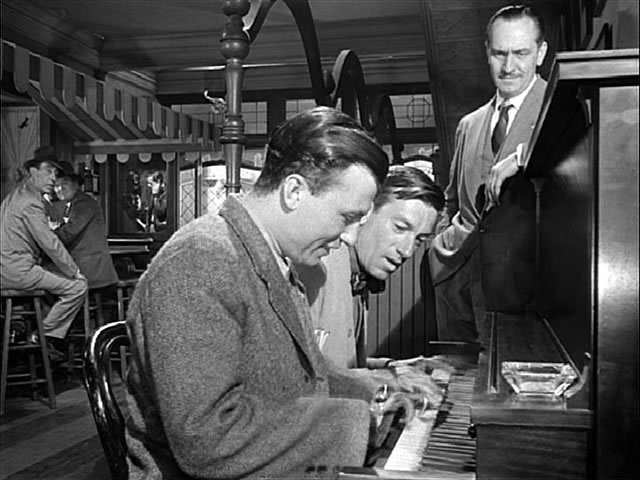
1. The Best Years of Our Lives. Peerless portrait of American family life. Not a weak performance in the movie. Full of moments to treasure, such as Myrna Loy's wordless reaction when she finally sees her husband, or Fredric March, contrasting a prewar picture of himself with the image in the mirror. And there's Harold Russell's homecoming to his family and his "swell girl" Wilma, as moving a scene as any Wyler ever filmed--and the prelude, as Dana Andrews watches Russell walk away and says sadly, "I hope Wilma is a swell girl." The movie is sometimes described as idealized, but the Siren absolutely disagrees. Virginia Mayo's trampy wife, Myrna Loy's expression while watching her husband drink too much, Russell's mother suppressing a gasp when she sees the hooks that have replaced her son's hands, Dana Andrews suffering what we'd now call PTSD--none of this is treated with anything near treacly sentiment.

2. The Bridge on the River Kwai. Most people seem to prefer Lawrence of Arabia to this earlier David Lean epic. Lawrence is a magnificent movie, but the Siren gives the edge to The Bridge, for its clearer and more pungent characterizations, its biting antiwar and anti-imperialist message and its satiric edge.

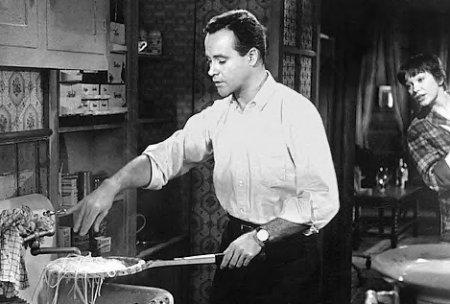
3. The Apartment. Next to The Crowd (a clear influence), the Wilder movie is the premiere meditation on surviving as a cog in the capitalist machinery, a theme that is notably under-explored in American film. Office Space can't hold a candle to the honesty and wit of this movie.

4. Annie Hall. The Siren knows some people don't like this movie, but it's like telling her you don't like ice cream. Doesn't compute. I particularly love Diane Keaton's and Woody Allen's split-screen shrink session when, asked how often they have sex, Keaton blurts "All the time. Twice a week!" and Allen laments, "Practically never. Twice a week."

5. All About Eve. Wordplay that remains unsurpassed more than a half-century after the movie was released.

6. The Godfather Part II. The Godfather movies began our fatuous romanticization of the Mob's vicious criminals, and therefore have a great deal to answer for. (The Siren agrees wholeheartedly with whoever was first to observe that The Godfather shows the Mafia the way they want to think of themselves, but the real Mobsters are the casually homicidal sadists of Goodfellas.) The first Godfather is perhaps more purely entertaining, but it's the second film that shows the escalating costs of violence. When Michael Corleone asks his mother whether it's possible to lose your family (Mr. Campaspe's favorite scene), she can't comprehend what he's talking about. It isn't possible, she tells him--but by that time, the audience knows it is not only possible, for Michael it is inevitable.


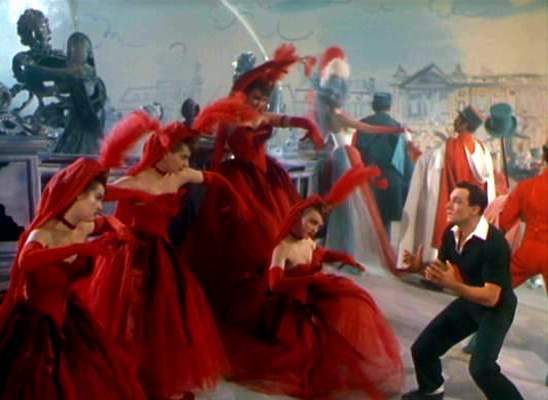
7. An American in Paris. Oh well, every list should have an item calculated to start an argument. This gorgeous musical occupies an odd position, beloved yet often called overrated. The final ballet sequence, with its dancers echoing French painters from Monet to Lautrec, gets a lot of eye-rolling from some modern audiences. Piffle, says the Siren. Remember, Gene Kelly's character is a struggling artist. That his fantasy sequence would be overrun with more talented painters is as logical as anything in an MGM musical ever gets. The ballet certainly makes as much sense as the "Louisiana Hayride" number in The Band Wagon (a film the Siren also loves, natch). And if Kelly and Leslie Caron on the banks of the Seine fail to enchant, the Siren thinks you should come clean and admit you just don't like musicals.

8. Unforgiven. A grimmer and more violent pendant to The Man Who Shot Liberty Valance. Like its predecessor, this movie asks the audience to look at how we know what we think we know about our heros and our history.

9. Rebecca. It's the atmosphere that makes this one so marvelous.

10. How Green Was My Valley. Yes, yes, yes, Citizen Kane should have won. That doesn't mean this exquisitely beautiful movie, more lyrical and heartfelt than any other John Ford made, should be overlooked. Roddy MacDowell gives perhaps the greatest child performance of all time, and Maureen O'Hara was never again as simple, direct and true as she was playing Angharad. In her memoirs she said that when the Welsh choir, hired to sing in a couple of sequences, saw Ford's set, its beauty made them burst into tears.

(Above left, Gregg Toland's deep focus for The Best Years of Our Lives turns a dingy bar into art. Middle right, Jack Lemmon demonstrates the movies' best-ever use of a tennis racket--although years later, Annie Hall came in a close second. Bottom left, Gene Kelly is menaced by showgirls in Paris. Perhaps they just wanted no more of his perfectionist rehearsals.)

Thứ Tư, 10 tháng 8, 2005

No Room at the Inn


The Siren suspects a lot of people buy this DVD thinking "Great! a Hitchcock I've never seen!" But Jamaica Inn (1939) is far more Laughton's movie, featuring a performance that makes the other characters shrink toward the edge of the frame whenever he's around. Like diners who know the waiter sees them, but despair of luring him back to their table, actors make vague gestures in Laughton's direction but don't seem to have any real hope of engaging him. Since the cliche about acting being reacting is quite true, I can't label this a great Laughton performance. I do recommend the movie, though, because flawed as it and Laughton are, Jamaica Inn has its good points.

I have read the Daphne DuMaurier novel the film is taken from, and like most adaptations of the period the book has been hacked to pieces. Novel and movie concern a band of wreckers on the Cornwall coast. The gang lures ships with false guiding lights, and when the ships founder, they loot the cargo and kill all survivors. The movie opens with just such a scene, and it offers one of the few moments of real fright in the film. (I especially like playwright/actor Emlyn Williams as the most heartless wrecker in this bad lot.) Maureen O'Hara says the opening and a later shipwreck scene were the only parts Alfred Hitchcock seemed to enjoy shooting. Otherwise, he was phoning it in, waiting to finish the thing and go to America to make his fortune (this was his last movie in Britain).

O'Hara plays Mary Yellan, whose parents have died and who is being sent to live with her aunt. The aunt is married to the sinister proprietor of the inn. When we first see Mary, she is in a coach headed for the inn, and this is where the film itself starts to lurch. The coachman, terrified at the mere mention of Jamaica Inn, whips his horses so they race past, tossing Mary around the carriage and delivering her several miles beyond her destination. Fatally, this is played for slapstick laughs, and the mood built up so nicely in the earlier scene shrivels and dies. From here on, very little of DuMaurier's atmosphere and sense of danger is retained.

Mary fetches up instead at Sir Humphrey Pengallan's place. This squire (we learn rapidly) actually leads the wreckers, running this criminal enterprise to maintain his life of luxury. In the novel, the leader is an albino vicar, which reads a lot scarier than it sounds. But it was 1939, there was censorship in Britain as well as the U.S., and an evil mass-murdering clergyman would never make it past the Pecksniffs. So Laughton, who O'Hara says was all for playing an albino vicar, was stuck playing a sinister squire. And play it he did, for all it was worth, apparently working even the redoubtable Hitchcock into a state of "Fine, Charles, do it your way."

Laughton's way creates a monster of the English gentry, convinced that his privilege is divine will, and that his appreciation of the finest objects and food justifies anything he may do to keep up a steady supply. One of the best things about Jamaica Inn is watching Sir Humphrey enjoy his private jokes at others' expense. They're nothing to him, just ants; the squire is another Harry Lime, moved back some generations and up a few rungs on the social ladder. Like Welles, Laughton had a face perfect for conveying sensuous depravity, with that overlarge lower lip doing half the work for him. When Maureen O'Hara walks in, you believe he wants her, but not in bed. O'Hara's beauty makes her another object to be acquired and handled, protected from the peons who won't appreciate her properly.

One reason Laughton overwhelms Jamaica Inn is that the actors he shares the screen with, including Robert Newton as the good guy, can't hold their own. Maybe they didn't have the chops, maybe Laughton's vision of his character never gave them the chance. Despite the fun to be had in watching Laughton, you wish his director had taken enough interest to rein him in a little and build the sense of menace. The suspense doesn't build again until a second shipwreck scene, far later in the movie, and by then it's too late. And Sir Humphrey's last, desperate maneuvers are fantastically over-the-top.

Definitely one for the Laughton fans. Look for his best work in something like Hobson's Choice or Witness for the Prosecution. Think of Jamaica Inn as what might have happened if Captain Bligh had directed Mutiny on the Bounty.

Thứ Sáu, 5 tháng 8, 2005


"As an actor, Laughton painted a physical portrait," says Maureen O'Hara. The Siren recently acquired and watched a number of movies on DVD that star Charles Laughton, one of the select number of actors she will watch in anything. Absolutely anything, as you shall see. Next post: Jamaica Inn. Posted by Picasa

'Tis Exhausting

Maureen O'Hara was not a great actress, but the Siren seldom realizes it when caught by her charm. She had marvelous presence and arresting beauty, and in many of her films that was all it took.

Despite her wondrous looks she has never been a pin-up icon, perhaps because her greatest pictures, with only one or two exceptions, were costumers. She lives in the Caribbean, and last year she published her memoirs. She has much to say about co-stars and directors. Briefly: They were out to get her, but she wouldn't let them.

The Siren has read a lot of Hollywood memoirs, but none weirder than this one. Usually when you read a star's autobiography, it all sounds pretty plausible until you fact-check. Even someone like Errol Flynn presents difficulties only when you must figure out which picture he was filming by seeing who he was getting drunk with that year.

With O'Hara, you wonder about your narrator's reliability by page 4, when she recounts a grievance against two teachers who must have been dead since De Valera was Taoiseach. OK, the Siren thought, I can still remember plenty of schoolroom slights. But that sets the tone. O'Hara was beset, plotted against, undermined, and eventually she emerged triumphant, having either forgiven her tormentor or exposed his perfidy or, on a good day, both. It's exhausting, and it's why it has taken me so long to write this one post.

Always the classic man's woman, O'Hara had a "boys will be boys" attitude that can be endearing at times, infuriating at others. Tyrone Power tricked her into telling dirty jokes to director Henry King during the making of The Black Swan, but Ty was a good guy. Errol Flynn amused himself one night by whispering disgusting innuendos to her at a formal function, but during Against All Flags, she "respected him professionally and was quite fond of him personally." In that scene in The Quiet Man where she is half-marched, half-dragged home, John Wayne and John Ford arranged to cover the hill in sheep dung. She had the warmest feelings for Wayne until the day he died.

If you're a John Ford hater (I know you're out there, probably socializing with the Mozart haters), buy this book. She depicts him as a lying, posing, bullying creep, and that's before the director punches her in the face at a dinner party. O'Hara also thinks Ford was in the closet; at point she catches him kissing a big-time (and unnamed) Hollywood actor. Ford, who spoke almost no Gaelic, would murmur gibberish into O'Hara's ear at public events to pretend they were both conversing in the language of the old country. Did I mention his alcoholism?

The picture of Ford is so monstrous that several reviewers have wondered about its accuracy. I've read enough about him to think much of what she says is true. His humiliation of Wayne, for example, has been well documented. Though she doesn't say so outright, it's easy to surmise that O'Hara's friendship with Wayne had roots in their both surviving Ford's displeasure on set, which she refers to as being "in the barrel."

Long after the reader has decided actors must have worked with Ford to convince themselves Otto Preminger was actually a pussycat, our Maureen insists she considered Ford a good friend. Odd, but consistent with her lifelong habit of excusing male nastiness. She is less believable when she says Ford destroyed the acting career of her brother Jimmy after the young man failed to show up for a meeting, or when she accuses Ford of single-handedly scuttling her chances for an Oscar nomination for The Quiet Man.

O'Hara had a long break with the director after a dismal experience shooting The Long Gray Line and after Ford directed some racial insults at the Mexican man she was dating at the time. But she still went to see the director in his last illness, and the book shows her straining to reconcile the rather loathsome man with his talent. She goes into great detail about the filming of The Quiet Man , and publishes some love letters she received from Ford while he was writing the script for that classic. O'Hara says he never spoke to her about the letters nor acted on his love for her, if love it was. She thinks he loved her character of Mary Kate Danaher, whatever sexuality he may have been repressing.

Throughout the book O'Hara refers to herself as a strong woman, feisty and wilful, one to brook nonsense from no man. The self-portrait goes nicely with her screen image but, as they say in first-year screenwriting class, what you tell and what you show are two different things.

Tis Herself shows us the first marriage, which O'Hara claims happened because, naive and fearful of giving offense, she didn't have the heart to tell the man to buzz off. Well, O'Hara was very young. But then she marries Will Price.

Price is a type anyone who's ever leafed through an actress bio could recognize at fifty paces in the dimmest-lit bar in Los Angeles. Good-looking in a vacuous sort of way. Knows a bunch of celebrities. Hard-drinking. In desultory pursuit of a career. Wants his famous wife to help him out. Needs all kinds of material goods to keep up their golden image. By the time Price showed up with a "financial consultant" and convinced O'Hara to give the goon complete control of her money, the Siren was ready to throw the book down, but didn't. Not even after the night when O'Hara, days from delivering her daughter Bronwyn, got punched in the stomach by her alcohol-fueled mate.

No, the Siren hurled the book when O'Hara stayed with Price, who later tried (so she says) to con her into having an unnecessary and highly dangerous operation. Attempted murder, in other words. And even when she finally divorced the slob--are you ready for this?--she kept the "financial consultant." And was really surprised when years afterward it turned out that all her money was gone.

Strong, feisty woman? You tell me. Those qualities show up more when she's settling accounts with enemies, which she does with a relish that may explain her support for Richard Nixon. Out comes the old story about Rex Harrison's role in Carole Landis's death. (The gossip is that it was a suicide pact that only Landis bothered to go through with.) Walt Disney gets thumped not for his anti-Semitism or other celebrated flaws, but for billing her second to Hayley Mills in The Parent Trap. Jimmy Stewart was a good actor, but not a generous one, and he saw to it that one of her best scenes was written out of The Rare Breed. Later on, O'Hara had a happy marriage to pilot Charlie Blair that ended with his death in a plane crash. The NTSA ruled it was pilot error. Would it surprise you to learn that she thinks it was a conspiracy linked to hubby's CIA activity?

Ordinarily it gladdens me to see frank talk about gay life in Hollywood, as this is the post-Stonewall era, and if your favorite star was or is gay you need to drag yourself into the 21st century and freaking well get over it. Tis Herself has an unpleasant pattern, though: The people who treated O'Hara badly were gay. That means John Ford, second husband Will Price, and Peter Lawford and Richard Boone. O'Hara says she rescued those last two from some bad publicity Down Under when they were caught in a brothel full of beautiful boys.

But Tyrone Power? He spoke to her often about the kids he wanted to have. Roddy McDowall? No mention of his love life. Charles Laughton? He wanted kids too. When Elsa Lanchester wrote they didn't have any because Laughton was gay, O'Hara says that was "rubbish...whether or not Laughton was homosexual." Lanchester couldn't get pregnant due to a botched abortion.

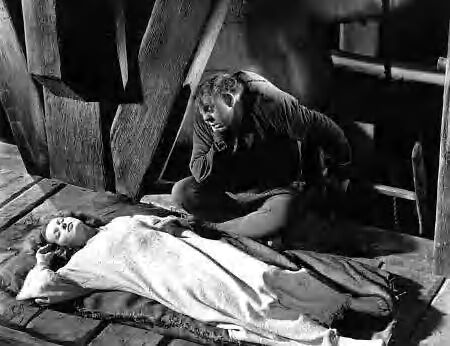
O'Hara has nothing but praise for Laughton, who started her career by casting her in Jamaica Inn. She describes Laughton, in full Quasimodo costume, reciting the Gettysburg Address on the set of Hunchback of Notre Dame the day Germany invaded Poland. I'm not saying I don't believe her, but wasn't that scene in Ruggles of Red Gap? Still, O'Hara's loyalty to Laughton, and clear-eyed observations about his talent, make you love her as you did in her movies. There isn't enough of that in this book.

When you're done with a star's memoirs, no matter what warts were revealed, you can always go back to the pictures. The Siren wants to go back to a shot of O'Hara in Hunchback. As she is carried off by celebrating Parisians, she turns to look up at Quasimodo for the last time. In that instant, she will always be beautiful, always be kindhearted, always be sympathetic.

Thứ Năm, 4 tháng 8, 2005

Baghdad and Boobs

No, this isn't a political post. It is a digression on a Hollywood genre. One IMDB reviewer calls these movies "Grecianized Near-Easterns," others call them sand-and-sandals. The Siren calls them Baghdad-and-boobs.

I have a big soft spot for these cinematic baubles, and Maureen O'Hara is one reason. A fair-skinned redhead myself, flicks like Sinbad the Sailor (1947) assured me that if I pursued an acting career I need not fear typecasting. I envisioned myself at casting calls for a "Scheherazade type." I could even bring my own chiffon, to audition with that cute little see-through square that passed for the veil in these movies.

O'Hara's autobiography dispenses with Sinbad in one line, and the Siren thinks this unfair. It's a most enjoyable movie, with a delicious framing device. There is a lighthearted, almost spoof-like aspect to it that works well. Douglas Fairbanks Jr. has the requisite dash, but unlike his dad he had a certain fey quality that hindered him as an action hero. Sinbad turns this into an advantage by emphasizing the title character's braggadocio. Is he a real hero, or a loudmouth con artist? You find out at the end, after plenty of sparring with O'Hara's trademark feisty princess.

As a girl I also enjoyed Son of Ali Baba with Tony Curtis and Piper Laurie. My memory has faded, but even watching that one on the Turner Superstation in the 1970s I think I realized Curtis was a lot more Brooklyn than Baghdad. They changed the ending of the old story, possibly because someone realized that in 1952, seven years after World War II, mass murder of forty thieves might not play in Peoria.

Piper Laurie even made another Baghdad-and-boobs flick in 1953, The Golden Blade, with Rock Hudson (stop giggling. No, I haven't seen it). Something about redheads seems to have made studio execs think, "Now where did I put that heavily edited edition of the Arabian Nights?" Rita Hayworth got the girdle-and-veil treatment, with a Biblical twist, in Salome. And while it isn't part of the genre, I still crack up when I see Shirley MacLaine as an Indian princess in Around the World in 80 Days. If you look closely you can see her freckles in a couple of close-ups. Wonder why they never got around to Moira Shearer?

Hollywood churned these things out by the urnful in the 1940s (often with poor, doomed Maria Montez) and into the 1950s, with occasional forays even after that, such as The Golden Voyage of Sinbad in 1974.

The only Baghdad-and-boobs saga that the Siren (and possibly anyone else) can consider a masterpiece is the 1940 Thief of Baghdad. Among its advantages were the brilliant Michael Powell, an uncredited William Cameron Menzies (six directors worked on the movie, all told), and dialogue by Miles Malleson that actually managed to evoke some cadences of a Khayyam translation without sounding ridiculous. It had the exacting Alexander Korda who, legend has it, looked at the Baghdad set and ordered, "Tear it down, build it three feet higher, and paint it pink." Finally, it gave us Sabu, a gifted and charismatic child actor who had the rare ability to react without mugging.

In case you're wondering, yes, the Siren does realize these films resemble true Arabic culture about as much as Mamie Van Doren resembles Marie Curie. But she cut her cinephile teeth on Busby Berkley musicals and figures realism is overrated anyway. These are fairy tales. If they teem with appalling Middle Eastern stereotypes (and boy do they), at least the heros are allegedly Arab or Persian too, albeit played by toothy Westerners. Talents like Turhan Bey and Sabu usually had to content themselves with supporting roles. Whereas today, of course, they'd be getting ... supporting roles.

Sabu's career was sadly limited by the typecasting of his time. When the Siren looks at something like The Mummy, however, she has to question whether he would have fared much better today. Perhaps he'd have found a place with independent filmmakers, but there wouldn't be much for him in the standard big-budget offering. The old days gave us patronizing Orientalism, but in the Siren's view, mainstream Hollywood manages to grow worse with age.

Chủ Nhật, 31 tháng 7, 2005

So They Say: Thoughts on Star Memoirs

The Siren has been devouring star autobiographies since she was knee-high to a prop table. Her first experience was with fellow Alabamian Tallulah Bankhead, as the Siren sought reassurance that being from Alabama need not preclude having a fascinating life. Tallulah gave that reassurance, and how. From there on out, star memoirs were the Siren's literary potato chips.

Blinded by the fun, the stories, the dish of it all, it took me years to discover that the hallmark of most Hollywood autobiographies is inaccuracy. (And ghostwriters, of course. Often I read memoirs imagining the ghostwriter saying soothingly, "But of COURSE I believe you. Everyone knows you're a teetotaler.")

Sometimes you get sins of omission, like Rosalind Russell's Life Is a Banquet, where she neglects to mention the celebrated contretemps over her failure to win an Oscar for Mourning Becomes Electra. You also run into the odd priorities of actresses like Ginger Rogers, who could remember every detail of her costumes for her Astaire pictures and almost nothing about trivia such as the choreography.

The great Lillian Gish gives fascinating details about filmmaking in The Movies, Mr. Griffith and Me. Alas, Lillian has certain blind spots, such as when she assures the reader that D.W. Griffith was "incapable of prejudice against any group" and if he had lived, he would done a film of "affirmation about the Negro." Suuuuuure he would have. Right after Leo McCarey made a film about the ghastly toll of the blacklist.

Other times you detect a certain tendency to elide personal foibles, as John Huston did in An Open Book. Read that one and you would think him the most reasonable of directors, which doesn't quite jibe with most actors' recollections. Gregory Peck once said he had the distinct impression that if getting a certain shot for Moby Dick had required his drowning on camera, that wouldn't have perturbed his director at all.

There are stars like Myrna Loy, whose admirable Being and Becoming shows loyalty to her friend Joan Crawford, but perhaps not that much ability to read between the lines of family disputes. Finally, there are the ones who just lie their little rear ends off, as Frank Capra apparently did in The Name Above the Title.

Despite all this I pounce on autobiographies year after year, including the latest, Tis Herself, by Maureen O'Hara. Ms. O'Hara deserves her own post, and the Siren plans to give her one in the next couple of days.