Hiển thị các bài đăng có nhãn Actors and Acting. Hiển thị tất cả bài đăng

Chủ Nhật, 24 tháng 5, 2015

Claude Rains: An Actor's Side-Eye


Think of Claude Rains, and what usually come to mind is The Voice. That liquid, caressing baritone, with just enough of an English accent. Voices don't come much sexier than Rains'. (If you need reminding, or just because he is excellent in it, here is a recording of "The Hands of Mr. Ottermole," a classic episode of the radio show "Suspense" that stars Rains along with Vincent Price.)

Recently, however, by the simple expedient of noodling around for good photos of Claude Rains (on whom the Siren, like her idol Bette Davis, has a raging crush), the Siren made a discovery. An intriguing discovery, if she says so herself, and she does.

In addition to speech so beautiful that David J. Skal's biography of Rains is called An Actor's Voice, Rains had a world-class side-eye.

In fact, until a challenger comes along, the Siren, by the authority she has invested in herself, awards Claude Rains the prize as The Greatest Side-Eye of All Time.

And here's a curious note about The Voice, and the unique sidelong look he brought to multiple roles over the course of a great career: The evidence suggests both had their roots in adversity.

Claude Rains, who brought a silky hint of culture, wit and high birth to so many roles, was born into a London family of small means in 1889. He had 11 brothers and sisters; in an era of measles, diptheria and a thousand other childhood scourges, many of the Rains children died in infancy. Only three of them, including Claude, made it to adulthood. His father, an actor of sorts, veered from one job to another, and was prone to beat his son for the smallest infraction. His mother spent time in an asylum, and Skal speculates that she suffered from postpartum depression. Young Willie (his birthname was William Claude) had a strong Cockney accent Skal says was picked up in the London streets, as well as both a lisp and a stammer. He got rid of them all by his late teens as he embarked on a career in the theatre, moving from call boy to prompter to speaking roles, and studying elocution books religiously, practicing every exercise.

In 1916 he volunteered for the famed London Scottish Regiment, known around these parts as the Most Devastatingly Attractive Regiment of All Time, including as it did Basil Rathbone, Herbert Marshall and Ronald Colman. Rains was deployed to Vimy Ridge, where months later his outfit was hit by mustard gas. A shell exploded near him and the last words he heard, before he lost consciousness, were "Well, they got Rains."

When he woke up in the hospital, he had lost nearly all the vision in his right eye, and his vocal cords were paralyzed. The voice came back, of course, but with a slightly rougher cast that movie audiences would grow to love. The blindness was permanent. Skal says "it would remain a closely guarded secret" right up to Rains' death in 1967.

It's hard, if not impossible, to know whether this contributed to the signature Rains glance, perhaps as one way of keeping a scene partner in his sightlines, without drawing attention to the right eye. What is indisputably true is that a sidelong look from Claude Rains is more intense than many another actor's head-on stare.

It wasn't an indiscriminate thing. He was too fine and precise an actor for that. You won't find it much, for example, in Mr. Skeffington, one of the Siren's favorite Rains roles, where he has the title role as the near-saintly man who loves Bette Davis' cold-hearted flirt. But when he needed it, hoo boy.  Side-eye is modern slang for a glance of derision, and certainly Rains could do that, so scathingly you imagine whoever is in the scene with him had to put up a fire-screen. But Rains had infinite variations, until that look became an art. With it, he could convey tender love, bitter betrayal, cynicism, defeat, lust, fear, laughter and a sense that the world is mad.

Behold. The Siren has collected evidence.

Publicity photo, or, The Come-Hither Side-Eye, in which Rains at his handsomest appears to glance away
 because you, yes you dear fan-person, you drive him mad with passion. Speaking of which...

Crime Without Passion (1934): "You're blonde now."
Anthony Adverse (1936): Calculating, with a hint of licentiousness. Rowr.

Stolen Holiday (1937): "No, of course I haven't concocted one of the greatest
financial frauds in French history. Bisou-bisou, darling."

They Won't Forget (1937): The Siren can't joke about this one; it's too grim, and fact-based to boot.
 All the same, that's a hell of a look.

The Adventures of Robin Hood (1938): In a scene with Basil Rathbone, former comrade from the Scottish Regiment, the Rains sidelong glance does not hesitate to upstage the Baz something fierce.

Four Daughters (1938): The rarely deployed twinkly version. 

Here Comes Mr. Jordan (1941): Precisely the look to convey to a subordinate, in this world or the next, that he has made a very big boo-boo.

The Wolf-Man (1941): "Down, boy. My billing's higher than yours."

Building up a "psychic bellyache" in Kings Row (1942).

Now, Voyager (1942): The look of a psychiatrist who realizes he's taking the wrong person to the sanitorium.

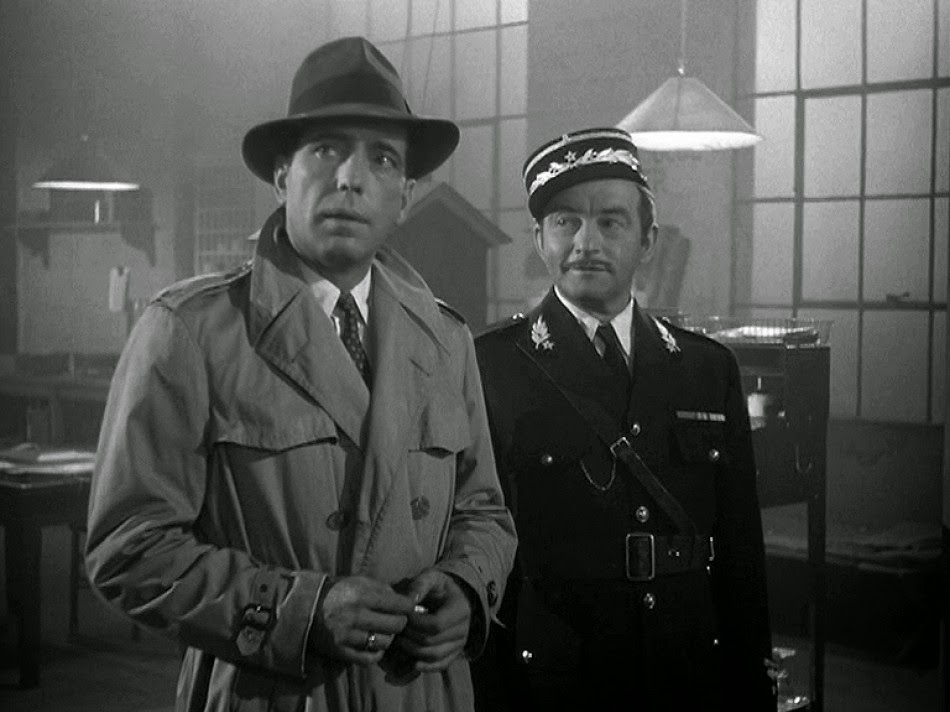
As Casablanca was peak Rains, in the public memory if nothing else, so also is it Peak Side-Eye, as here

and here...

and here...

...and of course, here.

Notorious: The "Yes, That's the Low-Cut Gown of the American Spy I Married" Side-Eye

Publicity for The Unsuspected (1946): "I dare you to suspect me."
(Wonderful film, another of the Siren's favorite Rains outings.)

Deception (1947): Side-Eye Emphasizing the Betrayed, Although Admittedly Crazed and Controlling, Lover 

Lawrence of Arabia (1962): Assessing just how much trouble T.E.'s "funny sense of fun" is going to cause him.

Some more good stuff about Claude Rains:

The Notorious screen-grabs and the ones from Now, Voyager are from the movie writeups at The Blonde at the Film.

His career in horror movies, from John McElwee at Greenbriar Picture Shows.

Karen at Shadows and Satin speculates it was Rains who got the first million-dollar salary.

Moira Finnie at Movie Morlocks has a tribute that mentions the signature look.

A biographical essay at The Hollywood Art, with quotes from Rains' only daughter, Jessica.


Chủ Nhật, 8 tháng 2, 2015

Charles Laughton: Actor as Artist


The folks at New York City’s Film Forum have just started a three-week, 35-film tribute to Charles Laughton. Obviously, they love the Siren and want her to be happy. That’s her working theory, anyway. April of this year will mark a full decade since the Siren began spinning in her corner of the Web. And Laughton was one of the first people she chose to write about.

What makes you adopt an actor? How do you decide that here’s a performer you will seek out, regardless of the vehicle? The Siren is always drawn to an actor who takes a 20-foot-high screen and gives you a focused, intelligent performance that fills out every square inch. That’s Laughton. His kind of acting is, sadly, not very fashionable anymore. Even Simon Callow, who wrote a fantastic biography that focuses almost entirely on the acting, admits Laughton’s fame these days is tied to The Night of the Hunter, his one-off directorial masterpiece. Laughton’s acting is “virtually unknown by anyone under 40,” Callow wrote recently.


Or, in some cases, worse than forgotten. “Laughton's mannered performances are liable to elicit laughter today,” sniffs one writer reviewing Callow’s book. This prompts the Siren to a rare display of temper. Mannered? What could be more mannered than some contemporary actors who wait for the camera to discover each tiny effect as they overact their underacting? (That is, if indeed they are actors; of late the Siren has endured too many nonprofessionals cast by wannabe Bressons.) You can keep that kind of pallid realism, where the goal is to be the closest thing to real life. Sure, it’s close. And real life is being on hold with the airline, or flossing your teeth, or staring into the middle distance while trying to recall whether you took your vitamins. The Siren doesn’t require tedium to be all that accurate.


Give her someone like Charles Laughton, who aimed big, even if from time to time he failed big. Give her the existential truth he dredges up, say, at the climax of Mutiny on the Bounty. God no, it’s not “realistic,” but for all time and no matter who else plays him, there’s Captain Bligh, standing in a rowboat, bellowing: “Casting me adrift 3,500 miles from a port of call! You're sending me to my doom, eh? Well, you're wrong, Christian! I'll take this boat as she floats, to England, if I must! I'll live to see you — all of you — hanging from the highest yardarm in the British Fleet!”

Now if you were an actor in class, assigned the unenviable task of recreating that speech, your action might be something like “placing a curse.” Captain Bligh is, in this MGM production of 80 years ago, a villain, a man who cares more about breadfruit than the human beings under his command. But as an actor, Laughton knows obsessiveness can bring about disaster, or it can keep a person alive. Bligh is transferring all his passion to the task of survival, so he can have his revenge. And Laughton points his hand as though he could reach up and tie the rope around Clark Gable’s neck himself. He’s not merely shouting, he layers hatred and determination under every syllable, pronouncing “ChrisCHUHN” so that the very name carries the wrath of the Almighty.


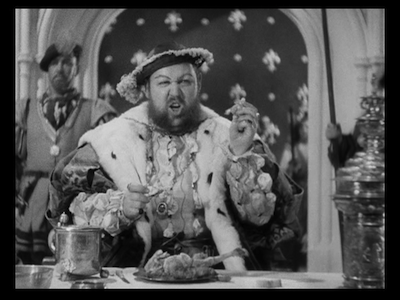
In other words, this is an actor who performed with ferocious totality. That’s what it takes to etch a character in the public mind. When people joke about Henry VIII picking up half a chicken and tearing the meat off with his teeth, they’re not remembering Holbein. They’re evoking Charles Laughton. Lon Chaney created a good Quasimodo, in the 1923 The Hunchback of Notre Dame, one that was quite close to the 19th-century illustrations of Victor Hugo’s book. But when Disney cleaned up the tale of the hunchback and the gypsy, to puzzling effect, they were, quite openly, doing a prettified version of Laughton. That’s because it was his Quasimodo, falling in love with Maureen O’Hara’s Esmeralda in the course of a single shot, who broke hearts. These images are there because Laughton’s performances put them there.


He achieved his effects through subtle methods as well as grand ones. For Rembrandt, a biopic directed by Alexander Korda, Laughton immersed himself in the artist’s work for weeks on end. It’s a somber movie, focused on Rembrandt’s tragic private life, and also on how his paintings gradually lost favor, even as Rembrandt was at the peak of his genius. Aided by the sensitive lighting of cinematographer Georges Perinal, Laughton approaches a canvas as though acceding to its demands. “Every man has a destined path,” says Laughton’s Rembrandt. “It leads him into the wilderness but he must follow it with head high and a smile on his lips.” It is no surprise to learn that Mike Leigh, in interviews, cites Rembrandt as a key influence on Mr. Turner.

Charles Laughton was born in 1899, the son of hoteliers. He worked until his early 20s in his parents’ hotel, starting at the lowest rung of the trade at the insistence of his formidable mother. His upbringing was prosperous, and he went to private schools such as Stonyhurst. He didn’t begin his acting career until his early 20s, after overcoming the strenuous disapproval of his family.

But Laughton, somehow, never identified much with privilege. Off-screen he pulled away from “toffs” all his life. When he played a bank clerk, a servant, a schoolteacher, he brought a rare and deep understanding of what it means to work hard for meager pay and nonexistent rank. And Laughton also reveled in showing what’s behind the petty exercise of power, say by a Victorian toff with his invalid poet-daughter in The Barretts of Wimpole Street, or a bootmaker of a similar era in Hobson's Choice, or, in The Big Clock, a CEO who finds a single light burning in a broom closet at his corporate headquarters.


He served in World War I as a private, saw time in the trenches, and was exposed to mustard gas in the last vicious weeks before peace. It damaged his throat and left him with painful, recurring hives for the rest of his life. The emotional effects of his service are harder to discover, because Laughton preferred not to speak of them. Still, Callow points to a possible connection between the ignoble terror of certain moments in This Land Is Mine, and the memories of war, and that feels right. In Jean Renoir’s superb movie about the occupation of a small (obviously French) town, there is a scene where Laughton’s Alfred Lory, a schoolteacher, looks out the window of his cell and sees his headmaster being marched to a firing squad. Lory was supposed to call to him: “Professor Sorel! Professor Sorel!” On the first take, Laughton gripped the bars on the window so hard they broke off.

Laughton had a stormy, complicated marriage to Elsa Lanchester that lasted from 1927 until his death in 1962. He was gay, and Laughton’s era was not, of course, hospitable to same-sex relationships, although the older he got, the more affairs he had, and the more frequently he would confide in people. (As he took a drive with Robert Mitchum during the filming of Night of the Hunter, Laughton confessed to his star that “there is a strong streak of homosexuality in me.” Mitchum’s priceless response: “No shit! Stop the car!”) Most good actors can suggest sexual undercurrents driving their characters, but Laughton treated desire, even in murderers like those in The Big Clock and Jamaica Inn, as an outgrowth of the mind, not merely a physical urge.


Seeing a big portion of Laughton’s work at Film Forum should dispel the notion that he was always massively overweight; he’s in pretty good shape in Mutiny on the Bounty, for example. He was an aesthete who prized the best and highest in music, in literature and in art. (One bond he had with Jean Renoir: Laughton had bought Renoir pere’s The Judgment of Paris for $35,000 in the 1930s.) But this man who loved beauty saw none in himself, no matter if Marilyn Monroe said he was “the sexiest thing she’d ever seen,” no matter if Marlene Dietrich told him before they started Witness for the Prosecution that she’d always yearned to play opposite him. “I look like a departing pachyderm,” he once said. The Siren never reads that joke without a wince. His looks did mean he would never be a leading man, but that is our good fortune; how many Hollywood idols could have created just one of Laughton’s monsters?


The Film Forum series shows that Laughton was also exceptional at more ordinary specimens of humanity. In The Suspect, directed by Robert Siodmak, Laughton is cast as a version of Dr. Crippen, a rare sympathetic figure in the annals of true crime — not least because he may not have actually murdered his wife, a possibility the film toys with, but basically rejects. Philip Marshall (Laughton) is chained in marriage to a vicious shrew (Rosalind Ivan, rehearsing her character in Scarlet Street, but doing it well); inevitably, he falls love with a gentle young woman (Ella Raines, who seemingly spent much of the 1940s cast as the foil to murderers). Made on an obviously low budget, it is still a fine movie, and Laughton and Elsa Lanchester considered Marshall to be one of his best creations. The tension comes from the question of which will win out, Marshall the murderer, or Marshall, the man who says, with infinite sadness, “I like people and I’ve never wanted to hurt them.” At a key late moment, Marshall is afraid that his secret is about to be discovered during a quiet social evening at home. As his own son fumbles around the spot that could reveal all, Marshall keeps smiling; you can watch the gradual transition, as Laughton’s smile turns into a ghastly mask of dread.

To a director, Laughton on set meant there would always be more than one temperament around, and Siodmak said later that The Suspect forced him into an unusual approach. When Laughton one day barged in declaring that every take had been wrong, all wrong, and would have to be redone, Siodmak responded by reeling around declaiming the actor's lines himself. Laughton became convinced he’d finally encountered a director who actually was a lunatic, as opposed to merely behaving like one. And after that, claimed Siodmak, his star was as gentle as the rain.


Jean Renoir was patient and kind, as he seemed to be with everyone, and mentioned Laughton fondly in interviews. During Spartacus, Stanley Kubrick had his hands full, what with the glory that was Rome and the grandeur that was Kirk Douglas, and let Laughton and Peter Ustinov rewrite most of their scenes together. Billy Wilder, who helped Robert Stephens to a breakdown and James Cagney to leaving the business, described making Witness for the Prosecution as delightful. (The Siren has watched that movie over and over again — it’s Laughton’s funniest, most wholly endearing performance. His scenes with Lanchester are perfection.) Otto Preminger (rather surprising, this one) treated Laughton with the utmost courtesy during Advise and Consent. He probably realized the actor was dying of cancer and that Senator Seb Cooley would be Laughton's last role. Laughton's physical condition caused him to play Cooley (obviously written as a portrait of Strom Thurmond) with spidery stillness. But Preminger also said Laughton asked for direction and was eager to take it.


Other times it was a different story. Even Laughton’s friends and admirers said he was hard to work with. Those directors who emerged with good memories tended to be ones who recognized that Laughton’s extreme seriousness was no act. Garson Kanin, who directed They Knew What They Wanted (long out of sight, not Laughton’s best work, and not part of the series), claimed to have respected Laughton, at least before shooting began. Laughton told Kanin that to play an Italian-American farmer, he would immerse himself in Vivaldi, Dante and Michelangelo. In his book Hollywood, Kanin all but calls this a sham.

But the fact is, that was absolutely Laughton’s approach, as it had been with Rembrandt. Alfred Hitchcock could have testified to that as well. When Laughton was unable to get his walk right as the sinister squire of Jamaica Inn, he refused to continue. He came back the next day saying he’d discovered how to do it, by listening to Carl Maria von Weber’s Invitation to the Dance.

Hitchcock, however, responded to this sort of thing about as well as Kanin did. Hitch liked his actors to be either consummate pros, who got the job done without fuss, or malleable, tentative souls he could push around as he liked. Laughton was the worst of both worlds: a headstrong talent who needed as much time and patience as any neophyte. Laughton's malevolent judge in The Paradine Case (poor Paradine Case, the Siren loves you even if no one else does) was a somewhat better experience. But Hitchcock told Pia Lindstrom years later, with placid malice, “The hardest things to photograph are dogs, babies, motor boats and Charles Laughton.”

Mind you, the Siren understands Hitchcock’s point of view. To see the way Laughton struggled, and directors struggled with him, you need only look at one 70-minute documentary: The Epic That Never Was, which Film Forum is showing on Feb. 22. Made in 1965 for the BBC, it pieces together what’s left of an effort to film Robert Graves’ I, Claudius in 1937. Laughton, who’d already been a memorably depraved Nero in The Sign of the Cross, was obvious casting as the stammering Roman who feigns stupidity in order to stay alive, and ends up as emperor. Josef von Sternberg, who’d just ended his string of sumptuously erotic films with Marlene Dietrich, was likewise a natural to film the dissipation of the ancients.

As they say, it seemed like a good idea at the time. Instead it was a disaster that ended with Merle Oberon (cast as Messalina) wrecking her car and her producer husband Alex Korda deciding that a nice tidy insurance settlement beat the heck out of making this movie.


More than anything, Laughton was ill-matched with Von Sternberg, who wrote, “An actor is rewarded with attention out of all proportion to his services. An actor is turned on and off like a spigot, and like the spigot, is not the source of the liquid that flows through him.” Laughton admired Von Sternberg greatly, but this was not a director who was going to understand why his spigot was studying the exact way a Roman would address the gods. There are many outtakes of Laughton stopping mid-scene, or up and leaving the set. You could say Von Sternberg lacked sympathy. “Acting is nothing remarkable,” he wrote, and meant every word. And in fairness, more often than not, when Laughton stops, it’s difficult at first to figure out why. He sounds fine. Sometimes he sounds great. Imagine you’re Von Sternberg, or, if you prefer, Hitchcock, with the crew seething and the hot breath of the studio executives steaming up the set, and all that’s between you and the film you can already watch in your head is this ACTOR and his insistence on forging things in the smithy of his soul.

“Jesus Christ, Charles, just hit your mark and say the line.

And then, Laughton addresses the Senate … and soars. In one scene he becomes every belittled, misjudged man who ever stood up and said, this is not who I am. At last it is possible to understand why Laughton placed such significance on the interior. He was acting the other takes, and they were good; in this one, he is being, and it is art.

Those who talk only of the single film Laughton directed, and shrug off the rest, are making a grave mistake. Laughton the director could never have made the shimmering, perfect thing that is Night of the Hunter, if it hadn’t been for Laughton the actor.


Links:

The schedule for Film Forum's Charles Laughton series can be found here. A restored Spartacus is screening this spring after the series concludes. Several rarities are being shown, including Forever and a Day and Arch of Triumph, neither of which the Siren has seen (yet). Also, though Laughton's part amounts to a glimpse, the dazzling Piccadilly is worth your time and includes one of Anna May Wong's best roles.

The Siren has in the past written about Ruggles of Red Gap, The Big Clock, Jamaica Inn and the charming Deanna Durbin vehicle It Started With Eve. She prefers David Cairns on The Man on the Eiffel Tower to her own post, which was written in a state of extreme irritation from the lousy DVD she watched.


Chủ Nhật, 26 tháng 10, 2014

A Few Words About Jack Carson

(Oct. 27 is Jack Carson's 104th birthday, and TCM is having an all-day, eight-film celebration that includes both Mildred Pierce, Cat on a Hot Tin Roof, and Roughly Speaking. The Siren wrote this in 2011 for the now-defunct Nomad, but never published it in full. Here's the whole thing, gussied up with edits and additions.)


Gather old-movie buffs around to ask them what they miss, and one answer will be character actors. Jack Carson, who packed nearly 100 movies into a career cut short by stomach cancer at the age of 52, was one of the greatest.

Carson was born in Manitoba in 1910, but the way his nasal voice lingered over a wisecrack always suggested an urban birthplace anywhere from Brooklyn to Chicago. A beefy man who stood six-foot-two, he had the physique and carriage of a football player grown too fond of roadside meals. His face was round and almost apple-cheeked, with a mole on his right cheek and small eyes that squinted into slits whenever the world dealt him a perplexing situation. With this un-starry equipment he built an unusually varied filmography.

He often played heels, as in his first big break playing James Cagney’s nemesis in Raoul Walsh’s The Strawberry Blonde. Much later on, in his most purely villainous role, Carson can be found destroying James Mason’s fragile psyche with a single vindictive bar conversation in George Cukor’s A Star Is Born. But he could play well in other keys; midway through Carson's credits are a string of light but often diverting comedies where he played Bob Hope to Dennis Morgan’s improbable Bing Crosby. And he had that ability of any good actor to show you more than what's in the script, even a brilliant script. In one of his last film roles, as Gooper in Cat on a Hot Tin Roof, Carson is both venal and sympathetic, a son whose greed for his father's money comes from the bitter knowledge that it's all he will ever get from an old man who doesn't love him, and never has.


In his best-known role, as Wally Fay in Mildred Pierce, Carson's a sleaze, yet weirdly lovable. He reels out of the beach house to tell the cops “There’s a stiff in there” with an expression that seems to say dead bodies are always happening to stand-up guys like him. This man’s romantic maneuvers are like watching the Queen Mary try to parallel-park: “Not too much ice in that drink you’re about to make for me.” Mildred Pierce also gives Carson what the Siren thinks of as his career-defining line. “I like to hear you talk,” says Joan Crawford, trying to distract him so she can pin a murder on him. “So do I,” replies Carson, pleased to have found common ground. “Something about the sound of my own voice fascinates me.”

Unlike a lot of character actors, however, Carson did land the occasional secondary lead. In two such movies, both made at Warner Brothers (and available on Warner Archive), he gave great performances. Neither character is a heel.


In The Hard Way (1943), Carson plays Albert Runkel, one half of a vaudeville act with Paul Collins (Dennis Morgan, as good as he ever got). Runkel and Collins are so hopeless they give the director, Vincent Sherman, a chance to echo the Citizen Kane shot of a stagehand holding his nose. But they are good enough to turn the head of Katherine Blaine (an unusually hard-edged Joan Leslie), a poor girl in a steel-mill town whose prettiness and big-eyed fascination with the two hams causes the goodhearted, hapless Albert to fall in love and marry her. But Albert reckons without Helen (Ida Lupino, in one of her best roles), Katie’s sister, who sees him as a way station on the route to bigger and better things. Pushed by Helen, Katie becomes a star, and Albert is left behind, knowing he’ll never get his wife back and never equal her, either.

The small-time sweetheart pursuing the heroine who’s on the rise — that regular Joe who shows up backstage to moan “But what about us, baby?” — is usually one of the least tolerable aspects of any showbiz saga. Carson makes his part truly touching. It’s Albert, not the teenage Katie, who’s the real innocent.

In one musical number, “Latin from Manhattan,” Albert wears a ghastly pom-pom-bedecked sombrero and strums a guitar while Leslie vamps around a nightclub stage. He's is selling it with everything he’s got, and he’s terrible. And Carson’s face says he knows it’s no good, but that naive faith that was there from the beginning is still carrying him as he prances after his wife.

And then there’s a party scene where Albert tries to get a now-successful Katie to return to him. This time Albert is selling his love for Katie and their marriage with everything he’s got, and he knows it probably won’t work. Unlike the nightclub, the hope in his eyes gets dimmer minute by minute, until Katie tells him that if he thinks she’s leaving, he’s crazy — and you watch the hope die right out of Carson's face.


In Roughly Speaking (Michael Curtiz, 1945), Carson’s character shows up for the first time about halfway through the movie. At that point Louise (Rosalind Russell) has endured the death of her father, the births of four children, the infantile paralysis of the youngest child, years of marriage to a stuffed shirt, the stuffed shirt’s infidelity, and a divorce. Harold (Carson) meets Russell at a costume party and falls for her within two hours of meeting her — after encountering all four of her children in her kitchen. Harold is the ne’er-do-well son of a rich man, and he’s looking for a woman who will approach life with an optimistic and adventurous spirit.

And they need it, as Harold and Louise’s every attempt to make money falls flat. They open a greenhouse and inadvertently flood the market with roses. They invest in a new type of airplane just as the stock market crashes. But the point of Roughly Speaking is that compatibility of temperament matters most in a marriage. Louise’s life was steadier with the stuffed shirt, but she could never be as happy as she is with Harold.

They don’t seem as though they should have chemistry, and yet Carson and Russell do. Not the red-hot sexual variety, but that of two people who seem to adore one another’s company, no matter what.

Their fortunes reach such a low ebb that Harold takes a job as a vacuum-cleaner salesman. He comes home to practice his pitch with his wife. As he shoves his shoulders in the door, throws lint on the carpet, gets the vacuum in reverse and covers the house in blowing soot, Carson’s easy camaraderie with his wife is more appealing than many a passionate love scene.

Later, Louise discovers that Harold found door-to-door sales so soul-draining he’s taken to earning money by doing a bit of pool-sharking at the local bar. She comes in and they sit at a table, Louise almost in tears, and Harold gently tells her that he would understand if she cleared out. Carson’s face is a marvel of drily unsentimental love and self-reproach.

Even more tender is the last scene in the movie, when they are sending the two oldest sons off to war. They’re Louise’s boys, Harold is their stepfather, but they call him “Pop” and tell him how much he's meant to them. As Carson watches them go, his eyes and expression show that these are now his sons. Perhaps Harold never completely considered them so before, but he does now. The ability to pack that much meaning into one look at a train station — that’s character indeed.

Thứ Hai, 7 tháng 4, 2014

In Memoriam: Mickey Rooney, 1920-2014


Roll out the red carpet, folks, and stand by. That boy is here again, the Pied Piper of the box office, the eighth or ninth wonder of the world, the kid himself — in short, Mickey Rooney.
— The New York Times reviews Strike Up the Band (1940)

Few terms are crueler than has-been. A has-been is Norma Desmond rattling around an empty mansion. Avoiding strong light like a vampire, bitterly dishing old enemies to skeptical interviewers. So focused on looking back that you never move forward.

Mickey Rooney was never a true has-been in his life, not with 90 years of work. Shorts and features, A pictures and B pictures, star turns and character parts. Social dramas, musicals, an impressive run of noirs, comedies, Emmy awards, sitcoms, a hit Broadway show. The Siren spotted him in The Muppets in 2011 and heard a college-age woman whisper to her companion, “Mickey Rooney.” If that’s has-been-dom, sign up the Siren.

Good script or bad, Rooney simply did not know how to approach his work any way other than full-out. You can find him in roles that sank into self-parody, things he probably took because he needed the money (let’s hope that’s how he wound up narrating Hollywood Blue). But phoning it in? Never happened.

Yes, Mickey Rooney was known for reminding people that he was once the biggest star in the world. That’s because he was once the biggest star in the world. It’s not like he spent decades dining out on how he scored the winning touchdown for Dead Skunk State College. That's why Dana Carvey’s exasperated tale of working with Rooney winds up adorable. Rooney was at once easy fodder for a dead-on impression, and inimitable.


He was one of the last remaining stars who started in silent movies; the Siren admits to being too depressed to look up who’s left. Rooney made his first indelible mark as Puck in Max Reinhardt’s production of A Midsummer Night’s Dream, both on stage and on screen. In the movie he was about 15 years old, and so good as to be almost freakish. This is not a normal kid. That laugh is positively sinister. It originates somewhere under the loincloth, rolls up past the collarbone and sprays out like a firehose. It’s not his eyes that sparkle, it’s those teeth. Any minute you feel this Puck may attach himself to someone’s ankle, terrier-style. Rooney is all the amoral mischief of childhood rolled up into one half-naked package.
"Don't let the little guy fool you. He knows every trick in the book."
— First wife Ava Gardner
You can see the prototype of a certain Rooney character in Manhattan Melodrama (1934), where he plays the young Clark Gable (!!), caught up in the 1904 tragedy of the General Slocum. It’s all there: the swagger, the loyalty, the tough cookie determined not to crumble, though he’s just a kid. Once the template was struck, Rooney could ring any number of changes on it, such as in Boys Town, where he’s an obnoxious delinquent, and a sobbing mixed-up kid, and stitches it together with moments of real heart.


“You’re Andy Hardy! You’re the United States! You’re a symbol! Behave yourself!”
— Billy Wilder, working at MGM on the script for Ninotchka, hears a commotion, rolls down his office window and spies Louis B. Mayer having a little man-to-man chat with his biggest star. Said chat, according to Wilder, involved Mayer seizing Rooney by the shoulders and shouting in his face.

There’s a TCM interview clip with the late Ann Rutherford where she discusses the Andy Hardy movies. There were 16 total, and Rutherford made 12 of those as Polly Benedict, the wholesome girlfriend Andy was supposed to make up with by the last reel, even if Lana Turner had been the alternative. Rutherford says the movies hold up pretty well, save the dread moment when Rooney would turn to Lewis Stone as Judge Hardy and say “Pop, can I talk to you, man-to-man?” The Andy Hardy films have a sweetness and funniness to them that still plays. But even at the time, they were like newsreels shot live on the scene of America’s fantasy life. Rooney's last Hardy movie was a 1958 revival that flopped; now, TV was in charge of idealizing the American home.

Rooney made some excellent movies during his years at the top of MGM. One of the best, The Human Comedy, had Rooney tender and gentle in his wartime role as a boy who delivers the last thing any soldier’s mother wants: telegrams.


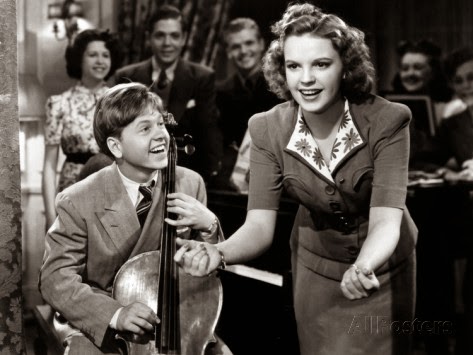
Another movie from when Mickey Rooney was the biggest star in the world is Babes in Arms, from 1939. Anyone who’s seen Babes in Arms knows that in the annals of barking-mad Hollywood musicals, it’s way up there. Rooney is the son of vaudeville troupers. His parents can’t accept that the old circuit is gone for good, and when they decide to stage a comeback, the authorities threaten to send Mickey and costar Judy Garland to a work farm. In the title song — the first big musical number — Busby Berkeley’s camera tracks all the kids as they march through the town and sing. Except these cuties are waving crates and the occasional bit of furniture, and they’re carrying torches to build a bonfire. Douglas MacPhail sings to the tune of “Ride of the Valkyries” while torches wave in the foreground. The kids play on the swingset and the seesaw while the other kids are putting the torch to the bonfire. And Douglas and Mickey and Judy climb a playground slide for the finale, while everybody plays ring-around-the-campfire. It’s a vaudeville Walpurgisnacht.

So when you decide to joke with your pals, “Hey kids! Let’s put on a show!” just remember that Mickey and Judy did that and then they staged a near-riot. This movie is many things. Wholesome isn’t necessarily one of them.

Check out this scene of Mickey and Judy auditioning for a big producer. There’s the way Rooney puts over a big number, and then there’s the way he’s doing “Good Morning” here. A little too bright, overcompensating, to cover up the nerves; it’s the way a newcomer would audition.

Then (sigh) there’s a blackface number, which is grisly, although at least it’s broken up by a thunderstorm. The final number, “God’s Country,” is a sort of MGM Manifesto: “We’ve got no Duce / We’ve got no Fuhrer / But we’ve got Gable / And Norma Shearer.”

The Siren doesn’t know that Rooney ever bothered to analyze exactly what the hell this movie was supposed to be saying, any more than he ever understood why everybody kept bugging him about Mr. Yunioshi. But it’s some kind of crackpot genius, all right, and here’s the thing about Rooney. In the midst of a vaudeville version of May ‘68, and (god help us) a minstrel show, and a closing number about God’s Country, “where every man / is his own dictator,” (what?) five-foot-two-or-three-inch Rooney is seizing that screen every single minute. If that seems no big deal, ponder Ruby Keeler for a minute or two. Nor is Rooney upstaging Garland. They worked together, not in opposition. They were still doing it in Words and Music nine years later.


“Mickey Rooney can act the legs off a centipede.”
— The Sunday Times of London, from a 1939 review of Babes in Arms

Some of Rooney’s best classic-era performances came after World War II, when hard living had given him a face even Mayer couldn’t sell as boyish anymore: Noir Comes to Andy Hardy. There’s Quicksand, with its uncomfortable echoes of Rooney’s real-life character. He’s an auto mechanic, but he’s also a skirt-chaser, and his pursuit of a pretty cashier leads him to one dumb decision after another. (He produced the film with Peter Lorre; they play well together.) Drive a Crooked Road finds Rooney a mechanic again, only this time he’s shy around the ladies and picked on by his coworkers. His yearning for a girlfriend gets him mixed up with a bad dame; those who think of Mickey as a flashy ham will be surprised at how naturally he plays shy and lonely. He’s a convincing psychopath in Don Siegel’s Baby Face Nelson — though, as James MacEachern pointed out earlier this year in a lovely tribute at Bright Lights Film Journal, at the time the movie did badly and Rooney’s reviews were poor. As the loyal pal of Anthony Quinn in the extremely depressing Requiem for a Heavyweight, Rooney was more touching than the ostensible lead. And the Siren adores The Strip, in which Rooney plays a musician sucked into a world of graft by a corrupt bookie. Here’s part of why: Rooney playing drums with Louis Armstrong and Earl “Fatha” Hines. He’s in character, but Rooney’s projecting a character who knows he’s jamming with the best.


Dear Mr. Mayer:
We have read the “God’s Country” Finale (pages 1 through 4) dated July 3, 1939, for your proposed production titled Babes in Arms, and are happy to report that this material comes under the requirements of the Production Code.

However, on Page 3, Mickey used the word “shag.” This should be changed since in England and the British colonies this word has a very objectionable sexual meaning which would cause its deletion by numerous political censor boards. 
You understand, of course, that our final judgment will be based upon the finished picture.
Cordially yours,
Joseph I. Breen
— quoted in The World of Entertainment! by Hugh Fordin

“He was the same off-screen as on, which meant that he made enemies,” wrote David Shipman. Some of them were undoubtedly exes. Rooney was a ravenous womanizer. Envy percolates through the writings of many male film critics when they get to the part where Rooney married 19-year-old Ava Gardner. There was also lovely Martha Vickers, whom Rooney also married; and six other wives and Lana Turner and...the Siren is getting tired, let’s just say it’s a cast list longer than It’s a Mad, Mad, Mad, Mad World. At least the last marriage, to Jan Chamberlin, stuck. He had nine children (eight survive him). By 1962, when he wound up in bankruptcy court for the first time (he’d be back), he’d earned $12 million over the course of his career. That’s about $93 million today.

Rooney, a compulsive gambler, always had big plans. Shipman notes, “When MGM were in difficulty in 1970, according to Variety, he offered to take over the reins, promising to make 20 films for $20 million. The offer was refused.” Kirk Kerkorian had already bought a big stake, attached the MGM name to a casino operation, and the Culver City assets were about to be sold off piece by piece. Rooney was no businessman, he approached things like a movie —an entertaining one, where auctioning everything down to Judy's ruby slippers was no way to end. How much better if in the last reel, the old studio says, “OK Mickey, you crazy kid. Let’s put on a show...”


(Review quotes from David Shipman's The Great Movie Stars; Billy Wilder story from Gavin Lambert's Norma Shearer biography; Ava Gardner quote from Lee Server's bio.)
(Updated 7/13/15; according to film historian Mark Alan Vieira, the only source for Rooney's affair with Norma Shearer was Rooney himself; Vieira says it never happened. So the Siren has redacted that conquest.)

Thứ Tư, 12 tháng 2, 2014

In Memoriam: Shirley Temple, 1928-2014


It was a day that, due to some long-forgotten domestic dust-up, required distraction, and the Siren sat her boy-girl twins in front of the computer and began to frantically search Youtube for something that would quiet them down. Here’s what she found.


The boy soon wandered off to fetch a toy. The girl sat quietly, so quietly that the Siren figured maybe she was too bored to move. When the video ended, Alida slid forward, pointed to one of the other videos on the sidebar and said, “Her. I want to see more of her.”

We watched about a half-dozen more clips.


My daughter still loves Shirley Temple. When the Siren broke the news that 85-year-old Shirley Temple had died, she cushioned the blow by reminding Alida that we still have Adventure in Baltimore to watch on the DVR, and that surely TCM would be running a tribute day (they are, March 9th). At age 10, she’s seen almost as much Temple as the Siren has.

On that first day surfing Youtube, it swiftly became obvious that Alida liked the dance routines with Bill Robinson best, proving she’s the Siren’s daughter all right. Alida was only four; thus the Siren was spared the need to explain that in the 1930s, the only white partner an adult black man was going to get onscreen was a little girl, and even that caused consternation. Also, since we weren’t watching the whole film, the Siren also didn’t have to explain The Little Colonel’s treatment of its black characters, a task that even now could send the Siren to bed with a sick headache.

All the same, their dancing together was, in its way, revolutionary. When the Siren was a kid, Just Around the Corner was one of her favorites. This number still charms — Bert Lahr stretching his mouth out like an animatronic clown, and Robinson charging down that staircase is thrilling. When Robinson and Temple start to dance, their off-camera regard for each other is apparent. There are all kinds of little ways dancers have of giving each other respect. Look at how, at just before the 1:50 mark, the number’s timing goes just the merest hair off, and they steady each other so fast you could miss it, if you haven’t watched Just Around the Corner three dozen times during your childhood.


Temple represented not only FDR’s remark about a baby who could help Americans forget their troubles, but also the movie studios’ banking on wholesomeness once the Production Code came down. Financially, that was an excellent bet; in the years that Shirley Temple was the world’s biggest movie star, the box office recovered from the slump it had endured in the early 1930s. It was a good bet for Temple, too, money-wise. She’s said to have made about $3 million during her years at the top, although a lavish lifestyle and bad investments depleted that nest egg before she had kids of her own.

Temple’s mother was by all accounts the driving force behind her child’s career. Little Shirley’s first films were Baby Burlesks, the misspelled title conveying the nature of the enterprise. Made at Educational Pictures, where Buster Keaton would wash up a few years later, the shorts are relics of another time when putting kids in adult costumes and scenarios was considered cute. Worse than the Burlesks themselves were the techniques, if you can call them that, used to control the tiny players. The parents weren’t allowed on set, and Temple later recalled that if a child misbehaved, she was shut in a windowless room with nothing to sit on but a block of ice.


Once Temple moved on, her mother was a constant presence; Allan Dwan, who directed Temple in Heidi and Rebecca of Sunnybrook Farm, recalled that Gertrude Temple would run lines with the little girl at night. Shirley was always letter-perfect by the time the cameras rolled, ready to prompt with the right line if an adult actor blew his cue. “We hated her for that,” said Alice Faye, co-star in Poor Little Rich Girl. Adolphe Menjou complained that Shirley, age 6, was upstaging him in Little Miss Marker, and she did, although if you’re gonna steal a scene from somebody, Adolphe’s a fine choice of target.

The Siren’s said this before, but give it a rest, please, with the stuff about sublimated sex in Shirley Temple movies. It makes the Siren want to coo, “My goodness, they just can’t slip any subtext past you, you wised-up sophisticated old thing! Next thing you’ll be telling me that war movies are homoerotic and Busby Berkeley’s chorus lines remind you of fascist rallies!” It’s been done.

And Graham Greene offers nothing to explain to anyone why Shirley Temple still has the ability to stop a crabby little girl in her tracks. Admittedly, it’s not necessarily easy from a distance of 80 years for an adult cinephile to figure out what the big deal was. Her early vehicles make Busby Berkeley look like a model of narrative logic. In something like Bright Eyes or Captain January, all you do is watch everybody defer to Temple. Sometimes the Siren can swear the gnashing of adult actors’ teeth is audible on screen, and not just Adolphe Menjou’s.


The appeal lies partly in the mystery of star quality, something Sheila O’Malley describes well: "She was a phenomenal performer. It is impossible, still, to watch her movies and not get sucked into who she is being, what she is bringing to the screen." When the Siren was in acting school, the catchphrase was “give it away.” Temple gave — gives — everything in a scene.

Children learn quickly and painfully that the world does not revolve around them. A kid watching a Shirley Temple movie gets a much sweeter version of life: A little girl who stops the show every time she sings or dances, and when the orchestra lays down its instruments, she runs around straightening out the adults. It was enchanting to the Siren, when she encountered Temple on TV; it shouldn’t have been surprising that Alida, and a very young acquaintance of David Cairns, were also ensnared.

As Temple got older, the musical numbers became less frequent and often less elaborate. But the essential elements are still there. There’s always a little girl facing off against people who are not truly evil, they are just in an extremely bad mood. Shirley knows how to fix that, through the all-conquering might of her childhood pizzazz. After singing and tapping her way through the early Fox musicals, Temple was ready to get a paralyzed child walking again in Heidi and to make a dour farm family sparkle in Rebecca of Sunnybrook Farm. In the wonderful Technicolor The Little Princess, Shirley could even call someone back from the afterlife, as her father (emphatically dead in the Frances Hodgson Burnett novel) reappears in a hospital, a mite banged up by the Boer War but otherwise ready for his closeup.

Is it the least bit surprising that in Wee Willie Winkie (still the Siren’s favorite) Shirley handily solves an Indian diplomatic crisis? No wonder the adult Temple could sail through Czechoslovakia’s Velvet Revolution as the American ambassador.

David Cairns also mentions that Mark Cousins, in his Story of Film, alleges (David's paraphrasing) "that Temple is too performative, not natural enough." The Siren doesn’t understand that at all. Critiquing Shirley Temple for being too performative is like yelling at Lassie for shedding. It’s what she does. How long, oh lord, how long must we suffer the notion that the best acting, child or adult, is always “natural” or “realistic”?


Cousins’ point, however, is an explanation sometimes offered for why Shirley didn’t make it as an adult actress, aside from the fact that she grew up. But the Siren disagrees with those who say Shirley grew into a bad actress. She glows in Since You Went Away, playing a 13-year-old with a crush on (of all God’s earthly people) Monty Woolley. John Ford thought well enough of her, years past Wee Willie Winkie, to give Temple a key role in the magnificent Fort Apache. In The Bachelor and the Bobby Soxer, her comic timing is on a par with that of co-stars Myrna Loy and Cary Grant, and the number of actors who can claim that is vanishingly small.

Temple faced three much bigger factors as she aged (and yes, that’s a mighty strange thing to write about an actress who basically retired when she was 22). The first was poor script quality; Ronald Reagan all but apologized for That Hagen Girl in his autobiography. And that problem probably stemmed from this one: Nobody knew what to do with Temple. She was still lovely, but the movies that made her name were already associated with a vanished time. There was a war on, and then it was over, but people still remembered the Temple of lollipops and animal crackers. Mickey Rooney, one of but a handful of child stars who ever experienced Temple’s level of fame, managed to make some highly credible noirs. When Deanna Durbin tried that in Christmas Holiday, even decent box-office receipts couldn’t persuade anybody that here was her future.

Hence factor number three: On some level Temple, like Durbin, had had enough.


Who can blame her for that? There’s something sad about such professionalism at a young age, the idea of a little girl crying when the director calls “Action,” instead of over spilled ice cream or a playroom squabble. (Dwan said if you wanted Temple to cry, all you had to do was tell her to imagine never seeing her mother again.) But Mrs. Temple, ambitious though she was, somehow kept Shirley grounded. The greatest testimony to that is how the little girl handled adulthood when it finally arrived.

In 1998 Shirley Temple Black, looking gorgeous, was a Kennedy Center honoree. In part one, look at the ovation she gets! The joy, the affection in that audience is glorious. And when every tap-dancing kid in America comes out to perform “The Good Ship Lollipop” in part two, watch for when they cut to her in the balcony — and Shirley Temple Black, almost 70 years old, is singing along and bopping to the music, happy to still be giving happiness. That’s it right there, what made her a star, and why she’ll always be one. Her. I want to see more of her.


Thứ Bảy, 4 tháng 1, 2014

In Memoriam: Juanita Moore, 1914-2014


The clip above is from a so-called soundie, made in 1943 to promote The Mills Brothers’ hit “Paper Doll.” The woman in the lap of the Mills Brother on the far left, best visible at about the one-minute mark, is Juanita Moore. She was 29 years old, and this was the first piece of film that ever captured her. She died Jan. 31, 2014, age 99.

With the exception of the Los Angeles Times and the New York Times, Moore’s obituaries have been a bit light on biographical material, focusing on her Best Supporting Actress nomination for Douglas Sirk's 1959 Imitation of Life. It's the story of two single mothers, Lora Meredith (Lana Turner) and Annie Johnson (Moore) and their daughters. Lora becomes a successful actress as her daughter Susie (Sandra Dee) becomes increasingly lonely. Annie's light-skinned daughter Sarah Jane is determined to "pass" for white; Sarah Jane is played by Susan Kohner, who is now the only one of the film’s central quartet still living. The AP, which has offended in the past, added another to the files with the words chosen to describe this women's picture, widely considered a landmark in the treatment of race on the American screen. “Weeper” — “tearjerker” — the Siren will believe that these descriptions are not evidence of condescending sexism when they are commonly applied to something like Spartacus or The Shawshank Redemption, and not until.

So with facts gleaned primarily from Sam Staggs’ Born to Be Hurt: The Untold Story of Imitation of Life, the Siren would like to fill you in on some of Moore’s life outside her one Oscar-nominated triumph. Anyone who reveres Moore, or this film, needs Staggs' book, which is a monument to loving, obsessive completism. It encompasses everything, from costumer Jean Louis to a detailed view of John Stahl’s 1934 version of Fannie Hurst’s novel, even an interview with the anonymous ghostwriter of Lana Turner’s autobiography. Staggs apparently knew Moore well, and she told him a lot about her background, her friends, her times.

Moore was born in Mississippi, the youngest in a family of seven girls and one boy. Her parents moved when she was a toddler to South Central Los Angeles, where they were able to make a good middle-class living from, among other things, running a laundry. At age 15 Moore came down with polio, and she said later that the doctors of the time were not much interested in treating a black girl. Her mother and sisters massaged her legs with olive oil, and she slowly recovered.

She could sing, and she could dance, and at least one teacher planted the idea that Juanita could grow into an entertainer. She attended performances by the Lafayette Players, a pioneering black theatre ensemble, thrilling to shows such as Madame X and Dr. Jekyll and Mr. Hyde. It was foreshadowing; throughout her life, with one exception, Moore got stronger, bigger roles with African American theater groups than she ever did in Hollywood.

Moore’s parents were religious, and afraid of the lowdown influences of a life in the theater. She ditched a short stint at college and made her way to Harlem, where she wouldn’t have to worry that Mr. and Mrs. Moore were worrying. Soon Moore was in the chorus line at Small’s Paradise, a “black and tan” Harlem club, meaning that while the audience was mostly white, blacks attended and mingled freely.


Moore married dancer Ananias “Nyas” Berry of the Berry brothers, an act that was one of the few rivals to Harold and Fayard Nicholas in terms of grace and acrobatics. (Here they perform “You’ll Never Know” in Lady Be Good; here they introduce Eleanor Powell in Fascinating Rhythm; Nyas is profiled here, and his own story is quite a saga.)

Ella Fitzgerald became a friend, and Moore had run-ins with Ethel Waters. Juanita Moore was notably polite about almost anyone she ever worked with, but Waters she invariably described as “the bitch of all time” — a phrase she once used, Staggs says, in front of a preacher, who spent the rest of the evening snickering about it.

Moore danced at the Zanzibar, atop the Winter Garden on Broadway. The Berry Brothers performed at the West 48th St. location of the segregated Cotton Club. At first the owners would not let Moore sit in the audience and watch her husband dance. Eventually they consented to let her sit at a remote table, by herself. In Imitation of Life, Juanita Moore’s Annie trawls nightclubs in search of her daughter Sarah Jane. In every place, Annie is seated in Siberia, lest she contaminate the white patrons' tables. As Staggs notes, Moore needed no advice on how to play the way that felt.


As the craze for nightclub entertainment waned, Moore went back to Los Angeles and began to get parts in movies. Small parts. Maid parts. She had a relatively substantial part in Affair in Trinidad, and spoke kindly about Glenn Ford and how hard he worked to make her feel comfortable in that Rita Hayworth vehicle. Director Vincent Sherman, in his autobiography, reminisced about “Juanita Hall” — another black actress, most famous for playing Bloody Mary in South Pacific.

Moore was cast in Band of Angels as a slave owner’s mistress; while Yvonne De Carlo played a plantation owner's daughter who’s sold into slavery after his death, because her mother was a black slave. Despite Raoul Walsh at the helm it’s a tedious picture. Moore had to sashay into one scene wearing a Creole getup, and Walsh told her to whisper bawdy stories in De Carlo’s ear. The result was one moment in the film that doesn't feel strained or silly.

Meanwhile, Moore also became involved with the Ebony Showcase Theatre. It was founded by actor Nick Stewart, who took his profits from playing Lightnin’ on the Amos ‘n Andy show, and used them to build his dream of a dedicated, artistic black acting troupe. For the Ebony, Moore played Ines in Sartre’s No Exit, and other roles over the years. Later she became a founding member of the Cambridge Players.

Her marriage to Berry had ended with his death in 1951. One day Moore was crossing the street, and a bus nearly hit her. The bus driver poked his head out to yell, “You better watch your step, young lady!,” and Moore yelled back at him, “You crazy-ass bus driver, what are you trying to do, kill me?”

They were married the next year and stayed together until Charles Burris died in 2001.

Moore took a job as a waitress at a chicken restaurant to make ends meet. One of her regulars was Marlon Brando; he accompanied her to classes at the Actors Laboratory Theatre, where after an all-night shift she once fell asleep and snored so loudly than Elia Kazan yelled “What the hell is that?” Kazan already knew her, from the part she had played in 1949’s Pinky, a story where yet another white actress — Jeanne Crain — played a tragic mulatto. It was something of a motif in Juanita Moore’s career, white actresses playing mixed-race parts, and Moore making a bit role memorable, this time as a nurse.


If you want to hear Juanita Moore sing, watch the clip above, from Women’s Prison in 1955, in which she sounds wonderful while she’s down on her knees, scrubbing the prison floor.


If you want to see Juanita Moore dance, watch Frank Tashlin’s 1956 The Girl Can’t Help It, here, bookmarked just past the 53-minute mark, when she, Tom Ewell and Jayne Mansfield are watching Eddie Cochran on TV. Moore starts dancing, and it’s delightful, and over way too soon, because the film was about Ewell and Mansfield. Moore was playing the maid. (The adorable screen cap above is from Peter Nelhaus' post about the film, which the Tashlin-skeptical Siren admits is quite a bit better than she remembered.)

The Siren well remembers Moore’s bit in Something of Value, a 1957 film about the Mau-Mau uprising in Kenya, where Moore plays a woman who’s beaten until she admits helping the rebels. She was not, on this occasion, anybody’s maid.


Moore was about 45 when Imitation of Life was released (her birth date is a bit fuzzy) and given Hollywood’s unforgiving attitude about women who dare to get older, the film was unlikely to bring her over-the-title stardom in any case. But for a white actor, a performance such as that would surely have brought steady, substantive character work. It worked that way for Thelma Ritter, 45 years old, after one scene in Miracle on 34th Street. It didn’t happen for Moore. Her movie roles after her Oscar nomination were mostly minor, although they did include what’s reportedly a good turn in The Singing Nun (the Siren has never made it through that one). In the theater, she played A Raisin in the Sun in London, and Sister Boxer in James Baldwin’s The Amen Corner on Broadway in 1965. In 1970, Moore played an Annie-esque part in the Mexican production Angelitos Negros, based on a film that may or may not have been a direct spin on the original 1934 Imitation of Life (it's complicated). She spoke the lines in Spanish as much as possible, even though she knew she'd be dubbed.

In the 1970s she made movies like Jules Dassin’s Uptight, and The Mack with Richard Pryor. Still later, a generation that had grown up with Sirk’s movie on TV cast Moore in other roles in films and on TV. She told Staggs of how, on the first day of shooting Paternity, Burt Reynolds took her around the set pointedly introducing her as “Miss Moore. Miss Juanita Moore.” In other words, this is a legend, mind your manners. Moore was deeply touched.

Black folks - like other folks who have felt ignored, underrepresented or stereotyped - have always rooted for the blacks we could find in celluloid. I remember how a showing on TV in the mid-'60s of that 1959 melodrama Imitation of Life ripped like a tornado through our emotions in Conyers, Ga. I couldn't have been older than 12. This melodrama, starring Lana Turner to some but Juanita Moore to us, was about a saintly black woman who worked herself to death for a daughter who chose to pass for white.
-E.R. Shipp, Daily News, 2002

When Richard Pryor was in the army in Germany, according to a 1999 New Yorker profile, he went to a screening of Imitation of Life, and a white soldier laughed loudly at the Annie and Sarah Jane scenes. Pryor and some other black soldiers beat him up. The incident landed Pryor in jail.

It is that kind of movie. Once seen under the right circumstances, it inspires a devotion that will brook no argument. We may disagree about certain elements, about whether the term “camp” applies to elements of the “blonde” storyline, for example. Staggs says yes; the Siren says no, and has written before about the importance of Lana Turner and Sandra Dee’s work. But no fan of this film has any reservations about Moore.


When the Siren first saw Imitation of Life, sometime in her early teens, she was swept away by the unutterable sadness of Annie Johnson, who begins as Lora Meredith’s compatriot in single motherdom, and ends as Lora’s maid. A beloved and respected maid, but a maid nonetheless. All the while Annie adores and tries to protect Sarah Jane, who yearns to escape what she sees as a prison of blackness, and is willing to deny her mother repeatedly to do it. When Sarah Jane is still a little girl played by Karin Dicker, she is caught for the first time passing for white at school. When they return to the apartment, the little girl storms off saying no one is her friend. Lora says, “Don’t worry Annie. I’m sure you’ll be able to explain things to her.” Annie responds, “I don’t know. How do you explain to your child, she was born to be hurt?”

Down the years you develop a relationship with a film you love, and so it has been with the Siren. That line of Moore’s is a killer even on first viewing. But the last time she saw the movie, the Siren was also struck by Moore’s delivery, as she stares after her daughter and seems to speak almost without thinking. There’s an undertone of resignation, a sense that Annie knows she’s telling the truth to someone who does not and can not understand what she means.


Moore’s performance has layers upon layers, right from the great opening, when Sarah Jane and Lora’s daughter Susie are playing on the beach, Lora mistakes Sarah Jane for Annie’s charge, and Annie corrects her: “Yes, ma'am. It surprises most people. Sarah Jane favors her daddy. He was practically white. He left before she was born.” Again, watch Moore’s face as she says that. Annie’s deeply religious, but in the sly light in her eyes is the idea that Sarah Jane’s father was a handsome man, that this was a torrid relationship and Annie remembers that pleasure even now that he’s left her. This is a vibrant, fully sexual woman, though we never see anyone in the picture treat her that way. The closest anyone comes is when Sandra Dee’s Susie asks Annie about “boys. What do you think about kissing, Annie?” Annie responds with “Well, there’s kissing, and there’s kissing,” and again we see the remembrance of love move across her features.

There are many instances where Sirk’s camera, and Moore’s performance, clue us in to the fact that Annie has large parts of her existence that are out of camera range, and thus well away from the white characters and us, the audience. She tries to convince Sarah Jane to go to a church social, telling her that there are plenty of nice boys there, and Sarah Jane snaps back, “Busboys, cooks, chaffeurs.” Annie's hurt tells you that her daughter is rejecting the place that her life revolves around; a black church, full of people she loves, where Annie is herself in a way that she isn’t in the Meredith house.

The final proof of that comes in Annie’s deathbed scene. A heartbroken Lora says to the woman who’s shared her life, “It never occurred to me that you had friends.” And Annie responds, without a trace of rancor, “You never asked.” In that single line reside generations of “the help” who kept their most important selves apart from their employers.

Douglas Sirk’s Imitation of Life, and his other great movies, tell us that when people are forced, against their character and inclination, into prefab roles that society has made for them, the result is agony. Juanita Moore’s career was shaped by forces that had nothing to do with her talent. She had a personality that struck people as nothing much like Annie’s. Staggs says Moore was “a real live wire,” with flashes of anger as well as salty humor. Moore told Staggs she had based Annie on one of her sisters, a devout woman who was the embodiment of Christian goodness.


Yet Annie, despite her suffering, is not passive; warmth and kindness are active choices, all the more so when made under harsh circumstances. Juanita Moore, who left behind friends, family, and millions of admirers, had more of Annie in her than she acknowledged.

(Corrected 3/25/14 for date of death and an error regarding whether Moore had children; she did not.)