Thứ Sáu, 27 tháng 1, 2006


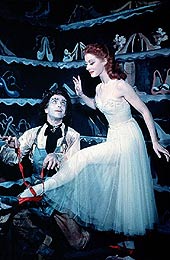
Post about her birthday, then drop out of sight ... such was not the Siren's intention. She actually had a very nice birthday, involving a lavish dinner and a present of tickets to a Wagner opera for this week. I hope that fellow redhead Moira Shearer, another Jan. 17 baby, had as lovely a time. Part Two of my Luise Rainer disquisition is almost done but has turned out to be a lot more work than I had anticipated. I hope to have it posted this weekend. Meanwhile, this beautiful still prompts me to wonder about all the many ballerinas who claim The Red Shoes sparked their desire to dance. Considering the movie's tragic ending, isn't that just a wee bit odd?

Chủ Nhật, 15 tháng 1, 2006

Shelley Winters, 1920-2006

My idea of a movie star is Joan Crawford, who can chew
up two directors and three producers before lunch.
--Shelley Winters


The best tribute the Siren can offer Shelley Winters is this: She was an utterly fearless actress. "Never underestimate the insecurity of a star," wrote William Goldman. And there you have, probably, why Winters never attained star status. She didn't care about the kind of gilded image a true star cherishes. She was willing to play homely, desperate, grasping, foolish, irritating. They tried to turn her into a glamor girl, and she didn't give a damn. She wanted to act.

Who the hell hasn't Shelley Winters slept with?
--Bette Davis, upon reading
Shelley

Late in life the fame of Winters, who died Jan. 14 age 85, rested on her girth and her celebrated love life. That, and her role in The Poseidon Adventure, where her touching, albeit oft-parodied, performance seemed the only one grounded in any recognizable form of reality.

The string of lovers contrasts with her best roles, in A Place in the Sun, The Night of the Hunter and Lolita. In all three movies, Shelley's character spends a too-short life pathetically yearning for love--and, having chosen a spectacularly unsuitable object for her affections, the woman dies for her pains. As often noted, Winters got murdered quite a lot. At other times she played baldly unsympathetic parts with gusto, including Oscar-winning turns as the horrific mother in A Patch of Blue and as Mrs. Van Daan in The Diary of Anne Frank.

I saw Shelley Winters in A Place in the Sun. She gave a very moving performance, which surprised me, because Shelley is not a sensitive girl socially.
--Joan Crawford


Shelley's dedication to Method acting was such that others sometimes wondered if she went too far. Montgomery Clift reportedly thought her pathetic turn as Alice in A Place in the Sun became annoying. He was right, and it helps the movie. Not many other 1950s blondes would have gone mouse-brown and let the desperation show so nakedly that the audience wants Clift to escape almost as much as he does. Good as she was, it is hard to imagine that from Gloria Grahame, who was up for the role.

The most famous shot of Winters from Night of the Hunter was actually a wax dummy filmed underwater. But the Siren's favorite moment is Winters as she shrinks back from Robert Mitchum after being told her sexual desire is disgusting. After this rejection, as brutal as any blow, her expression of beatific resignation forms a terrifying image of a personality being erased.


For me, her greatest accomplishment is Charlotte Haze in Lolita. Every camera angle in that movie makes it obvious that the ever-icy Stanley Kubrick feels no more compassion for Charlotte than Humbert does. She's presented as blubbery, ridiculous, her middle-aged face cruelly contrasted with Sue Lyon's dewy features. And she still grabs our sympathy, because Winters doesn't condescend to Charlotte, even if Kubrick does. Her expression when confronted with Humbert's treachery is the most tragic moment in the movie.

As the last of the Golden Age dies off, we often mourn the loss of its beauty and style. This morning, without Winters, movie acting seems just a little less bold, too.

Thứ Tư, 11 tháng 1, 2006

Snubbing the Showgirls

The Siren apologizes for her overlong absence. She was editing a physics monograph for a relative. No, she is not kidding. Her brain hurts.

But it seems she has arrived back just in the nick of time, for a group of film bloggers, including Siren faves Flickhead, Girish and Peter, have banded together in an attempt to resurrect the reputation of Paul Verhoeven's Showgirls--or, failing that, at least to discuss it with a straight face.


The Siren would never suggest that scenes such as the one above have muddied their usual sparkling thought processes. But she is still a bit worried. Hold the line while the Siren dabs her cyberfriends' foreheads with a lace handkerchief. Here, gentlemen, please borrow my marabou-trimmed fan for a moment. Pass it to Jacques Rivette when you are done. Breathe gently and evenly, and listen to the Siren.

The movie is a walking, pecking, flying, gobble-gobbling, ready-for-its-bourbon-bottle-closeup turkey. Sure, it has a certain '90s social relevance. So does "Veronica's Closet."

Douglas Sirk's movies smuggled a lot of subversive messages, but they were, even on the surface plot level, about serious subjects. Racism in Imitation of Life. The arrogance of the rich in Magnificent Obsession. Impotence, alcoholism and general family dysfunction in Written on the Wind. The petty constraints of bourgeois society in All That Heaven Allows.

What, exactly, is the serious subject matter of Showgirls? All that glitters is not gold? Except it is. There is no implicit critique of Vegas, the movie is celebrating--hell, wallowing--in it. Watch the camera linger lovingly on Nomi's every acquisition. See it sweep through the Haute Hick interiors as though doing an appraisal for tax purposes. And if the movie is anti-erotic, that is due to ineptitude, not deliberate distancing.

The acting is just atrocious. Elizabeth Berkley, moving her mouth as though the lip gloss is a surgical dressing she dare not disturb. Gina Gershon, sporting a "Texas" accent that even George Bush Sr. would deride as phony. Kyle MacLachlan, so obviously phoning it in he should have pinned his salary check to his shoulder.

And the dialogue. Sweet St. Francis of Assisi, the dialogue.

Cristal Connors: I've had dog food.
Nomi Malone: You have?
Cristal Connors: Mmm-hmmm. Long time ago. Doggy Chow. I used to love Doggy Chow.
Nomi Malone: I used to love Doggy Chow, too!

Joe Eszterhas shopped the script around Hollywood for years, it was his pet. The Siren remembers the pre-release publicity for this movie, before everyone realized it would bomb. The lure was that it was made for adults, supposedly very frank and open about its eroticism. During filming the screenwriter went nuts if anyone tampered with the dialogue. So if, when Gershon tells Berkley, "I like nice tits," Berkley wanted to reply "I like possessing nice tits" instead of "I like having nice tits," that was verboten, because you don't want to rough up the meter when dealing with poetry like that.

And the rape scene also tells you that these guys were serious, that was there was no winking at the audience. This was an exploitation flick gone horribly wrong and way over-budget. It has some value as camp, but that's it.

Gentlemen, the Siren usually worships your taste, but de gustibus non est disputandum and all that sort of thing. She sincerely hopes you do not mind this energetic dissent.

And now she is signing off...to watch a Douglas Sirk movie.

Before she does, the Siren sets aside her smelling salts to give you an updated list of the many hardy (lost?) souls participating in International Showgirls Day, commemorating the 10th anniversary of the film's European release.

UPDATE: The SHOWGIRLS BLOG ORGY includes, in alphabetical order:
Thứ Sáu, 30 tháng 12, 2005

Oh Kay

The Siren loves to discover a kindred spirit, especially in the person of an august critic who doesn't know she's alive.

"My familiarity with the film work of Kay Francis [is] intimate ...


...my appreciation for the screen choreography of Robert Alton unbounded..."


The gentleman's post mentions Francis & Alton only in passing, as he was settling a score with another site. All the same, bless James Wolcott's heart. Alton will be remembered as long as holidays bring scheduled screenings of White Christmas and Easter Parade (the still is from Ann Miller's dazzling "Shaking the Blues Away" number). But few recall Kay Francis, except for her role in the incomparable Trouble in Paradise. That's a shame.

Kay was gorgeous, looked amazing in evening gowns, gave some good performances on the rare occasions that she got a decent script, and had the most alluring lisp in film history, Bogart notwithstanding. She also seems to have been a laid-back, good-natured sort of star, as rare then as it is now. But how intimate is intimate? Did Mr. Wolcott make it all the way through The White Sister? No matter. If he ever blogs about the four-hanky chick flick supreme, One-Way Passage, the Siren swears she will send him a fan letter.

Thứ Năm, 22 tháng 12, 2005

The Marx Brothers Sum Up Christmas, Cheer Up Siren


Fiorello: What does this say here? This thing here.

Otis P. Driftwood: Oh, that? Oh, that's the usual clause. That's in every contract. That just says uh, it says uh, "If any of the parties participating in this contract is shown not to be in their right mind, the entire agreement is automatically nullified."

Fiorello: Well, I don't know...

Driftwood: It's all right, that's, that's in every contract. That's, that's what they call a "sanity clause."

Fiorello: Ha ha ha ha ha! You can't fool me. There ain't no Sanity Claus. Posted by Picasa

Thứ Sáu, 16 tháng 12, 2005


This still from Meet Me in St. Louis comes from the moments after "Have Yourself a Merry Little Christmas." Margaret O'Brien has just taken a shovel and gone after the snow family on the front lawn. This still has lousy color, for which I apologize. Judy's dress in the scene is red, and a gorgeous red at that. Posted by Picasa

Christmas Lurks Without

So the Siren has had a grumpy week. Toddlers with cabin fever and a whacking huge snowstorm have combined to make her far from her usual soignée and carefree self. Over the horizon looms Christmas. Seen from nine days away, sometimes Christmas seems joyous and glittering, like the winter ball in Doctor Zhivago. At other times it seems that, like the Czar's soldiers amassing outside the Moscow mansions, Christmas is waiting for a chance to trample me.

Christmas at the movies is usually a jolly affair. Deck them halls and all that stuff, ho-ho-ho and misteltoe and presents to pretty girls. Even if a Christmas scene starts out sad, few filmmakers can resist the urge to make it uplifting at the end. The Siren has been trying to compile a list of movies that manage to show the dark side of Christmas. Here is what she has so far.

1. Citizen Kane. The boy Kane throws the sled, Rosebud, at Walter Thatcher, the guardian who has come to take him away. Maybe the scene takes place on Christmas, maybe it doesn't; the Siren always believed it took place a day or two after Christmas, and that Rosebud was young Kane's favorite present. The next scene shows Kane unwrapping a replacement sled, and obviously hating it. Flash forward to another Christmas--and Thatcher wishing the now-adult Kane "a happy New Year." The whole sequence is achingly sad, and builds sympathy for Kane by showing his loneliness and isolation. And at least a kernel of that feeling stays throughout the movie, even as Kane becomes less and less loveable. Like no other, this film nails how disappointing and hollow Christmas can be--yet another reason to admire Citizen Kane, if any of us needed one.

2. Stalingrad. The title may be description enough, but the scene the Siren has in mind is a moment of quiet in this bloody, chaotic movie. Having taken a gutted factory with fearful loss of life, a group of German soldiers takes a break from fighting. They huddle around the radio, listening to the Fuhrer's Christmas speech. Hearing Hitler address his nation in an ordinary, conversational tone is almost shocking. Usually when you hear recordings of the man, he is shrieking at the top of his lungs and working his audience into a frenzy. Here, the exhausted soldiers listen to the radio with expressions ranging from numbed apathy to bitter disbelief.

2. Meet Me in St. Louis. Every doggone Christmas-song-video-clip-anthology in creation shows the scene from this movie where Judy Garland, looking more beautiful than she ever had or ever would again, sings "Have Yourself a Merry Little Christmas" to a tearstained Margaret O'Brien. When it's sandwiched between Bing's duet with David Bowie and a clip of Bruce Springsteen singing "Santa Claus is Coming to Town," you can forget how depressing the scene is. And that is even after song was altered before filming to make it a little less misery-inducing. The original lyrics began, "Have yourself a merry little Christmas, it may be your last ..." Break out the eggnog.

At this point in the plot, the Smith family is about to leave their beloved Saint Louis for (horrors!) New York. O'Brien, playing the child Tootie, listens to Judy's song looking as though someone just killed her dog. In fact, Vincente Minnelli, at the behest of the child's mother, had just told her a story about her dog getting shot, bleeding, stumbling around and then dying in order to get a properly devastated expression. (In his autobiography he said he felt like a monster, but added by way of justification that he got the scene in one take.) Everyone talks about the pathos of Judy's singing, but do you remember how well it goes down with Tootie? The kid is so cheered up that she runs out and beheads all the family snowmen. Sure, then the father notices Tootie is having a nervous breakdown and decides to let the family stay in St. Louis, but the scene usually requires a stiff drink and a great deal of Kleenex for the Siren to make it through.

I'm leaving out It's a Wonderful Life because I am on Wonderful Life hiatus, in hopes I will one day be able to watch it without remembering all the stupid commercials it's spawned. Besides, I am not sure it counts. Certainly there is some dark stuff, in the "life without George" sequence, but it's all just an illusion. The real world, according to Frank Capra, is the one where everybody shows up at your house and showers you with money. No wonder the man's films remain so popular.

So, what scenes am I forgetting? There must be others. What other films try to bury Christmas with a stake of holly through its heart? Preference is given to films where the absent father/Santa Claus/milk train/transformed Scrooge does not show up to make it all better.