Hiển thị các bài đăng có nhãn in memoriam. Hiển thị tất cả bài đăng

Thứ Năm, 12 tháng 6, 2014

In Memoriam: Ruby Dee, 1922-2014


She signed on even though she would not have the ingenue role of Walter Lee's sister that she desired; Diana Sands got the part, while Claudia McNeil portrayed his mother. Instead, Ms. Dee would play his wife, Ruth: "Another one of those put-upon wives. And they always seemed to be named Ruth!'' But, she added: ''I dusted off my disappointment. This was very important. It was going to be a Broadway show.''
— Michael Anderson talks to Ruby Dee about the original 1959 Broadway production of A Raisin in the Sun, New York Times, March 7, 1999


Dee made her film debut with [Ossie] Davis in No Way Out in 1950 and the same year played baseball player Jackie Robinson’s wife in The Jackie Robinson Story. She was the good, uncomplaining wife to Sidney Poitier again in Edge of the City and to Nat King Cole as W.C. Handy in St. Louis Blues (1958). She was cast in this kind of role so often that she was dubbed the “Negro June Allyson,” after a contemporary white film star who played similar “good girl” parts.
African Americans in the Performing Arts, by Steve Otfinoski. Above, Dee with Nat King Cole.


"Freedom isn't a thing you should be able to give me, Miss Ginny. Freedom is something I should have been born with."
— Ruby Dee in The Tall Target (1951)


"I usually played good-girl wives and mothers. And truthfully those good-girl roles were stretches."
— Ruby Dee in Backstage, March 9, 2001, explaining why she liked her roles in The Balcony and as Mary Tyrone in Long Day’s Journey Into Night


"The thing that fascinated me about her and her work was that in the really dramatic moments, it was as if her body had difficulty containing the emotions. That's the best compliment I could pay anybody who worked at this craft. We all hit a point in life at which we are unable to hide what we feel: Those emotions have either gotten away or are about to get away. Well, with her, she had control, but it was as if the control existed at the very edge of chaos. That's Ruby Dee."
— Sidney Poitier, who directed Dee in Buck and the Preacher; quoted in the Hollywood Reporter in 2001. Above, Dee with John Cassavetes and Kathleen Maguire in Edge of the City (1957), in which she played opposite Poitier.


"Dear Ossie, When I think of you, let there be silence and no writing at all. Ruby."
— Inscription on a photo she gave him during their courtship; they married in 1948


“In doing it our way, we didn’t have to sell more of ourselves than we could get back before the sun went down.”
— Ossie Davis on a lifetime’s shared career with Ruby Dee. Above, Martin Luther King Jr. visits the set of the stage production of Purlie Victorious, 1961.


“We've got to trust it and go wherever it takes us. Especially women. We women have a great function to perform. The world needs us. Feminine sensibilities are not being acknowledged, and we've allowed the anti-people to steal the children and are tolerating far too much: the assault on ourselves, the families of the world, permitting war and rape. More women are becoming enraged about these things and I think we're on the verge of doing something about them... We have to bring forward the graces in life and make them real. We have to institute democracy, which is still mostly an aspiration, and universal love, which is still unrealized. I dream of getting prisons off the stock exchange. It is a dastardly crime and an insult to the word democracy to make a commodity of jailing people.”
— Interview with Essence magazine in 2005, shortly after Davis’ death. Above, a protest over the shooting death of Amadou Diallo, 1999; Dee is in the lower right-hand corner. She and Davis were arrested that day.


"Cremation after a public ceremony, and then into an urn. A special urn, large enough and comfortable enough to hold both our ashes. Whoever goes first will wait for the other. When we are united at last, we want the family to say goodbye and seal the urn forever. Then on the side, in letters not too bold — but not too modest either — we want the following inscription: 'Ruby and Ossie — In This Thing Together.'"
— from In This Life Together, by Ossie Davis and Ruby Dee


“We keep going upward. But the ascent is jagged. Up a little, then back, then up some more. But, all in all, upward. We're going to come into our glory as a species. When someone challenges my optimism, I remember a line from Lorraine Hansberry, I think it's from her play The Sign in Sidney Brustein's Window. It goes, 'Why do you despairing ones think that only you know the truth?' ”
— from a 1996 interview with Joe Adcock in the Seattle Post-Intelligencer

Thứ Hai, 7 tháng 4, 2014

In Memoriam: Mickey Rooney, 1920-2014


Roll out the red carpet, folks, and stand by. That boy is here again, the Pied Piper of the box office, the eighth or ninth wonder of the world, the kid himself — in short, Mickey Rooney.
— The New York Times reviews Strike Up the Band (1940)

Few terms are crueler than has-been. A has-been is Norma Desmond rattling around an empty mansion. Avoiding strong light like a vampire, bitterly dishing old enemies to skeptical interviewers. So focused on looking back that you never move forward.

Mickey Rooney was never a true has-been in his life, not with 90 years of work. Shorts and features, A pictures and B pictures, star turns and character parts. Social dramas, musicals, an impressive run of noirs, comedies, Emmy awards, sitcoms, a hit Broadway show. The Siren spotted him in The Muppets in 2011 and heard a college-age woman whisper to her companion, “Mickey Rooney.” If that’s has-been-dom, sign up the Siren.

Good script or bad, Rooney simply did not know how to approach his work any way other than full-out. You can find him in roles that sank into self-parody, things he probably took because he needed the money (let’s hope that’s how he wound up narrating Hollywood Blue). But phoning it in? Never happened.

Yes, Mickey Rooney was known for reminding people that he was once the biggest star in the world. That’s because he was once the biggest star in the world. It’s not like he spent decades dining out on how he scored the winning touchdown for Dead Skunk State College. That's why Dana Carvey’s exasperated tale of working with Rooney winds up adorable. Rooney was at once easy fodder for a dead-on impression, and inimitable.


He was one of the last remaining stars who started in silent movies; the Siren admits to being too depressed to look up who’s left. Rooney made his first indelible mark as Puck in Max Reinhardt’s production of A Midsummer Night’s Dream, both on stage and on screen. In the movie he was about 15 years old, and so good as to be almost freakish. This is not a normal kid. That laugh is positively sinister. It originates somewhere under the loincloth, rolls up past the collarbone and sprays out like a firehose. It’s not his eyes that sparkle, it’s those teeth. Any minute you feel this Puck may attach himself to someone’s ankle, terrier-style. Rooney is all the amoral mischief of childhood rolled up into one half-naked package.
"Don't let the little guy fool you. He knows every trick in the book."
— First wife Ava Gardner
You can see the prototype of a certain Rooney character in Manhattan Melodrama (1934), where he plays the young Clark Gable (!!), caught up in the 1904 tragedy of the General Slocum. It’s all there: the swagger, the loyalty, the tough cookie determined not to crumble, though he’s just a kid. Once the template was struck, Rooney could ring any number of changes on it, such as in Boys Town, where he’s an obnoxious delinquent, and a sobbing mixed-up kid, and stitches it together with moments of real heart.


“You’re Andy Hardy! You’re the United States! You’re a symbol! Behave yourself!”
— Billy Wilder, working at MGM on the script for Ninotchka, hears a commotion, rolls down his office window and spies Louis B. Mayer having a little man-to-man chat with his biggest star. Said chat, according to Wilder, involved Mayer seizing Rooney by the shoulders and shouting in his face.

There’s a TCM interview clip with the late Ann Rutherford where she discusses the Andy Hardy movies. There were 16 total, and Rutherford made 12 of those as Polly Benedict, the wholesome girlfriend Andy was supposed to make up with by the last reel, even if Lana Turner had been the alternative. Rutherford says the movies hold up pretty well, save the dread moment when Rooney would turn to Lewis Stone as Judge Hardy and say “Pop, can I talk to you, man-to-man?” The Andy Hardy films have a sweetness and funniness to them that still plays. But even at the time, they were like newsreels shot live on the scene of America’s fantasy life. Rooney's last Hardy movie was a 1958 revival that flopped; now, TV was in charge of idealizing the American home.

Rooney made some excellent movies during his years at the top of MGM. One of the best, The Human Comedy, had Rooney tender and gentle in his wartime role as a boy who delivers the last thing any soldier’s mother wants: telegrams.


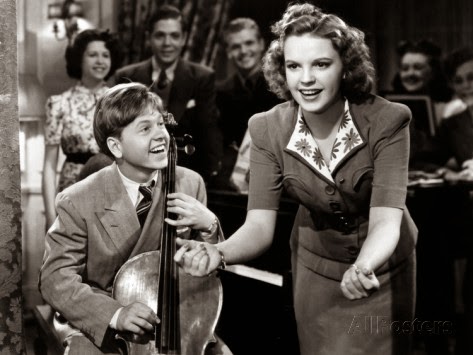
Another movie from when Mickey Rooney was the biggest star in the world is Babes in Arms, from 1939. Anyone who’s seen Babes in Arms knows that in the annals of barking-mad Hollywood musicals, it’s way up there. Rooney is the son of vaudeville troupers. His parents can’t accept that the old circuit is gone for good, and when they decide to stage a comeback, the authorities threaten to send Mickey and costar Judy Garland to a work farm. In the title song — the first big musical number — Busby Berkeley’s camera tracks all the kids as they march through the town and sing. Except these cuties are waving crates and the occasional bit of furniture, and they’re carrying torches to build a bonfire. Douglas MacPhail sings to the tune of “Ride of the Valkyries” while torches wave in the foreground. The kids play on the swingset and the seesaw while the other kids are putting the torch to the bonfire. And Douglas and Mickey and Judy climb a playground slide for the finale, while everybody plays ring-around-the-campfire. It’s a vaudeville Walpurgisnacht.

So when you decide to joke with your pals, “Hey kids! Let’s put on a show!” just remember that Mickey and Judy did that and then they staged a near-riot. This movie is many things. Wholesome isn’t necessarily one of them.

Check out this scene of Mickey and Judy auditioning for a big producer. There’s the way Rooney puts over a big number, and then there’s the way he’s doing “Good Morning” here. A little too bright, overcompensating, to cover up the nerves; it’s the way a newcomer would audition.

Then (sigh) there’s a blackface number, which is grisly, although at least it’s broken up by a thunderstorm. The final number, “God’s Country,” is a sort of MGM Manifesto: “We’ve got no Duce / We’ve got no Fuhrer / But we’ve got Gable / And Norma Shearer.”

The Siren doesn’t know that Rooney ever bothered to analyze exactly what the hell this movie was supposed to be saying, any more than he ever understood why everybody kept bugging him about Mr. Yunioshi. But it’s some kind of crackpot genius, all right, and here’s the thing about Rooney. In the midst of a vaudeville version of May ‘68, and (god help us) a minstrel show, and a closing number about God’s Country, “where every man / is his own dictator,” (what?) five-foot-two-or-three-inch Rooney is seizing that screen every single minute. If that seems no big deal, ponder Ruby Keeler for a minute or two. Nor is Rooney upstaging Garland. They worked together, not in opposition. They were still doing it in Words and Music nine years later.


“Mickey Rooney can act the legs off a centipede.”
— The Sunday Times of London, from a 1939 review of Babes in Arms

Some of Rooney’s best classic-era performances came after World War II, when hard living had given him a face even Mayer couldn’t sell as boyish anymore: Noir Comes to Andy Hardy. There’s Quicksand, with its uncomfortable echoes of Rooney’s real-life character. He’s an auto mechanic, but he’s also a skirt-chaser, and his pursuit of a pretty cashier leads him to one dumb decision after another. (He produced the film with Peter Lorre; they play well together.) Drive a Crooked Road finds Rooney a mechanic again, only this time he’s shy around the ladies and picked on by his coworkers. His yearning for a girlfriend gets him mixed up with a bad dame; those who think of Mickey as a flashy ham will be surprised at how naturally he plays shy and lonely. He’s a convincing psychopath in Don Siegel’s Baby Face Nelson — though, as James MacEachern pointed out earlier this year in a lovely tribute at Bright Lights Film Journal, at the time the movie did badly and Rooney’s reviews were poor. As the loyal pal of Anthony Quinn in the extremely depressing Requiem for a Heavyweight, Rooney was more touching than the ostensible lead. And the Siren adores The Strip, in which Rooney plays a musician sucked into a world of graft by a corrupt bookie. Here’s part of why: Rooney playing drums with Louis Armstrong and Earl “Fatha” Hines. He’s in character, but Rooney’s projecting a character who knows he’s jamming with the best.


Dear Mr. Mayer:
We have read the “God’s Country” Finale (pages 1 through 4) dated July 3, 1939, for your proposed production titled Babes in Arms, and are happy to report that this material comes under the requirements of the Production Code.

However, on Page 3, Mickey used the word “shag.” This should be changed since in England and the British colonies this word has a very objectionable sexual meaning which would cause its deletion by numerous political censor boards. 
You understand, of course, that our final judgment will be based upon the finished picture.
Cordially yours,
Joseph I. Breen
— quoted in The World of Entertainment! by Hugh Fordin

“He was the same off-screen as on, which meant that he made enemies,” wrote David Shipman. Some of them were undoubtedly exes. Rooney was a ravenous womanizer. Envy percolates through the writings of many male film critics when they get to the part where Rooney married 19-year-old Ava Gardner. There was also lovely Martha Vickers, whom Rooney also married; and six other wives and Lana Turner and...the Siren is getting tired, let’s just say it’s a cast list longer than It’s a Mad, Mad, Mad, Mad World. At least the last marriage, to Jan Chamberlin, stuck. He had nine children (eight survive him). By 1962, when he wound up in bankruptcy court for the first time (he’d be back), he’d earned $12 million over the course of his career. That’s about $93 million today.

Rooney, a compulsive gambler, always had big plans. Shipman notes, “When MGM were in difficulty in 1970, according to Variety, he offered to take over the reins, promising to make 20 films for $20 million. The offer was refused.” Kirk Kerkorian had already bought a big stake, attached the MGM name to a casino operation, and the Culver City assets were about to be sold off piece by piece. Rooney was no businessman, he approached things like a movie —an entertaining one, where auctioning everything down to Judy's ruby slippers was no way to end. How much better if in the last reel, the old studio says, “OK Mickey, you crazy kid. Let’s put on a show...”


(Review quotes from David Shipman's The Great Movie Stars; Billy Wilder story from Gavin Lambert's Norma Shearer biography; Ava Gardner quote from Lee Server's bio.)
(Updated 7/13/15; according to film historian Mark Alan Vieira, the only source for Rooney's affair with Norma Shearer was Rooney himself; Vieira says it never happened. So the Siren has redacted that conquest.)

Thứ Tư, 12 tháng 2, 2014

In Memoriam: Shirley Temple, 1928-2014


It was a day that, due to some long-forgotten domestic dust-up, required distraction, and the Siren sat her boy-girl twins in front of the computer and began to frantically search Youtube for something that would quiet them down. Here’s what she found.


The boy soon wandered off to fetch a toy. The girl sat quietly, so quietly that the Siren figured maybe she was too bored to move. When the video ended, Alida slid forward, pointed to one of the other videos on the sidebar and said, “Her. I want to see more of her.”

We watched about a half-dozen more clips.


My daughter still loves Shirley Temple. When the Siren broke the news that 85-year-old Shirley Temple had died, she cushioned the blow by reminding Alida that we still have Adventure in Baltimore to watch on the DVR, and that surely TCM would be running a tribute day (they are, March 9th). At age 10, she’s seen almost as much Temple as the Siren has.

On that first day surfing Youtube, it swiftly became obvious that Alida liked the dance routines with Bill Robinson best, proving she’s the Siren’s daughter all right. Alida was only four; thus the Siren was spared the need to explain that in the 1930s, the only white partner an adult black man was going to get onscreen was a little girl, and even that caused consternation. Also, since we weren’t watching the whole film, the Siren also didn’t have to explain The Little Colonel’s treatment of its black characters, a task that even now could send the Siren to bed with a sick headache.

All the same, their dancing together was, in its way, revolutionary. When the Siren was a kid, Just Around the Corner was one of her favorites. This number still charms — Bert Lahr stretching his mouth out like an animatronic clown, and Robinson charging down that staircase is thrilling. When Robinson and Temple start to dance, their off-camera regard for each other is apparent. There are all kinds of little ways dancers have of giving each other respect. Look at how, at just before the 1:50 mark, the number’s timing goes just the merest hair off, and they steady each other so fast you could miss it, if you haven’t watched Just Around the Corner three dozen times during your childhood.


Temple represented not only FDR’s remark about a baby who could help Americans forget their troubles, but also the movie studios’ banking on wholesomeness once the Production Code came down. Financially, that was an excellent bet; in the years that Shirley Temple was the world’s biggest movie star, the box office recovered from the slump it had endured in the early 1930s. It was a good bet for Temple, too, money-wise. She’s said to have made about $3 million during her years at the top, although a lavish lifestyle and bad investments depleted that nest egg before she had kids of her own.

Temple’s mother was by all accounts the driving force behind her child’s career. Little Shirley’s first films were Baby Burlesks, the misspelled title conveying the nature of the enterprise. Made at Educational Pictures, where Buster Keaton would wash up a few years later, the shorts are relics of another time when putting kids in adult costumes and scenarios was considered cute. Worse than the Burlesks themselves were the techniques, if you can call them that, used to control the tiny players. The parents weren’t allowed on set, and Temple later recalled that if a child misbehaved, she was shut in a windowless room with nothing to sit on but a block of ice.


Once Temple moved on, her mother was a constant presence; Allan Dwan, who directed Temple in Heidi and Rebecca of Sunnybrook Farm, recalled that Gertrude Temple would run lines with the little girl at night. Shirley was always letter-perfect by the time the cameras rolled, ready to prompt with the right line if an adult actor blew his cue. “We hated her for that,” said Alice Faye, co-star in Poor Little Rich Girl. Adolphe Menjou complained that Shirley, age 6, was upstaging him in Little Miss Marker, and she did, although if you’re gonna steal a scene from somebody, Adolphe’s a fine choice of target.

The Siren’s said this before, but give it a rest, please, with the stuff about sublimated sex in Shirley Temple movies. It makes the Siren want to coo, “My goodness, they just can’t slip any subtext past you, you wised-up sophisticated old thing! Next thing you’ll be telling me that war movies are homoerotic and Busby Berkeley’s chorus lines remind you of fascist rallies!” It’s been done.

And Graham Greene offers nothing to explain to anyone why Shirley Temple still has the ability to stop a crabby little girl in her tracks. Admittedly, it’s not necessarily easy from a distance of 80 years for an adult cinephile to figure out what the big deal was. Her early vehicles make Busby Berkeley look like a model of narrative logic. In something like Bright Eyes or Captain January, all you do is watch everybody defer to Temple. Sometimes the Siren can swear the gnashing of adult actors’ teeth is audible on screen, and not just Adolphe Menjou’s.


The appeal lies partly in the mystery of star quality, something Sheila O’Malley describes well: "She was a phenomenal performer. It is impossible, still, to watch her movies and not get sucked into who she is being, what she is bringing to the screen." When the Siren was in acting school, the catchphrase was “give it away.” Temple gave — gives — everything in a scene.

Children learn quickly and painfully that the world does not revolve around them. A kid watching a Shirley Temple movie gets a much sweeter version of life: A little girl who stops the show every time she sings or dances, and when the orchestra lays down its instruments, she runs around straightening out the adults. It was enchanting to the Siren, when she encountered Temple on TV; it shouldn’t have been surprising that Alida, and a very young acquaintance of David Cairns, were also ensnared.

As Temple got older, the musical numbers became less frequent and often less elaborate. But the essential elements are still there. There’s always a little girl facing off against people who are not truly evil, they are just in an extremely bad mood. Shirley knows how to fix that, through the all-conquering might of her childhood pizzazz. After singing and tapping her way through the early Fox musicals, Temple was ready to get a paralyzed child walking again in Heidi and to make a dour farm family sparkle in Rebecca of Sunnybrook Farm. In the wonderful Technicolor The Little Princess, Shirley could even call someone back from the afterlife, as her father (emphatically dead in the Frances Hodgson Burnett novel) reappears in a hospital, a mite banged up by the Boer War but otherwise ready for his closeup.

Is it the least bit surprising that in Wee Willie Winkie (still the Siren’s favorite) Shirley handily solves an Indian diplomatic crisis? No wonder the adult Temple could sail through Czechoslovakia’s Velvet Revolution as the American ambassador.

David Cairns also mentions that Mark Cousins, in his Story of Film, alleges (David's paraphrasing) "that Temple is too performative, not natural enough." The Siren doesn’t understand that at all. Critiquing Shirley Temple for being too performative is like yelling at Lassie for shedding. It’s what she does. How long, oh lord, how long must we suffer the notion that the best acting, child or adult, is always “natural” or “realistic”?


Cousins’ point, however, is an explanation sometimes offered for why Shirley didn’t make it as an adult actress, aside from the fact that she grew up. But the Siren disagrees with those who say Shirley grew into a bad actress. She glows in Since You Went Away, playing a 13-year-old with a crush on (of all God’s earthly people) Monty Woolley. John Ford thought well enough of her, years past Wee Willie Winkie, to give Temple a key role in the magnificent Fort Apache. In The Bachelor and the Bobby Soxer, her comic timing is on a par with that of co-stars Myrna Loy and Cary Grant, and the number of actors who can claim that is vanishingly small.

Temple faced three much bigger factors as she aged (and yes, that’s a mighty strange thing to write about an actress who basically retired when she was 22). The first was poor script quality; Ronald Reagan all but apologized for That Hagen Girl in his autobiography. And that problem probably stemmed from this one: Nobody knew what to do with Temple. She was still lovely, but the movies that made her name were already associated with a vanished time. There was a war on, and then it was over, but people still remembered the Temple of lollipops and animal crackers. Mickey Rooney, one of but a handful of child stars who ever experienced Temple’s level of fame, managed to make some highly credible noirs. When Deanna Durbin tried that in Christmas Holiday, even decent box-office receipts couldn’t persuade anybody that here was her future.

Hence factor number three: On some level Temple, like Durbin, had had enough.


Who can blame her for that? There’s something sad about such professionalism at a young age, the idea of a little girl crying when the director calls “Action,” instead of over spilled ice cream or a playroom squabble. (Dwan said if you wanted Temple to cry, all you had to do was tell her to imagine never seeing her mother again.) But Mrs. Temple, ambitious though she was, somehow kept Shirley grounded. The greatest testimony to that is how the little girl handled adulthood when it finally arrived.

In 1998 Shirley Temple Black, looking gorgeous, was a Kennedy Center honoree. In part one, look at the ovation she gets! The joy, the affection in that audience is glorious. And when every tap-dancing kid in America comes out to perform “The Good Ship Lollipop” in part two, watch for when they cut to her in the balcony — and Shirley Temple Black, almost 70 years old, is singing along and bopping to the music, happy to still be giving happiness. That’s it right there, what made her a star, and why she’ll always be one. Her. I want to see more of her.


Thứ Bảy, 4 tháng 1, 2014

In Memoriam: Juanita Moore, 1914-2014


The clip above is from a so-called soundie, made in 1943 to promote The Mills Brothers’ hit “Paper Doll.” The woman in the lap of the Mills Brother on the far left, best visible at about the one-minute mark, is Juanita Moore. She was 29 years old, and this was the first piece of film that ever captured her. She died Jan. 31, 2014, age 99.

With the exception of the Los Angeles Times and the New York Times, Moore’s obituaries have been a bit light on biographical material, focusing on her Best Supporting Actress nomination for Douglas Sirk's 1959 Imitation of Life. It's the story of two single mothers, Lora Meredith (Lana Turner) and Annie Johnson (Moore) and their daughters. Lora becomes a successful actress as her daughter Susie (Sandra Dee) becomes increasingly lonely. Annie's light-skinned daughter Sarah Jane is determined to "pass" for white; Sarah Jane is played by Susan Kohner, who is now the only one of the film’s central quartet still living. The AP, which has offended in the past, added another to the files with the words chosen to describe this women's picture, widely considered a landmark in the treatment of race on the American screen. “Weeper” — “tearjerker” — the Siren will believe that these descriptions are not evidence of condescending sexism when they are commonly applied to something like Spartacus or The Shawshank Redemption, and not until.

So with facts gleaned primarily from Sam Staggs’ Born to Be Hurt: The Untold Story of Imitation of Life, the Siren would like to fill you in on some of Moore’s life outside her one Oscar-nominated triumph. Anyone who reveres Moore, or this film, needs Staggs' book, which is a monument to loving, obsessive completism. It encompasses everything, from costumer Jean Louis to a detailed view of John Stahl’s 1934 version of Fannie Hurst’s novel, even an interview with the anonymous ghostwriter of Lana Turner’s autobiography. Staggs apparently knew Moore well, and she told him a lot about her background, her friends, her times.

Moore was born in Mississippi, the youngest in a family of seven girls and one boy. Her parents moved when she was a toddler to South Central Los Angeles, where they were able to make a good middle-class living from, among other things, running a laundry. At age 15 Moore came down with polio, and she said later that the doctors of the time were not much interested in treating a black girl. Her mother and sisters massaged her legs with olive oil, and she slowly recovered.

She could sing, and she could dance, and at least one teacher planted the idea that Juanita could grow into an entertainer. She attended performances by the Lafayette Players, a pioneering black theatre ensemble, thrilling to shows such as Madame X and Dr. Jekyll and Mr. Hyde. It was foreshadowing; throughout her life, with one exception, Moore got stronger, bigger roles with African American theater groups than she ever did in Hollywood.

Moore’s parents were religious, and afraid of the lowdown influences of a life in the theater. She ditched a short stint at college and made her way to Harlem, where she wouldn’t have to worry that Mr. and Mrs. Moore were worrying. Soon Moore was in the chorus line at Small’s Paradise, a “black and tan” Harlem club, meaning that while the audience was mostly white, blacks attended and mingled freely.


Moore married dancer Ananias “Nyas” Berry of the Berry brothers, an act that was one of the few rivals to Harold and Fayard Nicholas in terms of grace and acrobatics. (Here they perform “You’ll Never Know” in Lady Be Good; here they introduce Eleanor Powell in Fascinating Rhythm; Nyas is profiled here, and his own story is quite a saga.)

Ella Fitzgerald became a friend, and Moore had run-ins with Ethel Waters. Juanita Moore was notably polite about almost anyone she ever worked with, but Waters she invariably described as “the bitch of all time” — a phrase she once used, Staggs says, in front of a preacher, who spent the rest of the evening snickering about it.

Moore danced at the Zanzibar, atop the Winter Garden on Broadway. The Berry Brothers performed at the West 48th St. location of the segregated Cotton Club. At first the owners would not let Moore sit in the audience and watch her husband dance. Eventually they consented to let her sit at a remote table, by herself. In Imitation of Life, Juanita Moore’s Annie trawls nightclubs in search of her daughter Sarah Jane. In every place, Annie is seated in Siberia, lest she contaminate the white patrons' tables. As Staggs notes, Moore needed no advice on how to play the way that felt.


As the craze for nightclub entertainment waned, Moore went back to Los Angeles and began to get parts in movies. Small parts. Maid parts. She had a relatively substantial part in Affair in Trinidad, and spoke kindly about Glenn Ford and how hard he worked to make her feel comfortable in that Rita Hayworth vehicle. Director Vincent Sherman, in his autobiography, reminisced about “Juanita Hall” — another black actress, most famous for playing Bloody Mary in South Pacific.

Moore was cast in Band of Angels as a slave owner’s mistress; while Yvonne De Carlo played a plantation owner's daughter who’s sold into slavery after his death, because her mother was a black slave. Despite Raoul Walsh at the helm it’s a tedious picture. Moore had to sashay into one scene wearing a Creole getup, and Walsh told her to whisper bawdy stories in De Carlo’s ear. The result was one moment in the film that doesn't feel strained or silly.

Meanwhile, Moore also became involved with the Ebony Showcase Theatre. It was founded by actor Nick Stewart, who took his profits from playing Lightnin’ on the Amos ‘n Andy show, and used them to build his dream of a dedicated, artistic black acting troupe. For the Ebony, Moore played Ines in Sartre’s No Exit, and other roles over the years. Later she became a founding member of the Cambridge Players.

Her marriage to Berry had ended with his death in 1951. One day Moore was crossing the street, and a bus nearly hit her. The bus driver poked his head out to yell, “You better watch your step, young lady!,” and Moore yelled back at him, “You crazy-ass bus driver, what are you trying to do, kill me?”

They were married the next year and stayed together until Charles Burris died in 2001.

Moore took a job as a waitress at a chicken restaurant to make ends meet. One of her regulars was Marlon Brando; he accompanied her to classes at the Actors Laboratory Theatre, where after an all-night shift she once fell asleep and snored so loudly than Elia Kazan yelled “What the hell is that?” Kazan already knew her, from the part she had played in 1949’s Pinky, a story where yet another white actress — Jeanne Crain — played a tragic mulatto. It was something of a motif in Juanita Moore’s career, white actresses playing mixed-race parts, and Moore making a bit role memorable, this time as a nurse.


If you want to hear Juanita Moore sing, watch the clip above, from Women’s Prison in 1955, in which she sounds wonderful while she’s down on her knees, scrubbing the prison floor.


If you want to see Juanita Moore dance, watch Frank Tashlin’s 1956 The Girl Can’t Help It, here, bookmarked just past the 53-minute mark, when she, Tom Ewell and Jayne Mansfield are watching Eddie Cochran on TV. Moore starts dancing, and it’s delightful, and over way too soon, because the film was about Ewell and Mansfield. Moore was playing the maid. (The adorable screen cap above is from Peter Nelhaus' post about the film, which the Tashlin-skeptical Siren admits is quite a bit better than she remembered.)

The Siren well remembers Moore’s bit in Something of Value, a 1957 film about the Mau-Mau uprising in Kenya, where Moore plays a woman who’s beaten until she admits helping the rebels. She was not, on this occasion, anybody’s maid.


Moore was about 45 when Imitation of Life was released (her birth date is a bit fuzzy) and given Hollywood’s unforgiving attitude about women who dare to get older, the film was unlikely to bring her over-the-title stardom in any case. But for a white actor, a performance such as that would surely have brought steady, substantive character work. It worked that way for Thelma Ritter, 45 years old, after one scene in Miracle on 34th Street. It didn’t happen for Moore. Her movie roles after her Oscar nomination were mostly minor, although they did include what’s reportedly a good turn in The Singing Nun (the Siren has never made it through that one). In the theater, she played A Raisin in the Sun in London, and Sister Boxer in James Baldwin’s The Amen Corner on Broadway in 1965. In 1970, Moore played an Annie-esque part in the Mexican production Angelitos Negros, based on a film that may or may not have been a direct spin on the original 1934 Imitation of Life (it's complicated). She spoke the lines in Spanish as much as possible, even though she knew she'd be dubbed.

In the 1970s she made movies like Jules Dassin’s Uptight, and The Mack with Richard Pryor. Still later, a generation that had grown up with Sirk’s movie on TV cast Moore in other roles in films and on TV. She told Staggs of how, on the first day of shooting Paternity, Burt Reynolds took her around the set pointedly introducing her as “Miss Moore. Miss Juanita Moore.” In other words, this is a legend, mind your manners. Moore was deeply touched.

Black folks - like other folks who have felt ignored, underrepresented or stereotyped - have always rooted for the blacks we could find in celluloid. I remember how a showing on TV in the mid-'60s of that 1959 melodrama Imitation of Life ripped like a tornado through our emotions in Conyers, Ga. I couldn't have been older than 12. This melodrama, starring Lana Turner to some but Juanita Moore to us, was about a saintly black woman who worked herself to death for a daughter who chose to pass for white.
-E.R. Shipp, Daily News, 2002

When Richard Pryor was in the army in Germany, according to a 1999 New Yorker profile, he went to a screening of Imitation of Life, and a white soldier laughed loudly at the Annie and Sarah Jane scenes. Pryor and some other black soldiers beat him up. The incident landed Pryor in jail.

It is that kind of movie. Once seen under the right circumstances, it inspires a devotion that will brook no argument. We may disagree about certain elements, about whether the term “camp” applies to elements of the “blonde” storyline, for example. Staggs says yes; the Siren says no, and has written before about the importance of Lana Turner and Sandra Dee’s work. But no fan of this film has any reservations about Moore.


When the Siren first saw Imitation of Life, sometime in her early teens, she was swept away by the unutterable sadness of Annie Johnson, who begins as Lora Meredith’s compatriot in single motherdom, and ends as Lora’s maid. A beloved and respected maid, but a maid nonetheless. All the while Annie adores and tries to protect Sarah Jane, who yearns to escape what she sees as a prison of blackness, and is willing to deny her mother repeatedly to do it. When Sarah Jane is still a little girl played by Karin Dicker, she is caught for the first time passing for white at school. When they return to the apartment, the little girl storms off saying no one is her friend. Lora says, “Don’t worry Annie. I’m sure you’ll be able to explain things to her.” Annie responds, “I don’t know. How do you explain to your child, she was born to be hurt?”

Down the years you develop a relationship with a film you love, and so it has been with the Siren. That line of Moore’s is a killer even on first viewing. But the last time she saw the movie, the Siren was also struck by Moore’s delivery, as she stares after her daughter and seems to speak almost without thinking. There’s an undertone of resignation, a sense that Annie knows she’s telling the truth to someone who does not and can not understand what she means.


Moore’s performance has layers upon layers, right from the great opening, when Sarah Jane and Lora’s daughter Susie are playing on the beach, Lora mistakes Sarah Jane for Annie’s charge, and Annie corrects her: “Yes, ma'am. It surprises most people. Sarah Jane favors her daddy. He was practically white. He left before she was born.” Again, watch Moore’s face as she says that. Annie’s deeply religious, but in the sly light in her eyes is the idea that Sarah Jane’s father was a handsome man, that this was a torrid relationship and Annie remembers that pleasure even now that he’s left her. This is a vibrant, fully sexual woman, though we never see anyone in the picture treat her that way. The closest anyone comes is when Sandra Dee’s Susie asks Annie about “boys. What do you think about kissing, Annie?” Annie responds with “Well, there’s kissing, and there’s kissing,” and again we see the remembrance of love move across her features.

There are many instances where Sirk’s camera, and Moore’s performance, clue us in to the fact that Annie has large parts of her existence that are out of camera range, and thus well away from the white characters and us, the audience. She tries to convince Sarah Jane to go to a church social, telling her that there are plenty of nice boys there, and Sarah Jane snaps back, “Busboys, cooks, chaffeurs.” Annie's hurt tells you that her daughter is rejecting the place that her life revolves around; a black church, full of people she loves, where Annie is herself in a way that she isn’t in the Meredith house.

The final proof of that comes in Annie’s deathbed scene. A heartbroken Lora says to the woman who’s shared her life, “It never occurred to me that you had friends.” And Annie responds, without a trace of rancor, “You never asked.” In that single line reside generations of “the help” who kept their most important selves apart from their employers.

Douglas Sirk’s Imitation of Life, and his other great movies, tell us that when people are forced, against their character and inclination, into prefab roles that society has made for them, the result is agony. Juanita Moore’s career was shaped by forces that had nothing to do with her talent. She had a personality that struck people as nothing much like Annie’s. Staggs says Moore was “a real live wire,” with flashes of anger as well as salty humor. Moore told Staggs she had based Annie on one of her sisters, a devout woman who was the embodiment of Christian goodness.


Yet Annie, despite her suffering, is not passive; warmth and kindness are active choices, all the more so when made under harsh circumstances. Juanita Moore, who left behind friends, family, and millions of admirers, had more of Annie in her than she acknowledged.

(Corrected 3/25/14 for date of death and an error regarding whether Moore had children; she did not.)

Thứ Hai, 16 tháng 12, 2013

In Memoriam: Joan Fontaine, 1917-2013


Being a woman, I have found the road rougher than had I been born a man. Different defenses, different codes of ethics, different approaches to problems and personalities are a woman's lot. I have preferred to shun what is known as feminine wiles, the subterfuge of subtlety, reliance on tears and coquetry to shape my way. I am forthright, often blunt. I have learned to be a realist despite my romantic, emotional nature. I have no illusions that age, the rigors of my profession, disappointments, and unfulfilled dreams have not left their mark.

I am proud that I have carved my path on earth almost entirely by my own efforts, proud that I have compromised in my career only when I had no other recourse, when financial or contractual commitments dictated. Proud that I have never been involved in a physical liaison unless I was deeply attracted or in love. Proud that, whatever my worldly goods may be, they have been achieved by my own labors.
Joan Fontaine, No Bed of Roses

I have written many times about Joan Fontaine, but at the moment I’m sad about the movies I never wrote about while she was still with us. Such as The Constant Nymph, in which Fontaine plays a teenage girl, Tessa, who is deeply in love with the adult composer played by Charles Boyer. Fontaine’s performance walks a delicate line. Tessa’s feelings have all the force of an adult woman’s, perhaps even more because first love is always such a cataclysmic thing. At the same time, Tessa is only 14 when the action begins, and Fontaine (25 at the time) plays her innocence in a way that makes it natural that Boyer wouldn’t realize what is going on until quite late in the game. Without Fontaine’s acting, the entire movie loses its romantic glow.

And there’s Kiss the Blood Off My Hands, where Fontaine is a lonely nurse, living by herself in London just after the war's end. And what should climb her through her window one night but godlike masculinity in the form of Burt Lancaster. Fontaine reacts (naturally) with fear, but as she warily eyes this fugitive, there's also a dazed recognition that life has abruptly dropped pure, animal sex appeal right into her bedroom. The film is, despite the pulpy title, a noir love story more than anything. Fontaine has a later scene where she’s set to meet Lancaster, and she looks in the mirror, debating with herself over whether her hat is too dowdy. Played without a word, this little scene tells you all you need to know about her character’s desires, and her inner conflict about whether or not to indulge them.

“If Joan Fontaine does not presently attain real stardom, this is because she looks, behaves and dresses like that extraordinarily unfashionable thing, a lady. And by that I mean the properly nurtured daughter of gentlefolk,” wrote James Agate, in a review of Suspicion. This exceedingly British observation has truth: Indeed, Fontaine was nearly always ladylike, even when she was, say, poisoning her bothersome husband in Ivy. But that didn’t mean she was sexless — far from it. Not in life, and certainly not on screen. The desire that a proper lady feels for an improper man is just as strong as the lust of a temptress.

And it takes perhaps more courage for a lady to speak up for herself, to reach out for what she wants. Think of Fontaine’s character in Rebecca, stepping forward to call Maxim de Winter back from the cliff. Think of her standing up to Mrs. Van Hopper, and later even to Mrs. Danvers: “I am Mrs. de Winter now.” Joan Fontaine made you cheer for such small triumphs.

She had courage and intelligence in her own life. I would like people to remember, when paying tribute to Letter From an Unknown Woman, that we have that great movie because Joan Fontaine put its elements together. She chose the Stefan Zweig story because, she said, she wanted something that would appeal to women. It was produced by her joint venture, Rampart Productions, which she ran with her husband at the time, William Dozier, and released through Universal. She was instrumental in getting Max Ophuls to direct.

The Internet is speckled with people who find it ridiculous to grieve at the death of a 96-year-old movie star. That’s a good run, they say. For goodness sakes, did you expect her to live forever? And besides, did you know her?

No, I didn’t know her. But when I watched Rebecca, Suspicion, Ivy, The Constant Nymph, Kiss the Blood Off My Hands, Jane Eyre, A Damsel in Distress, Born to Be Bad, Something to Live For, Gunga Din, The Women, September Affair, Island in the Sun, Frenchman’s Creek, Beyond a Reasonable Doubt, Ivanhoe, Darling How Could You?, Until They Sail, and Letter From an Unknown Woman, I felt a little flame of happiness that Joan Fontaine was still alive somewhere. I feel colder without it.

Here are a few of the things I have written over the years about Joan Fontaine.

A birthday post from 2007 that includes the one personal story I have to tell about her.

Joan's autobiography, No Bed of Roses, and some early films, including Blond Cheat.


Rebecca and Suspicion, and a bit about her small role in The Women

Born to Be Bad

Something to Live For

A personal favorite: the little-known, wonderful Ivy

Frenchman's Creek

This one has a brief, but delightful, anecdote about why dating Adlai Stevenson didn't work out.

There's a bit about her marriage to Brian Aherne in an essay about his autobiography, A Proper Job.

Letter From an Unknown Woman

(The banner, courtesy of Zach Campbell, is the hat scene from Kiss the Blood Off My Hands.)

Chủ Nhật, 15 tháng 12, 2013

In Memoriam: Peter O'Toole, 1932-2013


He suffered from his eyes; he had eight operations on his left eye alone. He also suffered from intestinal trouble and relieved the pain by drinking. He adopted the persona of the professional Irishman, and became noted for such eccentricities as never going out with his front door keys. “I just hope some bastard’s in,” he said.
— Kevin Brownlow, David Lean: A Biography


The most important influence in my life has been David Lean. I graduated in Lean, took my BA in Lean, working with him virtually day and night for two years. I learned about the camera and the lens and the lights, and now I know more than some directors do.
— Peter O’Toole, quoted in Brownlow.


…"I forget the sequence, but Peter pulled out his bag of tricks and absolutely stunned Willy. Really stunned him. Willy said, ‘Cut. Take. One protection shot.’ Then he burst out laughing and went over to him. ‘Pete,’ he said, ‘you did it to me.’ They really got along.”
— Jules Buck, O’Toole’s friend and business partner, talks about the making of How to Steal a Million, directed by William Wyler; quoted in Jan Herman’s A Talent for Trouble. [NB: This, and not Lawrence of Arabia, was the Siren’s introduction to O’Toole. And if you have no love for this caper, that’s all right, because the Siren has enough to compensate.]


He's read books, you know, it's amazing. He's drunk and wenched his way through London but he's thinking all the time.
— O’Toole as Henry II in Becket


I've snapped and plotted all my life. There's no other way to be alive, king, and fifty all at once.
— O’Toole as Henry II in The Lion in Winter


He can do anything. A bit cuckoo, but sweet and terribly funny.
— Katharine Hepburn, 1981


…”Your pal O’Toole,” he said, "has been murdered by the English critics.” “For what?” asked I. "For Macbeth,” said he. I phoned Peter that night as soon as the hours were right and managed to catch him before he’d left the Old Vic. I said, “a couple of boys from the BBC were over today to record my voice and they told me you’ve had a bit of stick from the critics.” “Yes.” “How are the houses?” I asked. “Packed.” “Then remember this my boy,” I said (he is 4 years younger), “you are the most original actor to come out of Britain since the war and fuck the critics.”
The Richard Burton Diaries, Sept. 23, 1980


You constantly amaze me. You don't go to movies. What are you, a communist?
—O’Toole as Eli Cross in The Stunt Man (a performance he based on David Lean)


Since Masada and The Stunt Man, I’ve become madly partial to Peter O’Toole. I don’t know if he’s the best actor in the world, but I think he’s the most lordly, the most generous and pleasure-giving. When My Favorite Year ends with a shot of Alan Swann saluting the studio aduience by waving his sword in the air, the slow regal sweep of that wave itself seems like a bestowal of greatness. Without Peter O’Toole, My Favorite Year would have been an unassuming little item, but with him it tosses gleams with Shakespearean pluck and vigor, looses stray shafts of daring and mischief. The moist, hard-won gratitude in O’Toole’s eyes at the end of the movie becomes an emblem of happiness, his, and ours. Never say that the struggle naught availeth.
— James Wolcott, “Your Flick of Flicks,” in Critical Mass


“You know…” [Harris] scruffled his beard. ‘He told me— Peter O’Toole told me— last week, it was. Well...I t-t-hink it was.” He reflected a moment. “Isn’t that great, to be alive while everyone else thinks you’ve clogged it?”
— Richard Harris, 1999; quoted in Blow-Up and Other Exaggerations by David Hemmings

Thứ Tư, 1 tháng 5, 2013

In Memoriam: Deanna Durbin, 1921-2013


(This, the Siren's tribute to the admirable Deanna Durbin, combines, updates and elaborates on several previous pieces.)


A curly-haired teen stands on a set, surrounded by adoring middle-aged men. She clasps her hands, and the bright eyes look upward as though asking an archangel to give her the downbeat. She opens her mouth, and out comes a soprano you'd associate with a woman twice her age and size.

This is the image of Deanna Durbin, who has died at age 91: winsome, wholesome, able to hit high C without creasing a single dress ruffle. That hasn't exactly kept her name evergreen with modern critics, who react to wholesome as Frankenstein did to fire.

“She was boring, and therefore bored, in movies,” once wrote Richard Brody of Durbin, Universal’s great star for a span that lasted from Three Smart Girls in 1936 through For the Love of Mary in 1949. But really, this will not do. You can accuse her of being tricksy, of lacking truthful emotion on screen. Like many child stars she developed a highly technical mode of acting; Jean Renoir, when he walked off the Durbin vehicle The Amazing Mrs Holliday, said she “was unable to escape from the style that made her famous.” That style, however, included excellent comic timing, an ability to seem fresh no matter how contrived the plot, and striking charisma.

Boring she was not.


Today, the best-known Durbin fact concerns not her films, but her fate. Charles David, who directed her in Lady on a Train in 1945, became her third husband in 1950, after Durbin made him promise to give her what she wanted: "the life of nobody."

Like that other immortal Hollywood walkout, Greta Garbo, Durbin's motivations may have included an ability to read the handwriting on the wall. Before 1949's For the Love of Mary was released, Universal, the studio that Deanna Durbin films once saved from bankruptcy, announced they were ending her contract due to "increasing public apathy." One imagines Durbin snapping, "Likewise, buddy."

She was the highest-paid woman star in Hollywood in 1945 and 1947; she made good investments, and her retirement was comfortable. It needed to be, as it lasted 64 years. When Durbin said goodbye to the movies, it was forever.


David, having kept his promise to his wife, died in 1999. In the early 1970s it was reported that Durbin was living in France, and that she still enjoyed singing. In 1980, tired of reading rumors that she had grown enormously fat in retirement, Durbin released a picture of herself, looking trim and polished, holding up a current issue of Life. She gave an interview to film historian David Shipman in 1983. Otherwise, Durbin refused to talk publicly to the press or anyone else about her Hollywood career, although she's said to have sent pictures to fans. John McElwee of Greenbriar Picture Shows, who calls Durbin his favorite actress along with Norma Shearer, writes that he received a "friendly" note from her dated 1/30/86. That's more than almost anybody ever got from Garbo. Durbin wasn't a hermit, it seems. She wasn't bitter. She was just through.


Three Smart Girls (Henry Koster, 1936) was Durbin’s first starring role for Universal, after MGM signed her for a brief period but failed to exploit her. (The probably apocryphal legend goes that Louis B. Mayer saw a musical short subject Durbin made with Judy Garland and told his staff, "Drop the fat one"--meaning Garland. Durbin was cut instead, and wound up at Universal.) Three Smart Girls is a good-natured precursor to The Parent Trap. It's another movie that tells children of divorce, "You can get Mommy and Daddy back together! All you gotta do is reveal Daddy's girlfriend for the gold-digging tramp she is."

Durbin is the youngest of the three daughters engaged in these shenanigans, and by far the most interesting. She is occasionally too cute, too overemphatic, but when she’s onscreen, everything else recedes. And when Durbin’s gone, and she’s offscreen more than you’d expect, you miss her, despite Ray Milland’s best efforts as the heir to an Australian banking fortune. She has only three songs, the first sung in a boat sailing on a Swiss lake, the second to her father (Charles Winninger) as she’s being tucked into bed. Her voice is lovely, but neither number is a standout.

The third is. Durbin is in a police station, trying to convince the police officer in charge that she’s a Metropolitan Opera star. (If you’re the sort who insists on knowing the plot machinations that got her into that predicament, this movie probably isn’t for you.) She sings Luigi Arditi’s “Il Bacio” to the captain and two cops, and gradually the room fills with other uniformed men, all listening. By the time a man being hauled to the drunk tank tries to stop and get a listen, too, Durbin has become more than the main reason to watch the movie. She’s a star.


She was about 15 when Three Smart Girls came out, and though she's often described as a child star, her little-girl years were already numbered. She made the transition to adult roles--admittedly dulcet, charming adult roles--without much trouble, receiving her first screen kiss from Robert Stack in First Love in 1939. Stack remembered her as "completely self-contained, courteous, private, almost aloof off-camera."  On camera, her rendition of "One Fine Day" from Madame Butterfly brought both him and the crew to tears. But even in 1939, Durbin wasn't eager to stick around the studio. Stack recalled that "Deanna's penchant for leaving the set after her close-ups led to my first love scene with a blackboard."

Durbin's IMDB profile claims she was Winston Churchill's favorite actress, and that he screened One Hundred Men and a Girl after World War II victories by way of celebration. (Maybe. I have also read that Madeleine Carroll was his favorite actress, and elsewhere I was informed That Hamilton Woman was his favorite movie.) In the early 1940s, though, with or without Winston Churchill's approval, Durbin movies continued to rake it in.

The first Durbin movie the Siren ever saw was from the star's peak years: It Started With Eve. This spun-sugar, silly, irresistible 1941 comedy, directed again by Henry Koster, made the Siren a fan ever after. Charles Laughton plays Jonathan Reynolds, some sort of tycoon who's on his deathbed as the film opens. Robert Cummings, Reynolds' devoted but somewhat feckless son, wants to bring his fiancee to meet the old man, but the fiancee is out shopping and can't be found.

Since Laughton could cross the great divide at any moment, Cummings grabs a hat-check girl (Durbin) and drags her to the family mansion to pose as the absent betrothed. Well, one dose of Durbin is all the old man needed, and he recovers. The charade continues due to the fear that Laughton won't survive the shock of realizing his future daughter-in-law is really skinny Margaret Tallichet, who probably couldn't carry a tune in a bucket. Durbin, on the other hand, can sing up a storm and dreams of performing at the Met. Will she get a chance to sing for Leopold Stokowski and marry the rich son? Or is it back to the hat-check counter for her? (Take a wild guess.)


The great Laughton's scenes with Durbin are the funniest ones, and they obviously enjoyed each other. (This fan site says they stayed friends until Laughton's death in 1962.) The chief flaw is that Durbin's rapport with Laughton is much greater than with her supposed love interest. It isn't even that she and Robert Cummings lack chemistry, it's that they barely have enough screen time to get acquainted.

Still, the script was by Norman Krasna and Leo Townsend, and it has the same verve Krasna showed in Wife vs. Secretary and Bachelor Mother. When the doctor finds a forbidden cigar in Laughton's room, Durbin says "Don't look at me, I smoke a pipe." Cummings visits Durbin in her cluttered walk-up and remarks, with no conviction whatever, that it's a nice place. She responds, "Uh-huh. On a clear day you can see right across it."

It Started With Eve, and Durbin herself, always make the Siren wistful for the golden age of American middlebrow culture. Exact dates for this vanished era depend upon which old fogey you're reading, but Durbin singing a pop version of the waltz from Sleeping Beauty is a perfect example. She belonged to a time when educated people were expected to cultivate a taste for classical music, and that music permeates films from the 1930s all the way through the 1940s. Leopold Stokowski and Jascha Heifetz are name-checked in Eve, and the audience would have recognized the names, even the faces, as quickly as they'd have spotted Benny Goodman.

As that era receded, the sight of a pretty young woman singing opera's greatest hits became quaint, and so did Durbin's films. The voice, which made her a star, later made her a relic.

The restlessness set in. By the time she made Lady on a Train, in 1945, she had already tried, and failed, to alter her typecasting with Robert Siodmak’s fervidly sexed-up noir, Christmas Holiday (1944).


Nowadays this is the Durbin movie to cite approvingly, if you are a hip cinephile type, and it is easy to see why. Aside from the kind of auteurist cred that you just don't get from Henry Koster, Christmas Holiday is impeccably twisted. Siodmak and screenwriter Herman Mankiewicz take every last one of the fans' expectations, and back over them with a Mack truck. Erstwhile maiden Durbin shows up about 15 minutes in, wearing a black halter gown cut from here to eternity in her role as a barely disguised prostitute. Gene Kelly plays a psychopath, "mother-fixated" which, as David Ehrenstein points out, once was code for homosexual--as if all the delicate talk of Kelly's problems and his mother's hopes that marriage will "fix" him weren't tipoff enough.

The "holiday" of the title is soldier Charlie's (Dean Harens) last leave before heading for the battlefield. Charlie is on his way home, quite possibly with plans to kill the fiancee who's married another guy. Christmas comes into play at a gleaming, moving midnight mass where Deanna breaks down into sobs at the intonation of "mea culpa, mea maxima culpa." Durbin also sings Irving Berlin's exquisitely romantic "Always" like a death march.

The narrative structure swerves around even more than Mankiewicz's screenplay for Citizen Kane. The first flashback shows the wreck of Durbin's marriage and the next shows its beginnings, then we leap back again to show the consequences. The Siren's favorite moments are the sequences on the staircase of the New Orleans mansion Durbin is sharing with Gene Kelly and dear old mom, Gale Sondergaard. As Durbin cleans house in whistle-while-you-work style, chirping up and down the stairs and peering in the window, she gradually realizes that Sondergaard is concealing a murder for Kelly.


It's a real poisoned candy-cane of a movie, and therefore wonderful, but the Siren eventually began to wonder if the whole thing was a deliberate attempt to alienate everyone, it is that perverse. It's never been on video and--go figure--it never became a holiday TV staple alongside The Littlest Angel and Nestor the Long-Eared Christmas Donkey, to name two that bring the Siren to what Ehrenstein calls the true holiday spirit of "suicidal despair."

Durbin must have had some despair herself. Against all expectations, audiences dug the new her. Christmas Holiday made money. Ticket buyers were fine with a slutty-but-repentant Durbin; critics, not so much. ("Imagine a sweet school girl performing the role of Sadie Thompson in Rain!" protested Bosley Crowther.) Sometimes Hollywood's adherence to the tried and true defies not only logic, but its own box-office results. Universal scurried back to the old formulas. By most accounts, it was at this point that Durbin lost whatever interest she'd had in "that asshole business."


Despite Durbin's increasing distaste for her persona and her career, Lady on a Train is delightful. Usually described as a whodunit, it’s more of a farce, the presence of Edward Everett Horton being a huge tipoff. Durbin plays Nikki Collins, a San Francisco heiress who witnesses a murder as her train pulls into Grand Central. With the kind of logic common to Durbin plots, Nikki drafts her favorite mystery author (David Bruce) to help her track down the killer. This is a movie where a single conk on the head can knock a man out cold, only to have him revive minutes later, perfectly able to say something funny. Dan Duryea gets to be menacing and Ralph Bellamy shows up to fail at getting the girl. (Bellamy also has a line toward the end that’s as clear an incest implication as I’ve heard in any movie from that era, and that was, I must say, unexpected.)

Charles David’s direction is able, at times even surprising. The best visual moments include a noirish take on Durbin’s singing of "Night and Day," where’s she shot through a net, and an equally noir-looking scene where Duryea chases Durbin through a shipyard’s storage area, the hills of grain looking even more dangerous than Duryea.

Also interesting, and deeply strange, is the scene where Durbin sings “Silent Night” on the telephone (this is another Christmas-set movie). She lays down on the bed, her hair fanning out on the covers, and sings into the telephone, her expression and the lighting and framing no less romantic than Alice Faye singing “You’ll Never Know” on the phone in Hello, Frisco, Hello. The weird part isn't that the character is crooning a hymn; it’s that her father's on the other end of the line.

Elsewhere Durbin plays with wit and spontaneity, whether she’s shushing a pair of mastiffs, posing as a nightclub singer or handing Horton a ice bucket for a black eye he got while trying to keep her in line. She never looked prettier, either; her future husband shoots her like a man who knew what kind of a jackpot he'd hit.


Deanna Durbin once said her screen persona "never had any similarity to me, not even coincidentally." Perhaps. Post-retirement, no writer ever got close enough to her to find out. The Shipman interview does suggest that the serene self-confidence of Durbin’s characters was consistent with her personality off-screen. The Siren would love to believe that the poised, vivacious woman in Lady on a Train was some part of Durbin herself, the part that decided life away from Hollywood would, after all, be a happier ending.


(The pictures of Durbin in pajamas with future husband Charles David, on the set of Christmas Holiday with Robert See-odd-mack and the final shot are all from Deanna Durbin Devotees. There are many who will always love her.)