Hiển thị các bài đăng có nhãn Musicals. Hiển thị tất cả bài đăng

Thứ Hai, 7 tháng 4, 2014

In Memoriam: Mickey Rooney, 1920-2014


Roll out the red carpet, folks, and stand by. That boy is here again, the Pied Piper of the box office, the eighth or ninth wonder of the world, the kid himself — in short, Mickey Rooney.
— The New York Times reviews Strike Up the Band (1940)

Few terms are crueler than has-been. A has-been is Norma Desmond rattling around an empty mansion. Avoiding strong light like a vampire, bitterly dishing old enemies to skeptical interviewers. So focused on looking back that you never move forward.

Mickey Rooney was never a true has-been in his life, not with 90 years of work. Shorts and features, A pictures and B pictures, star turns and character parts. Social dramas, musicals, an impressive run of noirs, comedies, Emmy awards, sitcoms, a hit Broadway show. The Siren spotted him in The Muppets in 2011 and heard a college-age woman whisper to her companion, “Mickey Rooney.” If that’s has-been-dom, sign up the Siren.

Good script or bad, Rooney simply did not know how to approach his work any way other than full-out. You can find him in roles that sank into self-parody, things he probably took because he needed the money (let’s hope that’s how he wound up narrating Hollywood Blue). But phoning it in? Never happened.

Yes, Mickey Rooney was known for reminding people that he was once the biggest star in the world. That’s because he was once the biggest star in the world. It’s not like he spent decades dining out on how he scored the winning touchdown for Dead Skunk State College. That's why Dana Carvey’s exasperated tale of working with Rooney winds up adorable. Rooney was at once easy fodder for a dead-on impression, and inimitable.


He was one of the last remaining stars who started in silent movies; the Siren admits to being too depressed to look up who’s left. Rooney made his first indelible mark as Puck in Max Reinhardt’s production of A Midsummer Night’s Dream, both on stage and on screen. In the movie he was about 15 years old, and so good as to be almost freakish. This is not a normal kid. That laugh is positively sinister. It originates somewhere under the loincloth, rolls up past the collarbone and sprays out like a firehose. It’s not his eyes that sparkle, it’s those teeth. Any minute you feel this Puck may attach himself to someone’s ankle, terrier-style. Rooney is all the amoral mischief of childhood rolled up into one half-naked package.
"Don't let the little guy fool you. He knows every trick in the book."
— First wife Ava Gardner
You can see the prototype of a certain Rooney character in Manhattan Melodrama (1934), where he plays the young Clark Gable (!!), caught up in the 1904 tragedy of the General Slocum. It’s all there: the swagger, the loyalty, the tough cookie determined not to crumble, though he’s just a kid. Once the template was struck, Rooney could ring any number of changes on it, such as in Boys Town, where he’s an obnoxious delinquent, and a sobbing mixed-up kid, and stitches it together with moments of real heart.


“You’re Andy Hardy! You’re the United States! You’re a symbol! Behave yourself!”
— Billy Wilder, working at MGM on the script for Ninotchka, hears a commotion, rolls down his office window and spies Louis B. Mayer having a little man-to-man chat with his biggest star. Said chat, according to Wilder, involved Mayer seizing Rooney by the shoulders and shouting in his face.

There’s a TCM interview clip with the late Ann Rutherford where she discusses the Andy Hardy movies. There were 16 total, and Rutherford made 12 of those as Polly Benedict, the wholesome girlfriend Andy was supposed to make up with by the last reel, even if Lana Turner had been the alternative. Rutherford says the movies hold up pretty well, save the dread moment when Rooney would turn to Lewis Stone as Judge Hardy and say “Pop, can I talk to you, man-to-man?” The Andy Hardy films have a sweetness and funniness to them that still plays. But even at the time, they were like newsreels shot live on the scene of America’s fantasy life. Rooney's last Hardy movie was a 1958 revival that flopped; now, TV was in charge of idealizing the American home.

Rooney made some excellent movies during his years at the top of MGM. One of the best, The Human Comedy, had Rooney tender and gentle in his wartime role as a boy who delivers the last thing any soldier’s mother wants: telegrams.
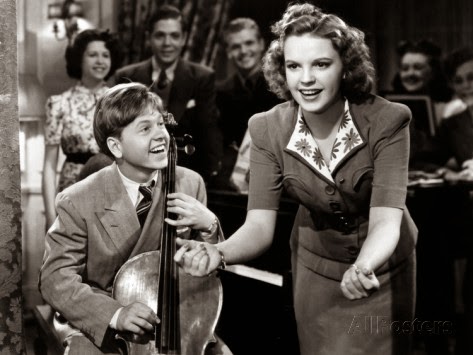


Another movie from when Mickey Rooney was the biggest star in the world is Babes in Arms, from 1939. Anyone who’s seen Babes in Arms knows that in the annals of barking-mad Hollywood musicals, it’s way up there. Rooney is the son of vaudeville troupers. His parents can’t accept that the old circuit is gone for good, and when they decide to stage a comeback, the authorities threaten to send Mickey and costar Judy Garland to a work farm. In the title song — the first big musical number — Busby Berkeley’s camera tracks all the kids as they march through the town and sing. Except these cuties are waving crates and the occasional bit of furniture, and they’re carrying torches to build a bonfire. Douglas MacPhail sings to the tune of “Ride of the Valkyries” while torches wave in the foreground. The kids play on the swingset and the seesaw while the other kids are putting the torch to the bonfire. And Douglas and Mickey and Judy climb a playground slide for the finale, while everybody plays ring-around-the-campfire. It’s a vaudeville Walpurgisnacht.

So when you decide to joke with your pals, “Hey kids! Let’s put on a show!” just remember that Mickey and Judy did that and then they staged a near-riot. This movie is many things. Wholesome isn’t necessarily one of them.

Check out this scene of Mickey and Judy auditioning for a big producer. There’s the way Rooney puts over a big number, and then there’s the way he’s doing “Good Morning” here. A little too bright, overcompensating, to cover up the nerves; it’s the way a newcomer would audition.

Then (sigh) there’s a blackface number, which is grisly, although at least it’s broken up by a thunderstorm. The final number, “God’s Country,” is a sort of MGM Manifesto: “We’ve got no Duce / We’ve got no Fuhrer / But we’ve got Gable / And Norma Shearer.”

The Siren doesn’t know that Rooney ever bothered to analyze exactly what the hell this movie was supposed to be saying, any more than he ever understood why everybody kept bugging him about Mr. Yunioshi. But it’s some kind of crackpot genius, all right, and here’s the thing about Rooney. In the midst of a vaudeville version of May ‘68, and (god help us) a minstrel show, and a closing number about God’s Country, “where every man / is his own dictator,” (what?) five-foot-two-or-three-inch Rooney is seizing that screen every single minute. If that seems no big deal, ponder Ruby Keeler for a minute or two. Nor is Rooney upstaging Garland. They worked together, not in opposition. They were still doing it in Words and Music nine years later.


“Mickey Rooney can act the legs off a centipede.”
— The Sunday Times of London, from a 1939 review of Babes in Arms

Some of Rooney’s best classic-era performances came after World War II, when hard living had given him a face even Mayer couldn’t sell as boyish anymore: Noir Comes to Andy Hardy. There’s Quicksand, with its uncomfortable echoes of Rooney’s real-life character. He’s an auto mechanic, but he’s also a skirt-chaser, and his pursuit of a pretty cashier leads him to one dumb decision after another. (He produced the film with Peter Lorre; they play well together.) Drive a Crooked Road finds Rooney a mechanic again, only this time he’s shy around the ladies and picked on by his coworkers. His yearning for a girlfriend gets him mixed up with a bad dame; those who think of Mickey as a flashy ham will be surprised at how naturally he plays shy and lonely. He’s a convincing psychopath in Don Siegel’s Baby Face Nelson — though, as James MacEachern pointed out earlier this year in a lovely tribute at Bright Lights Film Journal, at the time the movie did badly and Rooney’s reviews were poor. As the loyal pal of Anthony Quinn in the extremely depressing Requiem for a Heavyweight, Rooney was more touching than the ostensible lead. And the Siren adores The Strip, in which Rooney plays a musician sucked into a world of graft by a corrupt bookie. Here’s part of why: Rooney playing drums with Louis Armstrong and Earl “Fatha” Hines. He’s in character, but Rooney’s projecting a character who knows he’s jamming with the best.


Dear Mr. Mayer:
We have read the “God’s Country” Finale (pages 1 through 4) dated July 3, 1939, for your proposed production titled Babes in Arms, and are happy to report that this material comes under the requirements of the Production Code.

However, on Page 3, Mickey used the word “shag.” This should be changed since in England and the British colonies this word has a very objectionable sexual meaning which would cause its deletion by numerous political censor boards. 
You understand, of course, that our final judgment will be based upon the finished picture.
Cordially yours,
Joseph I. Breen
— quoted in The World of Entertainment! by Hugh Fordin

“He was the same off-screen as on, which meant that he made enemies,” wrote David Shipman. Some of them were undoubtedly exes. Rooney was a ravenous womanizer. Envy percolates through the writings of many male film critics when they get to the part where Rooney married 19-year-old Ava Gardner. There was also lovely Martha Vickers, whom Rooney also married; and six other wives and Lana Turner and...the Siren is getting tired, let’s just say it’s a cast list longer than It’s a Mad, Mad, Mad, Mad World. At least the last marriage, to Jan Chamberlin, stuck. He had nine children (eight survive him). By 1962, when he wound up in bankruptcy court for the first time (he’d be back), he’d earned $12 million over the course of his career. That’s about $93 million today.

Rooney, a compulsive gambler, always had big plans. Shipman notes, “When MGM were in difficulty in 1970, according to Variety, he offered to take over the reins, promising to make 20 films for $20 million. The offer was refused.” Kirk Kerkorian had already bought a big stake, attached the MGM name to a casino operation, and the Culver City assets were about to be sold off piece by piece. Rooney was no businessman, he approached things like a movie —an entertaining one, where auctioning everything down to Judy's ruby slippers was no way to end. How much better if in the last reel, the old studio says, “OK Mickey, you crazy kid. Let’s put on a show...”


(Review quotes from David Shipman's The Great Movie Stars; Billy Wilder story from Gavin Lambert's Norma Shearer biography; Ava Gardner quote from Lee Server's bio.)
(Updated 7/13/15; according to film historian Mark Alan Vieira, the only source for Rooney's affair with Norma Shearer was Rooney himself; Vieira says it never happened. So the Siren has redacted that conquest.)

Thứ Sáu, 28 tháng 2, 2014

Gigi (1958): A Defense


Kate Aurthur’s ranking of Best Picture winners is not the worst film list the Siren has ever seen, nor even the worst list she’s seen on Buzzfeed. Several movies the Siren reveres did pretty well with Ms Aurthur. Rebecca sits at No. 20, The Best Years of Our Lives is No. 16, It Happened One Night cracks the top 10 at No. 8 and at No. 1 is All About Eve. Any group this large must elicit a correspondingly large amount of disagreement; that is why lists are such reliable traffic-bait.

But the Siren almost didn’t make it through, because the very first item, Ms Aurthur’s choice for the worst Best Picture winner of all time, slapped her across the face like Joan Crawford on a rampage.

Yes, the creepiest, most pedophiliac movie ever to win Best Picture is this list’s worst. How to define “worst” in this context, especially when judging Gigi — a movie musical some people love now, and certainly many people loved in 1958 — against films that were barely movies as we currently recognize them? [NB: I know, I know, forge ahead, please.] This list is, of course, totally subjective: I factored in my personal feelings about each movie, along with how well it has held up, how influential it is, and what it was up against. And then there’s the ineffability of common wisdom, which I also have taken into account. No matter how I feel about Annie Hall or about Schindler’s List, for example, I know I’m in a minority view in my dislike — and that matters. Not with Gigi, though, in which Leslie Caron plays a Parisian girl being trained to be a courtesan who ends up in a push-and-pull relationship with the much older Gaston (Louis Jordan) [sic]. This is the movie that gave us that disturbing cultural artifact, the song “Thank Heaven For Little Girls.” If you want disturbing psychosexual movies from 1958, let’s agree that Vertigo, which was nominated only for Best Art Direction and Best Sound, is preferable. To reiterate: Gigi is the worst.

Pitting Vertigo against Gigi underlines the reason George C. Scott refused to pick up his Oscars: In addition to calling the ceremony “a meat parade,” he considered the idea of artists competing against one another to be absurd. He was not wrong. “Best” means something different for an Alfred Hitchcock thriller and a musical comedy from Vincente Minnelli and Lerner and Loewe. Then again, in cracking a joke, the author has accidentally made a point.

Vertigo, winner of the Sight and Sound “Greatest Film of All Time So Take That, Citizen Kane Award,” concerns a troubled ex-policeman who falls in love with the gorgeous and possibly insane woman he is hired to tail. When he attempts to save her from her demons, she winds up dead, or so he thinks. Then the ex-cop spots his lost love’s doppelganger on the street, and works to turn her into the image of that dead woman — dye job, new wardrobe, new makeup. The audience soon finds out it’s the same woman, and she’s sane, although the ex-cop is plainly not. Our two-timing woman loves this man, and tries frantically to please him, but in the end, she falls off a bell tower.


Now turn to Gigi, from Alan Jay Lerner’s screenplay, based on Colette’s story of a Parisian girl who’s descended from a line of courtesans and is being taught to take over the family business. But Gigi’s a lousy pupil, so far from considering a man’s happiness that she does not hesitate to clean his clock when they’re playing cards. The man in this instance is Gaston, a wealthy friend of the family who’s always had mistresses and enjoys Gigi’s company for the relief it brings from their demands, and from society’s. One day Gaston realizes that Gigi is no longer a little girl, and that he’s in love with her. He proposes to make her his latest mistress, although Gigi has spotted the flaw in this arrangement: It makes her disposable, and she’s in love with Gaston, and doesn’t want to be thrown away. Gaston in turn realizes that he loves Gigi too, and he doesn’t want to force her into a life that is utterly wrong for her. And so he marries her instead.

As Cosmopolitan might say, two makeovers, two very different results.

And one question: Why is Gigi, which ends with its vivacious heroine happily married to a rich man who loves her the way she is, a sick-sick-sick movie; while Vertigo, in which the lovelorn female lead tries to turn herself into a fictional character and winds up stone dead, is a “preferable” depiction of male-female relations?

Let’s see, which Oscar winners displayed sufficient rectitude to wind up near the top? Oh look, there’s Silence of the Lambs at No. 5, now there’s a movie that knows how to treat a lady. In The Godfather Part II, we have Kay Corleone getting the door slammed in her face as she tries to embrace her children; there’s The Godfather, where Talia Shire’s husband beats the living hell out of her; and let’s not mention (because Ms Aurthur doesn’t) the marital rape in Gone With the Wind (No. 11) and the speech in All About Eve about how a career means nothing for a woman if you turn over in bed and your man’s not there.


Fine movies, sure, but you see the point: Why pick on Gigi? If it were just Buzzfeed, the Siren might have shrugged and called for madder music and stronger wine. But alas, the woods are full of people saying Gigi is terrifying, the worst, chauvinist and hateful (et tu, Vadim?).

This wounds the Siren to her feminist core. She loves Gigi.

Yes, Gigi, played by 27-year-old Leslie Caron, is very young. Louis Jourdan, who plays Gaston, was 37. In the original Colette novella, Gigi is 16 and Gaston is 33, and in 2014, that is, as Ms Aurthur states, considered creepy.

Gigi, however, is set in 1900 in Paris. In that time and world, it was not unheard-of for a 16-year-old to get married, much less was it considered too young to embark on a career as a courtesan. Scowling at the sexual morals of an earlier time is fun and all, but it’s not an especially rewarding critical approach.


Let’s look at “Thank Heaven For Little Girls,” the song that freaks out Buzzfeed. These are not complicated lyrics, but the Siren’s emphasizing some salient lines anyway:

Thank heaven for little girls
For little girls get bigger every day. 
Thank heaven for little girls
They grow up in the most delightful way.
Those little eyes so helpless and appealing
One day will flash and send you crashing through the ceiling.
Thank heaven for little girls
Thank heaven for them all,
No matter where no matter who
Without them, what would little boys do?
Thank heaven . . . thank heaven . . .
Thank heaven for little girls!

Maybe you don’t want Maurice Chevalier, who turned 70 during filming, singing about little girls, period. But he isn’t saying, “Thank heaven for little girls because I want to have sex with them,” which would of course be “pedophiliac” and horrifying in many eras besides our own. The lyrics say “I like little girls because they grow up into beautiful women.” In other words this song, a frequent target of the irretrievably literal-minded, is the senior citizen who coos at your cute kid, “That one’s gonna be a heartbreaker.” If the correct response to such a sally is to smash the old buzzard over the head with your handbag and shriek “Get away from my child, you psychopath!!” then the Siren freely admits she’s been doing it wrong.

Furthermore (and the Siren can’t believe she has to point this out) there is not a single act of rape, whether statutory or not, in this film. No character shows a sexual interest in girls under 16, and that includes Chevalier as Honore Lachaille. It’s the opposite of pedophilia: People wait until they’re old enough by the Parisian standards of the time, and that’s that.


Up until the point where Gaston takes a look at Gigi in a grown-up dress and realizes she’s a young woman, he has no romantic or sexual interest in her. She’s a chum. She’s fun. And when she does show up in the dress, happy and proud as all teenagers are when they put on the trappings of an adult, Gaston’s reaction isn’t “hubba-hubba.” He yells at Gigi that she looks “like an organ-grinder’s monkey.” If a 16-year-old and a 33-year-old in love is disturbing, hey, here you go — Gaston is disturbed when confronted with a playmate who’s suddenly attractive. They have a blistering row and he stomps off, only to realize that as Gigi has grown up, so have his feelings.

Minnelli probably would have loved to direct My Fair Lady, but that film couldn’t be made until the record-breaking Broadway run was over. So he took on Gigi, which tracks the other musical so closely that dear old Bosley Crowther suggested Lerner and Loewe might want to sue themselves. (Ms Aurthur has the backlot-bound, slower and stiffer My Fair Lady at no. 15, in evident indifference both to the plot similarities and the fact that Eliza Doolittle is also a teenager, plus Henry Higgins is 20 years older than Eliza and is her teacher to boot.) Minnelli wanted to bring fin de siecle Paris and caricaturist Sem to life. Along with production designer Cecil Beaton (and despite Charles Walters, who had to take charge of some post-production reshoots), Minnelli did the impossible. He made Paris look even more beautiful than it is.


He did the same for every woman in the movie, as Janet Flanner wrote when she reported from the Paris set for The New Yorker that the film was “peopled…with some of the most extraordinary-looking young-and-old beauties that Paris has seen in a while.” Minnelli was lavish, but never vulgar. His camera admires. It does not leer, at Caron or any other woman, no, not even the lushly leer-able Eva Gabor.

But, you protest, this girl is being trained to be a prostitute. How is that acceptable to a feminist? Well, this feminist does not have a problem with consensual sex work. Much less does the Siren have a problem with sex work as a way that two old ladies once used to make a living that probably beat the hell out of taking in laundry or whatever else was open to the average woman in 19th-century France. Tante Alicia (Isabel Jeans) earned enough to live in grand retirement in a mansion with servants. Madame Alvarez (Hermione Gingold) has a much smaller budget, but she’s still keeping Gigi in basic comfort. She’s also supporting her daughter, Gigi’s mother, who’s rejected “the life” and is heard only from off-camera as she trains to be what sounds like the worst soprano since Susan Alexander stank up the opera house in Citizen Kane.


Alicia and Mamita, as Mme. Alvarez is called, are shrewd women who have made their way through life armed with their wits, and with attractiveness that is as much cultivated as it is natural. They call their own shots. When Eva Gabor’s Liane, Gaston’s mistress (who's pretty clearly older than he is), makes a phony suicide attempt, Tante Alicia waves it off for the dumbshow it is: “The usual way, insufficient poison.” These are not, perhaps, the rules these ladies would prefer to play by. The Siren thinks in our own era, Alicia’s basilisk eyes would be trained on the CAC-40, not the next wealthy protector for her niece. But it is, let’s repeat, 1900. In any era, you play the hand you’re dealt.

Gigi, far from being “creepily” youth-obsessed, has a complex and entrancing view of the stages of life. We see the heroine going from bewilderment at the games “The Parisians” play, to trying to play them herself. Gaston sees middle age edging closer, while he’s using the same kinds of women for the same thing and wondering why “It’s a Bore.” Meanwhile, Chevalier’s big number isn’t “Thank Heaven for Little Girls.” It’s “I’m Glad I’m Not Young Anymore.”

On the beach at Trouville, Honore is pursuing a likely (adult, for crying out loud) prospect. But he spies Mamita, with whom he once had an affair, and says, “I must tell you that you upset all my plans for the weekend! I came prepared for battle, and an old wound prevents me from charging.” What follows is the movie’s most tenderly romantic song, performed by two elderly people as the sun sets.


“Am I getting old?” “Oh no, not you.” Excuse the Siren a sec, she’s got something in her eye.

The Production Code Administration, diminished in 1958 but still in there swinging, took a long hard look at Gigi, but the Siren’s sources don’t indicate that what has Ms Aurthur calling Gigi's defenders "criminals" was the obstacle. Instead, what got the PCA riled up was the prostitution angle. After the usual horse-trading over the script, the objections boiled down to a single line: “To 'take care of me beautifully' means I shall go away with you, and that I shall sleep in your bed." Minnelli pleaded to be allowed to film that as written and have the censors make their call after seeing how it played. In the end, he said, Leslie Caron spoke the line so innocently that it passed without a murmur. Bad call for posterity, it seems. If Minnelli had ended on Gigi falling off a bell tower, maybe this thing would have lived up to the moral standards of Buzzfeed.

Thứ Sáu, 11 tháng 3, 2011

Nomadic Existence: Cover Girl


For the Siren's Retro-Fit column at Nomad Widescreen, a meditation on the very delightful 1944 Cover Girl, Charles Vidor's first major contribution to the eternal Rita Hayworth mystique (the second being Gilda). Billy Wilder claimed his first idea for a directing project was to make a big, candy-colored Hollywood musical, but when he saw this, he figured he'd been right to go with Double Indemnity: "I knew that no matter how good my musical might be, people would say it's no Cover Girl."


So, how are the numbers? The music is by Jerome Kern, the lyrics are by Ira Gershwin, the choreography is by Gene Kelly, and the numbers are swell. There's the title song, the climax of the show, a delirious memory lane of mostly long-gone print dinosaurs arrayed on a stage with a ramp big enough to make Busby Berkeley bite his wrist in envy: The American Home, Liberty, Mademoiselle, Collier's. Each magazine has its own visual theme and chorus girl, the music turning into a nursery jingle when one small girl appears on the cover of Look. (That was a bit creepy, to be honest, but never mind.) At the end, Hayworth appears at the top of the ramp, wearing a heavily sequined dressing gown because… well, because we get to see her take it off. And then, there she is, in the most beautiful costume in the movie, a flowing gold lame strapless that flies around her as she dances down the ramp toward a bunch of chorus boys that the camera never even tries to seek out because who cares? Rita Hayworth is dancing!

I imagine that this is the point at which Billy Wilder said, "Forget it. I can't compete."

Even better, though, is an earlier number called "Make Way for Tomorrow," which starts at an oyster bar where Hayworth, Kelly and Silvers romp in, wave their hands over the oysters and chant, "Come on, pearl!" (I dearly want to try this myself at multiple oyster bars before I die, just to see if a single waiter gets the reference.) And then, oh magic, they dance out onto Columbia's idea of the Brooklyn docks and use trash cans as cymbals and mock-row with oars and lock arms for a kick-step, until they encounter one of those cops who always turns up whenever you're in a musical, minding your own business with the orchestra in the background, just trying to dance your troubles away. They get away from the cop and continue into the Brooklyn streets where they gallop up and down stairs, interrupt a canoodling couple, do a time-step with the milkman — how much poorer movies are now that no one ever encounters a milkman.

It's interesting to note, with regard to our other topic of the week, James Agee, that the critic quite liked Cover Girl, particularly for Gene Kelly and Rita Hayworth "at her prettiest," although his dislike of lush Hollywood orchestrations was such that he even complained about too much music in his musicals.

Further to Hayworth, the Siren has linked to this before; but this post from Raymond de Felitta's archives, at Movies 'Til Dawn, remains one of the most poignant things you'll ever read about her. Also, Raymond pointed out (and the Siren neglected to mention) that Vidor didn't direct the musical numbers; that was somebody else you may be familiar with.

Thứ Ba, 3 tháng 2, 2009

Words and Music (1948)


In an excellent piece in Bright Lights Film Journal, Alan Vanneman asks if Words and Music is "An Unsung Masterpiece?" The short answer is no. What it may be, however, is the ultimate drug for musical purists, those souls who genuinely do not care about plot, dialogue or any other kind of connective tissue in a musical, but instead jump from number to number. When the numbers are from Rodgers and Hart, this has its definite advantages. Along with the Gershwins, this is the team whose songs always stop the Siren in her tracks. There were others equally as fine--Porter, Berlin, Kern, oh yes--but none to surpass.


The usual knock on Words and Music involves the phrase "sanitized biopic." Why yes, the movie does neglect to mention that Lorenz Hart, tormented genius, was tormented in part because he was gay. But it isn't as though gay themes were cropping up in a number of other movies that year, and Hart alone got his subplot scrubbed. Here's the Hart biographical stuff that does make it into the movie: his alcoholism, his unreliability, his self-hatred, his feelings of ugliness, his shortness (he's played by Mickey Rooney) and his doomed attempt to get a Broadway chanteuse to marry him. All true. Even an episode toward the end, where a drunken Rooney reels around the rainy streets of Manhattan after one final opening night and catches his death, amazingly happened in a very similar way. (Although the Siren hopes that Hart did not finally collapse in front of a store selling elevator shoes, as poor Rooney is made to do here.)


Compare this total score for accuracy to Song of Scheherazade, where the filmmakers got two things right: Nikolai Rimsky-Korsakov was Russian, and he composed "Scheherazade."

As for the airbrushed gay theme--the Siren thinks there are signals for the hep, as much as could be under Joe Breen's watchful eye. Check out Hart's overly dependent relationship with his mother (ah, shades of Christmas Holiday) and the singer's delicate references to gosh, just something about Hart that keeps her from marrying him.

Complaining that any MGM movie is sanitized is like yelling at Lassie for shedding. Of course it's sanitized, that's what MGM did. They took life and made it shinier. This is the studio that built a Hall of Mirrors set twice as big as the Versailles original. The real problem with the frame story is that Hart, even played by Puck, is a huge downer, only fleetingly portrayed as the witty life of the party that Hart's real-life friends remembered. The quiet, rather stuffy Richard Rodgers ("Boy Next Door" Tom Drake), robbed by the script of his legendary taste for chorus girls, can't sustain a role as a foil. Perhaps most composers and lyricists just aren't great subjects for biopics, unless they eventually went deaf or crazy.

But anyway, who in their right mind would watch this for the biographical drama? What you should want, and what you get, is Technicolor, great singing, and Robert Alton's choreography, supplemented with Gene Kelly's magnificent "Slaughter on Tenth Avenue" , the best dancing the luscious Vera-Ellen ever got to put on film.


What's that? You prefer Cyd Charisse? She's in there too, looking lovely in "On Your Toes" and spinning like a top to "Blue Room."

The Siren loves "Where or When," sung by Lena Horne. There is a melancholy feel to most Rodgers and Hart songs that is easy to overemphasize. Many singers opt for a happy surface with a tear-stained underpinning. Here, Lena flips that, the yearning right out on top, but a certain brightness underneath.

Then notice how Judy Garland takes the complicated and rather strange lyrics to "Johnny One-Note" and renders them clear as rainwater. How much does the Siren miss enunciation...

He may not be a convincing Hart, but Mickey Rooney has some great moments, too. He was one of those triple-threat entertainers who, as Pauline Kael once said about Liza Minnelli, are electrifying when all they need to be is charming. Instead of drawing a performance out of Rooney, a good director (which Norman Taurog pretty much wasn't) had to put a visor on the camera and tone him down a bit. Rooney's Words and Music scenes go back and forth between delightful and way-too-much, but his joyful, no-frills rendition of "I'll Take Manhattan" is perfect, a summary of everything that was best about him as a musical performer. And his duet with Garland (the last they ever did together), "I Wish I Were in Love Again," is almost as good.

Then you see Rooney during Mel Torme's superb rendition of "Blue Moon," doing a depressed drunk act and still managing to mug, and you realize that even if he had magically grown several inches, he was never going to fit in with the socially conscious 1950s, not even in the artier Freed-unit musicals that lay ahead.

There are many other numbers in Words and Music, including this one


which, the Siren is happy to report, is the perfect length for going down to the kitchen and whipping up a sandwich. (It isn't just June Allyson, the Siren can't stand "Thou Swell," finding it strained and cutesy in a way that Hart usually avoided.)

Ann Sothern gets a production number ("Where's That Rainbow?") that Vanneman didn't much care for, but the Siren adores it, mostly for the dancing boys behind Ann. Robert Alton was famous for individualizing the chorus--instead of a kaleidescope of identically clad, synchronized movement, his dancers stand out one by one even while they are backing the main singer. (This biographical entry reads that characteristic as "queer," an interpretation that the Siren found fascinating, although not completely convincing.)

Which brings the Siren to her favorite number, "Mountain Greenery," with a jaw-droppingly young Perry Como and a lovely dancer named Allyn McLerie. (Twenty years later, a very different kind of dancing would cause McLerie to bug out in They Shoot Horses, Don't They?) The lyrics are almost goofy, but the dancers and Como put it across with such utter, fetching sincerity that the Siren is charmed every time. To me, the dancers and singers twirling around to "down with noise and clutter, up with milk and butter " are, like the rest of Words and Music, just so utterly MGM, another step on the road to the perfection of The Band Wagon and Singin' in the Rain.

Thứ Năm, 20 tháng 11, 2008

Ten Things I Love About Old Movies

So, as threatened, the Siren is stealing Jacqueline T. Lynch's post idea. Jacqueline's concept was to look at relatively superficial, but satisfying, elements of classic film. Nothing like mise en scene, cinematography or acting styles, just the things that draw you into an older world.

So here, in rough order, are some things the Siren loves that didn't make it onto Jacqueline's list:

1. Intertitles in sound movies. One of the Siren's very favorite things ever, as she's mentioned before. I haven't seen one of these since Star Wars, and that wasn't strictly an intertitle since it was at the beginning. Do they just assume no one can read? That can't be, since everyone in the audience is texting like mad, a complaint that finds the Siren in complete accord with her friendly archnemesis Dirty Harry. Anyway. I adore intertitles, like the YELLOW JACK! alert in Jezebel and "And so the 'keeks' went out of another marriage" in That Uncertain Feeling and all the intertitles in this movie that you may have seen at some point:


2. Trains, especially trains with sleeping cars.


3. Dressing for dinner. The Siren has thrown many dinner parties here in glamourous little old New York, and not one person has ever shown up wearing something like this


or this


let alone this


or this.


Nope, not even me.

4. I love any scene of a woman getting undressed behind a screen. I doubt that women did this much in real life but in the movies it's a killer. Bonus points if the woman hits the man in the room (there's always a man in the room) with something she's just taken off.


(Yes, she's standing in front of the screen but she's about to go behind it any minute. Googling didn't get me far with this one. Where's C. Parker of Starlet Showcase on this category?)

5. Marcel waves. As a small girl watching her first black-and-white movies, the presence of marcel waves let the Siren know whether the movie was worthwhile. This meant she saw some good movies at an early age, like this one:


6. Nightclubs. Especially in the 1930s movies like Top Hat, where they appear to be roughly the size of an aircraft carrier.


Even non-musicals had fabulous nightclubs, as you can see in the background here in Nightmare Alley.


And even a nightclub that's supposed to be seedy, like The Blue Gardenia, looks stylish.


That brings us to

7. Smoking. People do it everywhere in old movies, with unapologetic gusto. The act of smoking can give rhythm to lines, buying the character some time.


It can tell you much about the way the characters relate.


It is, in short, a social activity.


(The Siren here adds the obligatory note that smoking is a Bad Thing, although why the failure to denounce smoking as soon as it's mentioned causes howls of protest is something the Siren doesn't get. No one freaks if the Siren fails to screech "Heroin kills!" when discussing The Man With the Golden Arm.)

8. Drinks. The way people knock 'em back in old movies fills the Siren with awe. And it's not just the ones you expect...


...it's even the folks hanging around the fortress of the American home. Watch Walter Huston pour out a simple Scotch in Dodsworth--about a half-tumbler. The Siren gets goggle-eyed every time she sees it. And of course, nobody drank like these two.


9. Full-length musical numbers in non-musicals. The Siren just saw one in Safe in Hell, in which the adorable Nina Mae McKinney sings a lovely version of "Sleepy Time Down South" while serving dinner to the sleaziest guests in the Caribbean. But there are lots of other examples. Even Howard Hawks had one, the "Drum Boogie" Barbara Stanwyck performs before kicking back with some academic types.


(Notice how often Hawks is popping up here? This is the stuff that really makes an auteur, I tell you.)

10. Closeups of notes in beautiful handwriting.


So, the Siren doesn't want to turn this into a meme. For one thing, the misuse of the term meme is irritating some of the purists around here. For another, the Siren has trouble picking people to tag. So this is not a meme, it's an invitation. If you want to contribute, please do so, either in commments, or at your own blog. If it's the latter drop me a line and I'll link back. The one rule is that we're looking for details and atmosphere, not big artistic stuff. And link back to Jacqueline, since she started it.

While we are on the subject, here are some delightful entries in the A-Z meme oopsImean list-by-invitation:

Operator_99 hits it out of the park with an all-1930s list
Jacqueline T. Lynch shows herself a kindred softy and lover of Dorothy McGuire
Goatdogblog goes international
Glenn Kenny gives some class to the joint
Dirty Harry, in a burst of liberality, mixes in some movies he didn't even like
Robert Avrech includes some wonderful silents
Filmbrain flashes film erudition it will be hard to top with An A-Z of Nikkatsu Sleaze and Action.

For a complete list of all 125 or so, check Blog Cabins. If this doesn't make him King of Google I don't know what will. Am I missing any good lists? Tell me. Finally, if you have the Siren on your blogroll, but have yet to spy yourself in the thickets of her sidebar, please say so via email or in comments. The Self-Styled Siren has a liberal blogrolling policy, and if you list her she will almost always list you back.

Thứ Năm, 10 tháng 7, 2008

New York City of the Mind


(bumped)

In the big city the twin spirits Romance and Adventure are always abroad seeking worthy wooers. As we roam the streets they slyly peep at us and challenge us in twenty different guises. Without knowing why, we look up suddenly to see in a window a face that seems to belong to our gallery of intimate portraits; in a sleeping thoroughfare we hear a cry of agony and fear coming from an empty and shuttered house; instead of at our familiar curb, a cab-driver deposits us before a strange door, which one, with a smile, opens for us and bids us enter; a slip of paper, written upon, flutters down to our feet from the high lattices of Chance; we exchange glances of instantaneous hate, affection and fear with hurrying strangers in the passing crowds; a sudden douse of rain--and our umbrella may be sheltering the daughter of the Full Moon and first cousin of the Sidereal System; at every corner handkerchiefs drop, fingers beckon, eyes besiege, and the lost, the lonely, the rapturous, the mysterious, the perilous, changing clues of adventure are slipped into our fingers.
--O. Henry, "The Green Door," from the collection The Four Million


E.B. White once divided New York, like Gaul, into three parts. First is the New York of the native, who takes the city and its treasures for granted. Second is the New York of commuters, "devoured by locusts each day and spat out each night." Then there is the last, and what White considered the greatest, the New York of the immigrant, "of the person who was born somewhere else and came to New York in quest of something."

For her contribution to the Derelict's New York City blogathon, the Siren is indulging herself with a mighty piece of presumption, and adding another New York to White's three categories. For it's always seemed to me that there is a New York of the mind, where the past incarnations of the city bump up against its Neo-Gilded Age present. Which corner of your psyche the city occupies is a personal matter, of course. You may think of it as "Gomorrah on the Hudson," as O. Henry called it, a daily assault on all that's otherwise righteous in the country. You may see yourself reflected in Tiffany's window, eating a bagel like Holly Golightly, or sipping a cosmo like her spiritual offspring, the Sex and the City ladies. But over it all hangs the spirit that O. Henry describes above. Could he be describing any city besides this one? It's easy to set a movie in New York because in the city of our minds, any type of adventure--or debacle--is possible.

The Siren knows that Lists Are Bullshit because Glenn Kenny told her so, and this is not a list. Truly, if it were a list it would horrify the Siren, as there are some big omissions. This just a group, an agglomeration if you will, in which each movie represents something the Siren has observed, experienced or yearned for in New York, some good, some bad. And this is the New York of the mind, not geography, so you will notice that not all were even shot entirely on location. In fact, we'll start with one that captures a great deal of New York's allure, and did so almost entirely on a Paramount soundstage.


Jeff, you know, if someone came in here, they wouldn't believe what they'd see. You and me with long faces plunged into despair because we find out a man didn't kill his wife. We're two of the most frightening ghouls I've ever known.

People-watching - Rear Window. The word voyeurism is usually linked to sexual matters, and lord knows there is plenty of that in Rear Window, both overt and implied. But for a New Yorker there is more than a mere sexual thrill in observing other people. It's part of the attraction of the place. There is an endless amount of people-watching, and most of all, the people are interesting. Usually not trunk-murder interesting, but more vivid and watchable than what you'd see across a backyard in Plano, I'll bet.


Sally: But Sidney, you make a living. Where do you want to get?
Sidney Falco: Way up high, Sam, where it's always balmy. Where no one snaps his fingers and says, "Hey, Shrimp, rack the balls!" Or, "Hey, mouse, mouse, go out and buy me a pack of butts." I don't want tips from the kitty. I'm in the big game with the big players... In brief, from now on, the best of everything is good enough for me.

Ambition - Sweet Smell of Success. Ambition is New York's defining characteristic, as everyone from Billy Wilder to Kander and Ebb could tell you. That's why this poisonous, cynical, glittering little fable is, for most of us, the defining movie about New York. Burt Lancaster is superb as J.J. Hunsecker, the Walter Winchell-based columnist with an unhealthy obsession with his sister. But the real thematic meat of the movie is Tony Curtis's Sidney Falco, and watching him try to climb the ladder, suck-up by suck-up. He gets told off a lot, if you notice, by people who have a lot of noble things to say, but he keeps right on keeping on. His persistence is more realistic than some of the huffy speeches directed at him, in fact, as is his fitful self-awareness. Falco knows he's throwing away pieces of his soul, but he's had his soul wrapped up in an old newspaper in the back of the closet for some time. Curtis later told what attracted him to the part: "All I had to hear was New York. I was raised in that city."


It shrinks my liver, doesn't it, Nat? It pickles my kidneys, yeah. But what it does to the mind? It tosses the sandbags overboard so the balloon can soar. Suddenly I'm above the ordinary. I'm competent.

Addiction - The Lost Weekend. For years the Siren worked retail at a rambling store in an old building below 8th Street. Her coworkers were usually young and hungry, just like she was. Come late afternoon on Tuesdays and Fridays, the Siren would be rearranging the fingerless lace gloves over at the accessories counter, and it would start: "BAM! BAM! BAM!" The hammering. Customers would almost jump through the display case as part-timer Janine (not her real name, believe me) came through on her hands and knees, wielding a hammer and whacking down any stray nailheads in the old, buckling floorboards. "What is WITH her? I don't even see nails anymore," the Siren asked coworker Bill one day, tired of the ritual. "Her shift's almost over. She's got to burn off the time before her next line somehow," came the reply.

When the Siren saw The Lost Weekend a year or two later (at the much-lamented Theater 80) and watched Ray Milland staggering up Second Avenue in a fruitless attempt to hock his typewriter on Yom Kippur, she immediately thought of Janine. If you live long enough in New York, you'll know someone either bottoming out or (we hope) recovering. In many ways Wilder's movie is truthful about the city, as Ed Sikov discussed in his Wilder bio. In production meetings Wilder insisted that the skyline be visible in the shot of the whiskey bottle hanging from Ray Milland's window; he fought to make sure the kitchen was a realistically tiny specimen. Wilder filmed from a camera concealed in a truck, and then spent weeks cutting out footage of New Yorkers scratching parts of their anatomy that the Breen Office didn't want to know about. But most of all, in the character of Don Birnam, Wilder got at a certain type of New York addict. He's smart, he's talented, he has standards, but in all categories he's a near miss. None of it is quite getting Birnam to the spot he feels he should have--none of it, that is, until he has that drink.


We sailed the seas and played a bit of poker
Way in Mandalay
We've walked the streets till the night was over
And we can safely say
The most fabulous sight is New York
In the light of day, our only day.


Adventure - On the Town Okay, so they jettisoned much of Bernstein's landmark score and put in some novelty numbers. But can anything beat that opening, even with the bowdlerized lyrics? That's the spirit, damn it. That's the way to approach the city, wide open to appreciate anything it brings. Those boys are O. Henry's "true adventurers," and honorary New Yorkers if ever there were any.


Roberta kept a diary. Great stuff. "Couldn't sleep. Went into kitchen. Gary came in, turned on light. Gary left. Finished birthday cake." Pages of it. It's got to be a cover, nobody's life could be this boring!

Romance - Desperately Seeking Susan Yeah, yeah, yeah, it was the Madonna movie, back then because it was her first, and now because it's the only one where she's good. But the Siren loves this film for the sweet-natured love story between Rosanna Arquette and Aidan Quinn. Seidelman's movie is one of the few that has any sense of what 1980s downtown New York looked like. The movie also shows how finding a place to crash in this overcrowded, overpriced town can lead to all sorts of entanglements, good and bad. The scene where Arquette is trying to leave Quinn's apartment, then accidentally dumps her suitcase and winds up kissing him on the floor, is pure sex to me, without so much as a button unbuttoned. Of all the films in this post, this is the one to make the Siren all maudlin and nostalgic for the things she found when she first came to the city, and the things that took her a lot longer to find.


On November 1st, 1959, the population of New York City was 8,042,783. If you laid all these people end to end, figuring an average height of five feet six and a half inches, they would reach from Times Square to the outskirts of Karachi, Pakistan. I know facts like this because I work for an insurance company - Consolidated Life of New York. We're one of the top five companies in the country. Our home office has 31,259 employees, which is more than the entire population of uhh... Natchez, Mississippi. I work on the 19th floor. Ordinary Policy Department, Premium Accounting Division, Section W, desk number 861.

Drudgery - The Apartment. The Siren could file this one under ambition, too, but that's a peripheral theme. In addition to the love story, it's about being part of The Crowd (the masterpiece to which it is indebted). There's the loneliness, the grind, the way you search out something interesting--preferably cute and interesting--in order to feel like you aren't just another cog. But in reality, you know that Fred MacMurray is right, and for most New Yorkers, it's gonna take years to work your way up to the twenty-seventh floor, and thirty seconds to be out on the street again. One of the Siren's favorite moments in this movie is a very small one--Jack Lemmon finally returning to his empty apartment to nurse his cold. Bosses and their affairs aside, the Siren's lived that scene. Haven't you?


Bin Laden can drop another one right next door. I ain't moving.

Resilience - The 25th Hour. Spike Lee is the Siren's favorite working American filmmaker. That's my story and I'm sticking to it, boys. And one of the many reasons is the way he gets New York, not just the look and feel of the city--hell, all kinds of directors have managed that--but the way New Yorkers react and process things. With a few simple images and a bit of dialogue, this movie got at something fundamental in the way New Yorkers reacted to 9/11 in a way almost no other artist has. 9/11 has been so thoroughly and, in many cases, disgustingly co-opted that having it crop up in a movie based on a novel written before the attack set off some warning signals. But instead Lee used it to underpin his story about the pursuit of redemption. The 25th Hour was about making amends for the wrongs you've done, but it was also about the far more difficult task of moving past the wrongs that were done to you.

Thứ Tư, 18 tháng 6, 2008

Cyd Charisse, 1921-2008

I was less than 10 years old but I can still remember my father's expression when one morning he told me he was going to watch Brigadoon. "Who's in it?" I asked. "Gene Kelly and Cyd Charisse." "Cyd Charisse? Who's he?"

With great emphasis: "SHE."

"A lady named Cyd?"

"YES, honey."

"So she was pretty?"

If all goes well with childrearing there aren't many moments where a parent says to himself "what the hell have I produced here?" but this was one for my father, I have no doubt. His face was beyond pained as he said, "All right. We'll watch this movie and then you tell me."

For many fans of Cyd Charisse, Brigadoon probably ranks somewhere between Meet Me in Las Vegas and that bit in The Harvey Girls where she sings (via dubbing) about being from Providence, Rhode Island. But as a child I thought it was swell and I still do. Why does everybody single out Brigadoon for being shot on the back lot? Does Seven Brides for Seven Brothers look like it was shot in Oregon? Does Easter Parade scream "sidewalks of New York" to you? Brigadoon is a fantasy, for crying out loud. Of course it doesn't look like Scotland. That is because Scotland has no magical disappearing 18th-century villages. In the Siren's view, Vincente Minnelli struggling with Cinemascope, which he disliked, had more to do with some of the movie's awkwardness than the obvious sets.

But there is still a lot to love. Minnelli lit the interiors to resemble Flemish paintings. The scene in the crowded Manhattan bar is brilliant. Van Johnson proved he could really act, and the Lerner and Loewe score is fabulously beautiful.


Most of all, "The Heather on the Hill" is sublime, with that sexual longing that's in all Charisse's dancing, married to a spiritual feeling in keeping with the film's mysticism.

So the Siren has a special place in her heart for Brigadoon for a number of reasons, but the greatest of these is undoubtedly that the movie was the first time she saw Cyd Charisse, the matchless dancer who died yesterday at age 86.


I think the next time I saw Charisse was in Singin' in the Rain. I like to think this was probably my father's introduction to her, as he was in the Army around this time, and could easily have been in an audience reacting exactly the way David Shipman describes here:

If you were in an air-force cinema, circa 1952, you'll never forget the sound which greeted the appearance of Cyd Charisse halfway through the climactic ballet in Singin' in the Rain. The audience to a man greeted the sinuous leggy beauty with a loud and prolonged 'Ooooaah!' As she slithered round an understandably bewildered Gene Kelly, there was uproar in the cinema. Cyd Charisse didn't do more than dance in Singin' in the Rain and people remember her in it.


It was a star-making turn such as few performers ever get. Up to that time the beautiful Texan had been getting herself married, having a son, getting divorced, then getting married to singer Tony Martin in 1948 and having another son. (One early role the Siren would like to see: Cyd's brief turn as Galina Ulanova in the notorious Mission to Moscow.) There were movies along the way as Hollywood gave her dancing numbers in generally inferior musicals and tried to find use for her in straight roles. She never comfortably adapted to non-musical parts, despite a pretty good late-career performance in the underrated Two Weeks in Another Town.


It was her run of musicals at MGM in the 1950s that guaranteed her immortality, including Singin' in the Rain and another masterpiece that followed it, The Band Wagon. Fred Astaire called "The Girl Hunt Ballet" his favorite dance. Charisse, who had been in a couple of noirs without making much of an impression, took a Mickey Spillane spoof and danced a femme fatale for the ages: "She was bad...she was dangerous. I wouldn't trust any further than I can throw her. But she was my kind of woman."


As in The Band Wagon, Charisse's greatest moments usually cast her as a woman whose jazzed-up dancing is seen as slumming somehow. In that sense she was perfectly of the 1950s, her sensuality boiling along under the surface as she gives her frequently wooden line readings. Then the music starts, she begins to dance and all hell breaks loose. You realize that here is the real Cyd, a dose of sex so strong that at some point in the dance her partner, even a great like Astaire or Kelly, seems bowled over by it.

So in The Band Wagon, she's a ballerina with a bad attitude about musicals, until she and Astaire go "Dancing in the Dark." In Meet Me in Las Vegas, she's a ballerina again, horrified by her contract to perform in Vegas, giving a nice-but-no-more bit from Swan Lake--and then all but igniting the film stock with "Frankie and Johnny."

She gave her best all-around performance in It's Always Fair Weather as a woman who harbors a brain under the bombshell exterior, sporting some dangerously feminist ideas in a cab scene with Gene Kelly, then raising the gym roof with a chorus of punch-drunk boxers in "Baby, You Knock Me Out." Her final musical at MGM had her taking the old Garbo role as a defrosted Soviet in the Ninotchka remake, Silk Stockings, discovering the power of her own beauty in a number partnered only by some lingerie and the items of the title. Her last great dancing part, in Nicholas Ray's Party Girl, brought the two-sided Cyd to some sort of apotheosis, as she tries to set Robert Taylor straight while performing two dances that would turn any good man bad.

For years now the Siren had occasionally searched around for current pictures of Charisse, and she always looked radiantly happy and beautiful. It was a great life, but it's still a sad day for us. The Siren leaves the final word to Astaire: "That Cyd! When you've danced with her, you stay danced with."