Hiển thị các bài đăng có nhãn Myrna Loy. Hiển thị tất cả bài đăng

Thứ Ba, 2 tháng 8, 2011

Happy Birthday, Myrna Loy


Myrna Loy, dear, dear Miss Loy. Today is her 106th birthday, bless that talented, loyal, fiercely intelligent and enlightened woman. Do you have a copy of her autobiography, Being and Becoming? If not, what on earth is stopping you? You can get it at ABE Books and any number of other places, and it's worth whatever price they charge.

Last week the Siren participated in a roundtable at Movie Morlocks, sponsored by the ever-fab Kimberly Lindbergs of Cinebeats. The discussion centered on racist images in classic films, and how much, or even whether, we need to protect impressionable children from it. And it made the Siren think of Loy, who made no excuses for the sins of her era, but rather owned up to her mistakes:


…Those exotics started to predominate. My bit as a mulatto in The Heart of Maryland led to a role that I'm very much ashamed of. Zanuck wrote Ham and Eggs at the Front, a parody of What Price Glory?, casting me as a spy. How could I ever have put on blackface? When I think of it now, it horrifies me. Well, our awareness broadens, thank God! It was a tasteless slapstick comedy that I mercifully remember very little of.


Loy recognized what was behind her "Oriental" phase, didn't like it, but was still able to be scathingly funny about it. After Love Me Tonight (she knew that was a good one--Miss Loy was very smart about most of her roles), she wrote,


They dropped me right back into the vamp mold, loaning me to RKO for Thirteen Women. As a Javanese-Indian half-caste, I methodically murder all the white schoolmates who've patronized me. I recall little about that racist concoction, but it came up recently when the National Board of Review honored me with its first Career Achievement Award. Betty Furness, a charming mistress of ceremonies, who had started at RKO doubling for my hands in closeups when I was busy elsewhere, said that she'd been dropped from Thirteen Women. (Despite its title, there were only ten in the final print.) 'You were lucky,' I told her, 'because I just would have killed you, too. The only one who escaped me in that picture was Irene Dunne, and I regretted it every time she got the parts I wanted.'


Thirteen Women is actually quite an interesting pre-Code; as Filmbrain points out, despite the stereotypical spooky powers that are presumed to be congenital for an Asian beauty, Loy's character goes bad because she's a victim of racism. She is turning her treatment back on her tormentors. But it is easy to see why Loy would lack patience for yet another evil exotic.

On screen Loy was a byword for sophistication; off screen, like Nora Charles, she combined that quality with broadmindedness and old-fashioned common sense. Immediately after Thirteen Women, Loy did The Mask of Fu Manchu, and found herself confronted with a script that asked her to whip a man "while uttering gleefully suggestive sounds." She'd had it with this sort of stuff, and furthermore she'd been reading Freud and picked up a thing or two. She went to producer Hunt Stromberg and refused to film it: "I've done a lot of terrible things in films, but this girl's a sadistic nymphomaniac." Stromberg said, "What's that?", which lack of familiarity with less-conventional sexuality makes you wonder how Hunt Stromberg ever got anywhere as a Hollywood producer, but never mind. Loy replied, "Well, you better find out, because that's what she is and I won't play her that way." Studio contracts being what they were, she did play her that way, but she succeeded in getting Stromberg to trim some excesses. "She wasn't Rebecca of Sunnybrook Farm," said Miss Loy, "but, as I remember, she just watched while others did the whipping."

The banner above (you can send thank-you notes to the Siren's email address on the sidebar) is from The Barbarian, a pre-Code that the Siren hasn't seen (yet). Filming that scene brought out an example of just how much Loy's coworkers must have loved her.


After I was safely submerged in a sunken marble tub, they scattered rose petals on the water, stationing men to keep them circulating with long, toothless rakes. They keep pushing those rose petals closer and closer to cover me--somewhat overzealously, it seemed. I looked up and saw a ring of familiar faces, Culver City friends and neighbors who worked in the studio. Unaware that I wore flesh-toned garments, they were diligently trying to protect the virtue of a local girl. It was so sweet, but didn't work. Some magazine photographer got in, took a picture that made me look stark naked, and syndicated it all over the world.


Last night, of course, the Siren wanted to watch a Myrna Loy movie, and she did: 1940's Third Finger, Left Hand, a nicely titled Robert Z. Leonard comedy with Melvyn Douglas. It isn't much more than diverting, but the role is a bit unusual for Loy, in that her character is a career woman who has invented a phony husband in order to avoid getting hit on at work. Without a husband, the CEO's jealous wife would push her out in a matter of months; with a ring on her finger, she can do her job. And the CEO's wife? "We're pals," says Loy.


In most of my pictures I complemented the male character, who usually carried the story. This often meant that my roles were subordinate, but that's the way I wanted it. The Bette Davis type of classic woman's role wasn't for me, nor was the Roz Russell female-executive routine, which is what I did in Third Finger, Left Hand.


She liked Melvyn Douglas ("he was a great person, a tireless fighter for liberal causes," noted Loy) and their comic rhythms are very much in tune, even if one inevitably misses William Powell. The Siren would tell you to watch this movie just for a scene where Loy fakes a tough-tootsie Brooklyn persona to embarrass Douglas. She pulls her gum out of her mouth in a string--if that doesn't sell you, it should. There's also her white evening gown in a nightclub scene, and her fake wedding night with Melvyn Douglas; Miss Loy being carried unwillingly over the threshold shows she could do physical comedy as well as she did repartee.

The Siren read Being and Becoming when it first came out in 1987, picks it up all the time to this day, and still recalls many passages without much effort, as you can see. She already adored Miss Loy--from The Thin Man on, there is scarcely a movie the Siren wouldn't be in clover watching, and there's a good deal to worship before that watershed film, too. But Loy's memoirs are special, because they show such a rare thing--an artist whose work means the world to you, whom you can also admire as a person. Not a saint, oh no--wouldn't Miss Loy have hooted at that?--but a woman anyone would have been privileged to have as a coworker, proud to have as a friend.

And so last night, watching Third Finger, Left Hand, the Siren was struck by the character of Sam, a Pullman porter played by the African American actor Ernest Whitman. Whitman is stuck with what passed for black dialect in 1940 Hollywood, but it's an unusual and charming character. He is neither shuffling nor particularly servile, just genial and polite. And when Melvyn Douglas needs a lawyer (he's divorcing Loy--you don't really want me to explain why, do you?) it turns out that Sam has been studying law. He proceeds to run rings around Loy's tony attorney and would-be fiance, Lee Bowman, quoting hilariously abstruse passages from case law until Bowman calls it a night. Sam's character is the one who paves the way for true love.

And when the end credits rolled, the Siren marched straight back to Loy, and this:


During my early years in the studios, movie people were too busy getting a foothold to concern themselves with social conscience. I once asked, 'Why does every Negro in a film have to play a servant? How about just a black person walking up the steps of a courthouse carrying a briefcase?' Well! The storm that caused!


When artists die, there are always some scolds who insist that it simply isn't possible to miss--deeply, personally miss--a woman you were never fortunate enough to meet. The Siren says phooey to that. Because she misses Miss Loy, and always will.

Thứ Bảy, 16 tháng 7, 2011

On a Veranda with Myrna and Tyrone


The Siren’s dearest wish for the summer holidays of her patient readers is that they will bring along a book so good that they are utterly absorbed, and they sit by the pool or beach or lake or whatever and forget to get into the water, unless dragged there by a trio of urchins (ahem). Such was her experience on vacation in Lebanon with Isabel Wilkerson’s The Warmth of Other Suns: The Epic Story of America’s Great Migration.

The great migration Wilkerson refers to is the move made by about six million black Americans, from the South where they were concentrated at the beginning of the 20th century, to cities in the North and West. The exodus took decades, from 1915 to 1970, and Wilkerson argues that the changes it wrought were as profound as those brought about by the immigrants who came through Ellis Island.

To bring her narrative down to scale, she focuses on three who made the move: Ida Mae Gladney, who went from picking cotton in Mississippi to a home in Chicago; George Starling, who left brutal oppression in Florida for Harlem; and Robert Foster, a doctor who moved from Louisiana to success in California. This trio gives The Warmth of Other Suns the emotion and sweep of a great novel. It is not a perfect book; the author has a couple of style tics, and Wilkerson’s faith in the historical importance of her story (and she sure convinced the Siren) also leads her to the journalist’s habit of repeating her points. But those are quibbles. The Siren loved these people and finished the book deeply sorry that she could not ever meet them herself.

“Their migration was a response to an economic and social structure not of their making,” writes Wilkerson. “They did what humans have done for centuries when life became untenable...They did what human beings looking for freedom, throughout history, have often done. They left.” A large part of The Warmth of Other Suns is given to showing what they left--the violent, pitiless racial caste system of the South. A native Southerner herself, the Siren is well versed in that history. It’s one thing to have the general knowledge, though, and quite another to be hit with Wilkerson’s accretion of detail. Story by story, she shows the cold horror of what African-Americans endured, from the ghastly beatings and lynchings, down to the endless petty humiliations.

And so we come to a passage that has stayed with the Siren well past finishing the book. The Siren’s deepest cinematic love is for Hollywood films made before the mid-’60s. This story of Robert Foster (then called by his middle name, Pershing) attending the Paramount theater in Monroe, La., in the 1930s, shows what some Americans went through just to see those movies.


He could see the double glass doors in front and a crowd forming outside. He knew to ignore the front entrance. It was off-limits to people like him.

He went to get his ticket. It was a more complicated affair than it had to be, owing to the whims and peculiarities of how Jim Crow played out in a particular town or establishment. For a time, there was a single ticket agent working both booths--the window for the colored and the one for the white. The agent swiveled between the two openings to sell the movie tickets, a roll to the white line and then a pivot to the colored. It created unnecessary confusion and waiting time for one line or the other, the waiting borne more likely by the colored moviegoers than the white, as waiting to be served after colored people would have been unacceptable to the white clientele. By the time Pershing was nearly grown, the swiveling ticket agent was dispensed with in favor of altogether separate windows and ticket sellers, which would cost a little more but would move the white and colored lines along more quickly and more in keeping with the usual protocols of Jim Crow.

The Paramount fancied itself like one of the great opera houses of Europe with its crimson velvet curtains and pipe organ rising from the orchestra pit. A double-wide staircase ushered theatergoers to its box seats. But Pershing would not be permitted near them. He followed the colored crowd to the little door at the side entrance, while the white people passed through the heavy glass doors...

The side door opened onto a dark stairway. Pershing mounted the steps, anxious to get a seat before the lights went dim. He went up one flight, two flights, three, four, five flights of stairs. The scent of urine told him he was getting closer to the colored seats.

At the top of the stairs, there was Bennie Anderson, the colored ticket taker, ready to take his stub. The urine aroma was thick and heavy now. The toilet was stopped up most of the time, and the people did what they had to. Some relieved themselves on the way up. Pershing thought they did it on purpose--a protest maybe for the condition of the place, not registering that it was other colored people who had to suffer for it. He could understand it, but he didn’t much approve.

Pershing sat hard in the wooden seat and tried not to notice the stuffed upholstery on the main floor below. Sometimes the kids would rain popcorn and soda pop on the white people. At last, the place went dark, and Pershing left Monroe. He was on a bright veranda with Myrna Loy and Tyrone Power out in California. It was a perfect world, and he could see himself in it.


Now the Siren admits that many, if not most, of Wilkerson’s readers do not encounter that story and wonder afterward which movie Foster was seeing, but around these parts that reaction is perfectly understandable. The passage is in a section dated 1933, a year the Siren’s readers will immediately identify as off. Myrna Loy made one movie with Tyrone Power, and it was 1939’s The Rains Came. The material comes from Wilkerson’s interviews with Foster, conducted in 1996 and 1997 when he was almost 80 years old, and it’s possible his memory telescoped the movies he saw as a teen. Still, it’s intriguing that Foster’s mind lit on an image from that particular film, so please excuse the Siren for a moment as she riffs on it.


The verandas were shot in California, but the setting is colonial India. The Rains Came depicts an interracial romance between Tyrone Power’s aristocratic Indian, a doctor like Foster, and Myrna Loy’s adulterous Englishwoman. In the banner year of 1939 it can’t be said to stand out as a masterpiece, but the movie holds up as good entertainment via the talented Clarence Brown. It’s a handsome picture, shot by Bert Glennon and Arthur C. Miller, two cinematographers whose genius with black-and-white could take anyone out of Monroe, La., or anywhere else.

The Siren hasn’t been able to track down exactly how The Rains Came made it past the Production Code’s miscegenation clause. This grimly simple statement (“Miscegenation (sex relationship between the black and white races) is forbidden”) was long interpreted as barring interracial love affairs whether they came via script or casting. (The rule cost Anna May Wong the lead in The Good Earth, scuttled Lena Horne’s chances for Show Boat, and was no doubt a big reason for Merle Oberon’s silence on her own Indian roots.) Thomas Doherty’s biography of Joseph Breen offers no help, and if anyone has information, please share. It’s possible that the story’s origin, in a bestselling novel by Louis Bromfield, and the star power of the white leads for once rendered it a moot point. Ronald Bergan, reviewing a book on images of India in the movies at Bright Lights Film Journal, also points out that Loy’s character “has to die in the end to avoid breaking the taboo.”

Still, anything Foster saw in a cinema in the 1930s would have had to clear not only the Hays Office, but the network of local censors crisscrossing the country, people like Lloyd T. Binford, whose father wrote the Jim Crow laws for Tennessee and who, as head of the Memphis censorship board, banned the 1947 comedy Curley for showing a white teacher with a racially diverse class. Doherty quotes Binford: “I am sorry to have to inform you that the Memphis Board of Censors was unable to approve your Curley picture with the little Negroes as the South does not permit Negroes in white schools nor recognize equality between the races, even children.” This piece of madness caused embarrassment even at the time, and enabled Breen to pose as the broadminded defender of art, saying that “we are opposed to political censorship from outside the industry” and pursuing a lawsuit against the Memphis board, which Doherty says the MPAA lost on a technicality. You see the Siren’s point; a segregated theater was far from the only obstacle facing a black movie-lover (and Foster did love movies) seventy years ago.

The Rains Came’s most celebrated moments are a series of natural disasters. The special effects used to create an earthquake, torrential rains and a dam bursting won an Oscar, and they still look great. The Siren thinks CGI has only the slightest edge, if any, over certain movies shot with miniatures and, in this case, sets that were destroyed one by one using a 50,000-gallon water tank. (She would think that, wouldn’t she, although others agree.)


But no matter how they’re filmed, disasters serve but one, and I do mean one, purpose in Hollywood movies, new or old: They're a conspicuously flashy way for the characters to reassess their lives. (Here the Siren casts a sidelong glance at the much-discussed Contagion trailer, and wonders whether Steven Soderbergh will break this rule. The movie looks good, but judging by Matt Damon’s tormented demeanor out in the woods, she’s gonna go with no.) Rama Safti (Power) is torn between his calling as a doctor and his position as heir to the Maharajah; Lady Edwina Esketh (Loy, in a role she beat out numerous other actresses for) is married to a rich, but boring old duffer (Nigel Bruce, bien sur) and cheating on him as blatantly as the Code will permit. By the time the dam breaks, Lady Esketh is in love with Safti. And the plague (yes, plague, because an earthquake, flood and a busted dam aren’t enough to get these two to shape up) that follows the other calamities prompts Lady E. to don a nurse’s uniform and minister to the sick, a job that also lets her be close to the man she loves. Witnessing suffering alters Lady Esketh's selfish nature, and Safti falls in love with her at last. Lady Esketh’s death from the plague, and the death of the Maharajah, show Safti he must accept his responsibilities.

Unlike the other two people profiled in The Warmth of Other Suns, Foster came from a prominent family, and he was expected to make a name for himself. The treatment meted out to him in the South, however, always galled this proud man, and in 1953 he left for California. There his highly successful practice eventually grew to include Ray Charles; it was Dr. Foster who sewed up Charles’ hand after the singer put it through a glass coffee table, thereby preserving Charles’ piano-playing. We all owe the doctor for that.


So there is Foster in a segregated movie theater, watching a story that was daring for the time, about an Indian doctor with distinguished roots, who makes it through hardship and loss to claim his rightful legacy.

It fits, doesn’t it.

Thứ Bảy, 26 tháng 6, 2010

Women's Costumes at the Movies: Faux Fashion Blogger Edition


My final defeat, which made me cry real tears, came at the end of [Pandora's Box], when [G.W. Pabst] went through my trunks to select a dress to be 'aged' for Lulu's murder as a streetwalker in the arms of Jack the Ripper. With his instinctive understanding of my tastes, he decided on the blouse and skirt of my very favorite suit. I was anguished. "Why can't you buy some cheap little dress to be ruined? Why does it have to be my dress?" To these questions I got no answer till the next morning, when my once lovely clothes were returned to me in the studio dressing room. They were torn and foul with grease stains. Not some indifferent rags from the wardrobe department but my own suit, which only last Sunday I had worn to lunch at the Adlon Hotel! Josifine hooked up my skirt, I slipped the blouse over my head, and I went on the set feeling as hopelessly defiled as my clothes. Working in that outfit, I didn't care what happened to me...

I did not realize until I saw Pandora's Box in 1956 how marvelously Mr. Pabst's perfect costume sense symbolized Lulu's character and her destruction. There is not a single spot of blood on the pure-white bridal stain in which she kills her husband. Making love to her wearing the clean white peignoir, Alva asks, "Do you love me, Lulu?" "I? Never a soul!" It is in the worn and filthy garments of the streetwalker that she feels passion for the first time--come to life so that she may die.
--Louise Brooks, Lulu in Hollywood

The Siren was recently designated a fashion blogger by a European site called Wikio, an honor that left her equal parts amused, flattered and puzzled. Aside from her annual rant about the costume awards at the Oscars, a tribute to Mary Astor's makeup and a brief series of posts about perfume, the Siren can't recall saying much about fashion here at her Web outpost, although certainly clothing and makeup rank high on her list of semi-private obsessions. Yet there she is, right next to the black-belt shoppers of Fashionista and seven notches below the cool gaze of the Sartorialist, who would probably stop the Siren in the street right around the same time Dorothy Lamour showed up in hell with a platter of Mai Tais.

Still, the unexpected accolade made the Siren start thinking about costumes in film. The period stuff does get most of the attention, but sometimes deservedly so, as with Walter Plunkett's incredible designs for Gone with the Wind. Those dresses are so brilliantly in tune with Scarlett's character and the events of the movie that you would swear they all must be in the book. The drapery dress is, but just about none of the others are. William Pratt points out that if Plunkett had followed Margaret Mitchell's descriptions to the letter, Scarlett would have spent 9/10ths of the movie wearing green, the author's favorite color. The "scarlet woman" dress that Rhett throws at Scarlett before Ashley's birthday party, for example, was entirely Plunkett's doing. And the Siren has always wanted a better look at the cloudlike indigo gown Scarlett wears in a brief scene of her New Orleans honeymoon. Look closely and you'll see it's adorned with nine stuffed birds--a witty commentary on the once-starving Scarlett stuffing herself with the finest in Louisiana cuisine.

Other great moments in period costume would have to include Marie Antoinette; Jezebel (that red dress was actually bronze, the better to photograph in black-and-white); The Adventures of Robin Hood (Olivia de Havilland spends most of the movie with her hair completely covered, so when she shows up in her bedroom with her hair down in braids, it's a potent sign of sexual yearning); and Queen Christina (the moment when Garbo turns so the firelight outlines her form under a man's shirt is one of the most sensual in all of 1930s cinema).

But the Siren is always drawn to contemporary costumes, particularly those for women. Louise Brooks's essay on Pabst contains what is still the best explanation of costume and performance that the Siren has ever read. Robert Avrech recently posted about designer Helen Rose, and in comments we discussed how an actor's clothing influences a performance. Confronted with that, plus her new job description, the Siren's palms began to itch and she got that yen, the one that says, "It's time to make a highly idiosyncratic list of things I like so that everyone can argue with me, politely."

As Yojimboen has pointed out, the ins and outs of costume credits in old movies can be worse than Kremlinology. Some of these were undoubtedly purchased off the rack, but as Annie or Daria could tell you, there's an art to selecting the right clothes, too. The Siren is mostly sticking with the screen credit, but if someone knows the real scoop on who did what, by all means tell us in comments and I'll update.

So, ten great moments in women's costume design. Let's hope this makes whoever clicks over from Wikio more happy and less confused.

1. Bette Davis in Now, Voyager (Orry-Kelly)
I’ll be wearing my white lace gown tonight. I’d like you to wear your black and white foulard.
--Gladys Cooper as Mrs. Henry Windle Vale


Cooper has a lot of bitchy moments in Now, Voyager, such as, just to pick one out of a hat, throwing herself down a staircase to ensure her daughter stays chained up as a nursemaid.

But the Siren thinks even trying to order the newly fashionable Charlotte back into this offense to the human eyesight is as evil as it gets. Have you ever seen anything to equal this horror? The hem that hits just the right spot to get that redwood-forest effect every woman wants for her legs. The neckline that rests at her throat only because the climb to the earlobes got too exhausting. The lace at the collar, probably thrown there by Gladys in one of her temper fits. The way the dress droops away from the body, yet clings enough to say, "There is a whole world of lumpy oatmeal under here and brother, you want no part of it." It's a goddamn triumph of costuming. Kim Morgan recently said every woman should have Claude Rains as her psychiatrist, and ain't that the truth--but Dr. Jaquith's one mistake is waiting to talk to Charlotte before they leave together for his cozy sanitorium. The second she entered wearing that monstrosity, he should have said, "Right, we're outta here."

2. Jean Seberg in Breathless (N/A)
Michel: How old are you?
Patricia: A hundred.
Michel: You don't look it.


Throw a rock down any street in America and you will hit a woman wearing tight pants and a t-shirt. And not one of them, no matter how beautiful, will look one infinitesimal fraction as dangerous as Jean Seberg does in Breathless. Seberg wears this getup because it's her job to wear it, but when Godard's camera catches her calling "New York Herald Tribune," you see a warning sign that Belmondo does not. It's more than her beauty. It's the way she walks, not just casual in her clothes, but careless. Another down-market outfit, another wasteful American in Paris, ready to toss things aside for who knows what reason.

3. Audrey Hepburn's suit in Sabrina (screen credit, Edith Head; actual design, Hubert de Givenchy.)

You needn't pick me up at the airport. I'll just take the Long Island Rail Road and you can meet me at the train...If you should have any difficulty recognizing your daughter, I shall be the most sophisticated woman at the Glen Cove station.


Over at Glenn's place there is a discussion under way about the old saw that Jaws and/or Star Wars "killed the movies." The Siren remarked that the movies were neither dead, nor dying, nor even feeling a bit faint. Here she adds that this kind of chic, however, is deader than vaudeville. Just imagine showing up at the fetid underground bunker that is modern-day Penn Station wearing that suit. You'd get fewer stares wearing a sandwich board. The suit isn't the movie's most famous costume; that's the Sabrina dress, a version of which the Siren has in her own vintage-clothing collection. But this moment, as Wilder's camera gloats over Hepburn from the top of her hat to the little dog at her feet, is one of the most thrilling in the history of film fashion. Sabrina, the lovelorn chaffeur's daughter, has learned poise and confidence, the essential elements of style. Even the least observant visitor to Paris sees that a fashionable Frenchwoman wears chic clothing because she IS self-assured, not because she WANTS to be. This, this is what Paris and a genius designer can do for you!

4. Jean Harlow in China Seas (Adrian)

During my earliest days at Metro, I was put into movies with Joan Crawford and Jean Harlow, and I was always taking their men away from them. Temporarily. It was ludicrous. There would be Jean, all alabaster skin and cleft chin, savory as a ripe peach, and I'd be saying disdainfully (and usually with an English accent, I played a lot of Lady Mary roles) to Gable or Bob Montgomery, "How can you spend time with her? She's rahther vulgar, isn't she?"
--Rosalind Russell, Life Is a Banquet


The Siren would love to tell you this little number is a turning point in China Seas, Tay Garnett's lovable strumpet-on-the-high-seas melodrama from 1935. It isn't, although Harlow wears it in a drinking scene with thoroughgoing louse Wallace Beery, and the jeweled straps do suggest a trap. The neckline is almost modest--right up near the collarbone--as long as you ignore Harlow's obvious lack of underwear and those strips of fabric making an oh-so-scalable ladder down the pure-white arms. Russell was right; it is unlikely Gable would even realize there were other women on the ship.


5. Mary Astor & Ruth Chatterton in Dodsworth (Omar Kiam)
Edith: My dear...don't.


The British gave us the cruel expression "mutton dressed as lamb," but it's Americans who gave us its best illustration, in Dodsworth. Poor Ruth Chatterton. Her character may turn out to be a harpy, but here the Siren aches for her. That hairpiece, ridiculous on anyone who's out of the schoolroom, hellishly combined with the ill-judged white fabric and the simpering black-velvet bow at the too-low neckline. And, to complete the picture of humiliation, there's Mary Astor, a piece of carved ivory in a perfectly draped evening gown, necklace nestled in a neckline that's even lower than Chatterton's--yet somehow not the slightest bit vulgar. The scene is one of the most poignant in the movie, as Dan Callahan writes so well here, but the costumes take the contrast even further.

6. Barbara Stanwyck in The Bitter Tea of General Yen (Robert Kalloch & Edward Stevenson)

General Yen: I'm going to convert a missionary.


From the second she dons a spectacular Chinese robe, every aspect of Stanwyck's movement changes. Her arms float away from her body, she takes longer strides around the room, she suddenly seems conscious of having breasts and hips under the fabric. And you sense, too, that the lack of underpinnings makes her feel just that much more vulnerable to the General, even though she is technically as covered up as she was in her missionary garb.

7. Kay Francis in Mandalay (Orry-Kelly)
They call her Spot White. It should be Spot Cash.


Like Harlow's China Seas dress, this one wins for sheer wow factor. Kay Francis, betrayed by the man she loves, winds up as the top earner in a Burmese whorehouse, and shows she won't let the bastard get her down by strutting down a staircase wearing this. She makes that piece of liquid silver seem worth a crash course in male perfidy.

8. Myrna Loy in The Thin Man (Dolly Tree, wardrobe)
Nick: Have you a nice evening gown?
Nora: What's that got to do with it?
Nick: Have you got a nice evening gown?
Nora: Yes, I've got a lulu. Why?
Nick: I'm going to give a party and invite all the suspects.
Nora: The suspects? They won't come.
Nick: Yes, they will.


The Siren can't remember whether the above-referenced "lulu" is the famous one in the above picture, or the halter-necked black gown Loy wears in the last scenes of the movie. No matter; every good husband who asks a question like that should be rewarded by the sight of his wife wearing something like this, even if nobody ever does show. Maybe especially if no one shows.


9. Elizabeth Taylor in Cat on a Hot Tin Roof (Helen Rose, costume and wardrobe department)

Maggie: You've got a nice smell about you. Is your bath water cool?
Brick: No.
Maggie: I know somethin' that would make you feel cool and fresh. Alcohol rub. Cologne.
Brick: No thanks. We'd smell alike. Like a couple of cats in the heat.


In New York City this past week it has been, as Auntie Mame would say, "hot as a crotch." So of course the Siren had to give a nod to Elizabeth Taylor, who set the standard for riding out a heat wave without air conditioning by donning a slip and trying to seduce Paul Newman. The Siren once had the pleasure of relating Cat on a Hot Tin Roof's censorship history to a confused Argentine male who had just watched it and could not get over, indeed seemed personally offended by, Newman's failure to respond to Taylor's come-on: "It was the strangest thing I have ever seen. There's Elizabeth Taylor! and she's wearing that slip! Thank god you explained this..."

10. Kasey Rogers in Strangers on a Train (Leah Rhodes, wardrobe)
Senator Morton: Poor unfortunate girl.
Barbara Morton: She was a tramp.
Senator Morton: She was a human being. Let me remind you that even the most unworthy of us has a right to life and the pursuit of happiness.
Barbara Morton: From what I hear she pursued it in all directions.


Alfred Hitchcock's attention to what his actresses wore gets a lot of press, usually for Rear Window and Vertigo. Here's one that deserves more discussion. Every time the Siren sees this magnificent movie, she's struck again by the brilliance of Miriam's look, how it represents a summit of Hitchcock's oft-stated preference for buttoned-up women. We've already been told about this mantrap who's cuckolding handsome Farley Granger, and we're expecting maybe Linda Darnell. Instead we get a four-eyed tootsie wearing a simple print dress with cap sleeves and a daintily pointed collar, not nearly as tight, body-conscious or as low-cut as you could go in 1951. Miriam probably wore it because it was vaguely pretty and would be easy to clean if she got popcorn butter on it. And the glasses--the Siren can't be the only one mesmerized by Miriam's eyeglasses. Mind you, the glasses are vital to the plot, but Kasey Rogers wields them the way Dietrich wielded a cigarette. This is an everyday black widow we're dealing with, says that costume, the sort of woman who would show up to a backyard pool party in a full-coverage one-piece and a sarong and, given five minutes' opportunity, would still wind up behind the rhododendrons pulling the swimming trunks off the hostess' husband.

There's an awful of lot of sex in this post, isn't there? There are advantages to this whole fashion-blogger gig...

Thứ Hai, 19 tháng 4, 2010

Myrna Loy: "Something That Made Them Trust Me"


My favorite Myrna Loy story. As you can perhaps tell from the new banner, it is particularly appropriate this fine Brooklyn morning.

It's from her autobiography Being and Becoming, published in 1988. If you had never seen a single Myrna Loy movie, this book would make you forever her slave. Myrna (I hope the first name doesn't seem like lèse majesté --I love her too much to think of her as Miss Loy) put her movie career somewhat on hold during World War II and afterward to do various forms of charitable work. During the war she spent a lot of time visiting military hospitals. Amputees, burn victims, men blinded in battle, eventually even the shell-shocked guys in the mental wards, she went to see them all. "Apparently I had something that made them trust me," she says, with her usual graceful understatement. "The blind boys would hear my name, put their hands over my face, get hold of my nose, and say 'Yup, that's her.' I would have fun with them for a little while and then go to the ladies' room and cry."

Here is Myrna, offering a steadying arm, kind counsel and a well-timed hair of the dog to another star on a visit to Halloran Hospital in Staten Island.


The biggest hit of all was Betty Grable, who agreed to visit Halloran during a brief stop in New York. When I picked her up at the hotel, she flopped limply into the car. 'Have I got a hangover,' she groaned. 'Harry James and I were out on the town last night.' A game gal, direct and unaffected, she tried to make polite conversation on the way to Halloran while obviously suffering. Finally, I stopped at a little roadhouse, and made her take some beer to appease the gremlins.


Then we got up there, and she's a sensation. Can you imagine? This was the pinup girl of the Navy, the Army and the Marine Corps. They were so thrilled, so excited--some of them shy, some of them forward--and she was absolutely terrific, which wasn't easy in her condition, particularly since she hadn't been prepared for all that horror. Overcome at one point in the burn ward, she sat down on the edge of an empty bed, looking up at me like a little girl ashamed of being naughty. 'That's all right,' I said. 'You can sit and rest.' In the last ward, to cap the climax, we ran into a sexy, life-size model of Betty. The men had built it out of cardboard, with the emphasis, of course, on her famous legs. She was a little upset by it, a bit taken aback. Betty was sick and tired of her legs. All the so-called sexpots become aggravated by the preoccupation with their legs or whatever it is that's concentrated on. 'Oh no, don't be upset,' I told her. 'They love you. They're just happy to see you.' So she stayed quite a while and bore the adulation, giving kisses and autographs, putting her lip-prints on plaster casts as the men moved joyfully around her, some on crutches, some legless in wheelchairs, some excitedly clapping their good hands against their legs, in lieu of a hand that was gone. Once you had seen those men and talked with them, watched their faces light up and heard them call you by your first name, once you realized the amazing impact of your presence--to them you were something of home, however little it might have been--you couldn't walk away.

Thứ Hai, 28 tháng 12, 2009

The Luck of Luise; Or, We Should All Be So Cursed

On Jan. 12 of the fast-approaching New Year, the enduringly mysterious Luise Rainer turns 100 years old. Almost four years ago the Siren wrote one of her first true marathon posts on this actress, gaining in the process a great deal of respect and affection for her. She was talented, intellectual and free-spirited, and therefore a problematic fit for Hollywood in that age or this. But the Siren treasures those who refuse to let busted stardom crush them altogether. Rainer did what she could, and when that ebbed, she moved on and created another life, a fine one.

The Siren points out that in celebration of this birthday of one of the last of the great stars from the glory days, Turner Classic Movies will screen a marathon of Luise movies. The Siren recommends: The Great Ziegfeld (Rainer's scene is indeed quite special); The Good Earth (her finest performance and a moving film); and Big City (very good, gritty social drama with Spencer Tracy in fine form, directed by Frank Borzage and that last bit alone should make you set the DVR). The Great Waltz (directed by David Cairns' beloved Julien Duvivier) has definite, batty charms as well. The one going on the Siren's DVR will be The Emperor's Candlesticks. William Powell is always, wonderfully William Powell.

Here, then, for those who missed it the first time around, is The Luck of Luise, which the Siren now subtitles: We Should All Be So Cursed. It has been revised and updated to account for certain things like my not wanting to go off on the Golden Globes again, I've now seen Big City and Luise was just fine, and The Good Earth is out on DVD.

P.S. On an unrelated note, if you are near a newstand this month and happen to see a copy of the January GQ--that would be the one with a half-naked Rihanna--please consider buying it and turning to page 32. There is, I admit, no naked Rihanna on that page, but you will find me listed as critic Tom Caron's "Fave Film Blogger." The Siren is tickled to death at the honor and thanks Tom profusely, although she hopes finding out her real identity wasn't truly as big a letdown as finding out that Kissinger wasn't Deep Throat.

*****************************
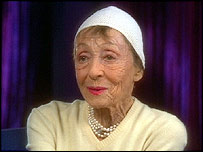

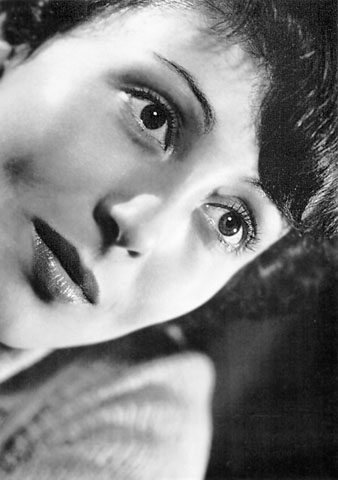
The start of the annual awards season has the Siren contemplating the mysteries of awards in general. So let's talk about Luise Rainer, the most famous double-Oscar-winning flameout in the history of Hollywood. Her career couldn't even be termed a brief candle--more like the brilliance and timespan of a bottle rocket.

On Jan. 12, Ms. Rainer turns 100 years old, bless her. The last time she showed at the Oscars, in 2002, she looked astonishingly good, as you can see from the photo here. When her Hollywood career was finished, she married a wealthy publisher and retired, and she now lives in London's Belgravia, surely one of the world's most beautiful neighborhoods. So obviously, Luise is doing much better than all right. That she made so few movies is our loss, but happily it doesn't seem to have been hers.
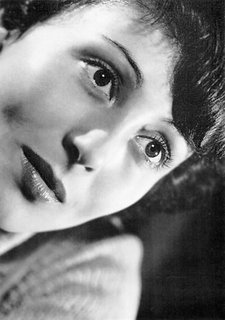

Born in Vienna in 1910 (some accounts say 1912, and others claim she was born in Dusseldorf, Germany), she was brought to Hollywood by MGM. Apparently in the mid-1930s, MGM was full of talent scouts who heard a European accent of any sort and immediately thought, "the successor to Garbo!" L.B. Mayer often used an up-and-comer as a none-too-subtle threat to an established star. (For years, Rosalind Russell was the threat behind Myrna Loy, unlikely as that sounds. Russell recalled an occasion when she was being fitted for a costume. Loy walked in and said "They signed my contract," and Russell had to disrobe on the spot. Fortunately, they were friends and could joke about it.)

So the dark, elfin Viennese came to California to line up behind the blonde, chiseled Swede like a taxi in front of a hotel. For a while she was given no roles but then, according to film historian David Shipman, Myrna Loy declined Escapade and Rainer was given the part. (Where was Russell?) The movie was forgettable, but Rainer photographed well, and the studio decided to cast her as Anna Held, The Great Ziegfeld's first wife.

The Siren enjoys The Great Ziegfeld (1936), though when she remembers it won the Academy Award for Best Picture over Modern Times she does tend to put hand to forehead. Rainer has an astonishingly short role, with but one evergreen scene. She calls Flo Ziegfeld (William Powell) on the telephone, to congratulate him on his marriage to Billie Burke (Myrna Loy). She still loves him, but she's determined to maintain her dignity. He tells her he's happy. She says she's happy, too. Tears pouring down her face, smiling all the while, Anna remarks on how funny it is, two former spouses "telling each other how 'appy we are."

Consider now what the Oscars were like in 1937, the year Rainer won. The dinner was open to favored members of the press but was nothing like the lavish stage show we see now. Stars were usually filmed for newsreels after the ceremony, giving canned versions of their speeches. Extras were permitted to vote, which they did in huge numbers, resulting, some say, in ex-extra Walter Brennan's extraordinary run--as Shipman put it, three Oscars, one performance. MGM also commanded a hefty bloc of people on its payroll who, essentially, voted as their bosses wanted them to. The power of that bloc endured for years.

Rainer got her award in the first year the Supporting Actress category was added, but MGM nominated her for a leading role anyway. It was the most powerful studio in town, and its brass did as they pleased. The telephone scene is nicely played, but I doubt most people nowadays would grant it an Oscar. But win Rainer did, over Carole Lombard in My Man Godfrey, among others.

In later years, Rainer would claim the first award was no lucky break, but a harbinger of career doom.
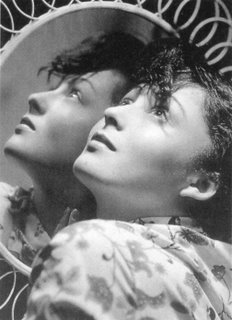


David Shipman's essay on Luise Rainer starts with an anecdote about Raymond Chandler preparing to go to an Oscar ceremony. The writer, no fan of Hollywood, still was nervous over his nomination for Double Indemnity. His wife told him to relax, that an Oscar was no big deal--"after all, Luise Rainer won it twice."

Since Rainer left Hollywood in 1940, judgments on her career have fallen into two categories. Mrs. Chandler summarizes one line of thinking, echoed here--Rainer was a zealously promoted, so-so actress whose Oscar wins over the likes of Lombard, Garbo, Dunne and Stanwyck are an enduring mystery. The other you can find here and here, with Luise described as an early Hollywood rebel, a great talent whose intellect couldn't suffer the film colony gladly.

After spending the week looking at all the Luise material she could find, the Siren thinks Luise was a little of both. She didn't blaze off the screen like a Crawford or a Garbo, but on the strength of her best performance, she surely could have had a long, productive career if the cards had turned a little differently.

In 2003, before appearing in a line-up of former Academy Award winners, Rainer gave an interview to the BBC, describing the night in 1937 when she won her first Oscar. Her endearing catalogue of small disasters involves a breathless maid, an oversized mattress sent by her father-in-law and a spat on the way to the banquet that forced her to ask the driver to circle the block a few times so she could pull herself together and go inside.

The squabble was with playwright (and Barton Fink model) Clifford Odets, whom Rainer had married earlier that year. It would not be the last time he caused her grief. Whatever you think of Odets as a playwright, as a husband his desirable qualities were less in evidence, such as when he carried on an affair with the luckless Frances Farmer. (While few would name Odets as the source of Farmer's legendary instability, there appears to be consensus that he sure as hell didn't help.)

Despite the home situation, Rainer's career was at its apex. Soon after her first Oscar she won the role of Olan in Irving Thalberg's swan song, The Good Earth. The decision broke the heart of Anna May Wong, the stunning Chinese-American actress who tested several times for the role. But once Rainer's fellow Austrian Paul Muni was cast as Olan's husband, Wong could not play the part without triggering the wrath of the Hays Office. High on that useless body's list of things it didn't want Americans seeing was on-screen miscegenation, actual or depicted. Anna couldn't even get the secondary role of the concubine Lotus, and had to watch that go to yet another Austrian, and a dancer at that, Tilly Losch. As a result the movie gives the odd impression that Chinese women tend to sound German. (Some secondary roles are played by Asian actors, notably the wonderful Keye Luke as the Elder Son.)

This sad casting history, and the offense a later age feels at Caucasian actors in yellowface, have marred The Good Earth's reputation. The Siren hopes that won't submerge it entirely; it was released on DVD in 2006. The movie is a dazzling piece of old-style filmmaking, the definition of the sort of epic we shall not see again, and at times it is very moving, due in large part to Rainer's performance.
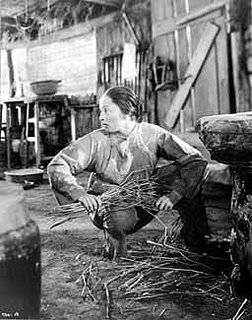
The Siren's knowledge of Chinese history is pitifully inadequate, but she suspects, suspects mind you, that The Good Earth is not a lifelike depiction of Chinese peasants before the rise of Mao. She respectfully suggests that the film shouldn't be judged that way. The art direction by Cedric Gibbons and the costumes are beautiful, and Karl Freund's cinematography is astounding. This is an archetypal story of peasants fighting against nature and their own baser impulses. It has more in common with Laura Ingalls Wilder's novels or even Renoir's The Southerner than it probably does with, say, some of the Chinese talkies that Filmbrain has written about.

Rainer's method of conveying Chinese-ness relies less on broad strokes and indication than Muni's. Her makeup is minimal, leaving her eyes unhampered for the camera. The stoic Olan, deeply in love with her selfish husband, is given sparse dialogue. And so Rainer's performance has effects similar to the best silent acting, with emotion conveyed by the flicker of an eyelid or the position of a hand. Her greatest moments come during the long, agonizing famine scenes. Her character is often derided as a doormat, but look at the scene where Olan gives birth as the family is starving. There is a brief cry, then silence. Rainer appears and tell Muni their child is dead. "But I heard a cry ..." Muni begins. "The child is dead," replies Rainer, with an intensity that silences her husband in mid-sentence.
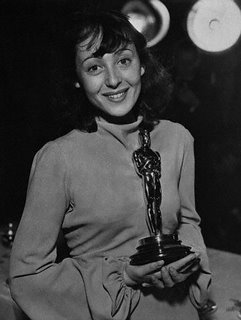
Convinced she couldn't possibly win two years in a row, Rainer opted to stay home on Oscar night in 1938. Then came another phone call, and another headlong rush to the banquet. In photos from that night she looks almost as though she's still panting. Her win came, notoriously, over contenders that included Garbo for Camille. Despite her high regard for Rainer's performance, the Siren herself would have voted for Irene Dunne in The Awful Truth. To this day, however, Oscar tends to go home with someone who's perceived to have tackled a "difficult" role--meaning, heart-rendingly dramatic and preferably something that requires the actress to look plain, or at least de-glammed. The Academy evidently decided that for a Hollywood actress, a starving peasant is more of a stretch than a kept woman.

Rainer rounded out the year with The Emperor's Candlesticks (some titles seem designed to warn you off, don't they?) and Frank Borzage's The Big City with Spencer Tracy. She made little box-office impression in either, although the Siren can attest that she's swell in the Borzage. Shipman says Rainer, with two Oscars for support, asked MGM for more money. I haven't been able to track down whether she got it, but the fact that she disappeared for part of 1938 suggests "no." On hiatus at the very time she should have been expanding upon her success, Rainer finally made The Toy Wife.

The Siren caught this one a few years ago on Turner Classic Movies. Rather than the fiery Southern belle you get in Jezebel or that Selznick movie, in this one you get Southern Belle Version 2.0, the doomed variety. Rainer's character is named Frou Frou, in imitation of the sound her skirts make. She was educated in Paris and returns to her native New Orleans with a German accent. She marries Melvyn Douglas, but has an affair with Robert Taylor, and for whatever reason, Rainer was about 100 times more convincing as a Chinese peasant. The one moment where the Siren thought she saw an actress was a scene where Frou Frou's small son comes to wake her up. She bounces around on the bed and plays with him, and in this small moment displays an unaffected sparkle that she never summons again, not in this movie.

She finally got another hit with The Great Waltz, Julien Duvivier's venture into the MGM musical. Or is operetta? or biopic? or historical romance? The movie is so transcendently weird that you can take your pick. My favorite interpretation so far is the IMDB review that insists the movie is a political allegory about the Anschluss. Well, The Great Waltz has at least as much to do with the Anschluss as it does with the life of Johann Strauss. As the wife, Rainer did a good job with what the script gave her. Unfortunately, the script left her to dangle her bonnet and mope after Fernand Gravet's Strauss as he pursues Miliza Korjus and composes waltz after waltz. Luise had the billing, but Korjus got to help compose "Tales from the Vienna Woods" in a single carriage ride.

The next movie, Dramatic School, was intended as a showcase for Rainer. It flopped. Rainer was given six months' leave, Shipman says, to visit Odets and prop up their shaky marriage. Her contract was not renewed. She did a couple of plays in London and returned to Hollywood in 1939. There was no way Rainer, Jewish and proudly left-wing, would go back to Europe, but the months slipped past with no roles in sight. In 1940 she returned to New York with Odets, divorcing him later that year.

Shipman says "her potential was exhausted." Later writers would say that L.B. Mayer offered Rainer a series of roles that were beneath her. Rainer, they say, became frustrated with the sheer dumbness of Hollywood, a place "where clothes were a major preoccupation."

Hollywood bored her right out of a career. Plausible. But, to quote the lyrics from a song by an intelligent composer who did just fine in movies, it ain't necessarily so. When the Siren hears someone--particularly a German-speaking actress--calling the Hollywood of 1940 an intellectual Sahara, her eyebrows just about disappear into her hairline. By that year the film community was awash with refugees, including some of the century's finest European minds. Many of them met regularly at the home of Garbo's favorite screenwriter, the Austrian Salka Viertel. If Luise had wangled an invitation (and surely two Oscars at least got you that) she could have chatted up Arnold Schoenberg, Thomas Mann, Heinrich Mann, Erich Maria Remarque, Gina Kaus, Bruno & Liesl Frank, Berlin Alexanderplatz novelist Alfred Döblin and Grand Hotel author Vicki Baum. If she had stuck around until December she might have encountered Alma Mahler-Werfel and husband Franz Werfel. Bertholt Brecht arrived the next year.

Anyhow, you see my point. The idea that there was nothing in Hollywood to interest an intellectual and politically engaged woman doesn't wash. Especially if you have seen The Toy Wife.

Her marriage over, Rainer spent the war years doing the occasional play and selling war bonds. In 1943 she did a movie at Paramount, Hostages. The Resistance drama did not rekindle interest in her. She didn't make another movie until 1997's The Gambler. She married publisher Robert Knittel, returned with him to Europe after the war, and by all accounts has led a contented life.

There is a sting, however, in her latter-day remarks about Hollywood, one that suggests some regret. Her IMDB bio quotes her saying in 1997, "I was dreaming naturally like anyone to do something very good, but after I got the two Academy Awards the studio thought, it doesn't matter what she gets. They threw all kinds of stuff on me, and I thought, no, I didn't want to be an actress."

Though Rainer has, admirably, never emphasized this, her marriage to Odets couldn't have come at a worse time. There's nothing like a turbulent personal life to bleed a career. You can deduce, too, that in addition to her scorn for the sucking-up a Hollywood career thrives on, Rainer may not have been all velvet to work with. Lana Turner's autobiography described Rainer holding up production on the set of Dramatic School. Federico Fellini wanted Rainer for a part in La Dolce Vita, but she asked for rewrites and he abandoned the idea. Demanding rewrites from the director of La Strada suggests, shall we say, a certain perfectionism.

Curses make for cute headlines, but lousy analysis. The Hope diamond didn't doom Harry Winston, the discoverer of King Tutankhamen's tomb died in bed, and Rainer's career was undone by a combination of bad timing, a bad husband and some bad choices. She made only eight movies in the 1930s. She's pretty good in three of them and very good indeed in one more. Looking at the chic, beautiful old woman as she stands in a line-up of past Oscar winners, her confidence evident in every line of her carriage, the Siren concludes that Luise was lucky indeed.

Thứ Hai, 14 tháng 9, 2009

Ten Melos the Siren Would Watch Instead of "Mad Men"


If sticking it out for two-and-a-half episodes of Season 1 and one episode this season can be called trying, the Siren has tried with "Mad Men". She sees the attraction, even if the hype blows her mind--everything from Banana Republic to Barron's, for heaven's sake. The Siren admires the cinematic qualities of the series, the fluid camerawork, the carefully angled shots, the flawless integration of sets and costumes. It's pretty. The actors are pretty. The period detail is enough to warm an old-movie hound's heart. But on the whole, the Siren just doesn't dig it.

Despite the stratospheric sex appeal of Jon Hamm, January Jones and Christina Hendricks, the show is just so goddamned dour. The Siren suspects series creator Matthew Weiner wanted to avoid the nostalgia trap, but this is too far in the other direction. A little soupçon of affection for the past will not turn Mr. Weiner's dead-serious critique into "The Wonder Years Meets Ad Age." The Siren has seen movies from the era, and in those movies, people have a good time--every now and then, you understand, between bouts of weltschmerz. As James Wolcott wrote in Vanity Fair, "Mad Men" "has a seductive look, a compelling mood, a cast that could have been carved from a giant bar of Ivory soap, but zero grasp of the elastic optimism and vigor of the Kennedy years, the let-go spring of release after the constriction of the Eisenhower 50s."

Everyone on "Mad Men" goes around smoking and drinking and eating whatever they hell they want and having office affairs without once looking over their lovers' shoulders for process servers bearing class-action subpoenas, but does anyone enjoy it? Not from what the Siren has seen. It's like Saint Augustine wrote the scripts. Such laughs as "Mad Men" affords are tethered to hindsight--"We never indulge in such sexism/racism/anti-Semitism/homophobia now, and even if we do, we sure don't smoke."

Still, the Siren will probably watch more this season--between Wolcott's liveblogging and Lance's occasional commentaries, she doesn't want to be the clueless playground oddball. But in her heart, she'd rather watch a melodrama from the actual late Eisenhower-early Kennedy era. Good or bad, there's plenty to choose from.

So that's my justification for posting these brief takes on ten films actually made during the "Mad Men" period--dramas, because "Mad Men" is not, god knows, a comedy or a musical. These movies vary widely in terms of quality and critical repute, from bona fide masterpieces to simple soapers. But the Siren likes them all, as she likes a lot of the melodramas from this period. Many directors were exploring widescreen technique to admirable effect, and it was a great era for clothes and interiors. And when you watch the movies, you realize that people were far more aware of what was under society's facade than many suppose. (Two of the movies date to 1959--if Don Draper can fade out to Bob Dylan in 1960 then the Siren can cheat back a single year, she figures.)


Imitation of Life (Douglas Sirk, 1959)
Social Issue: Racism.
Sets and Costumes: Perfection.
Sex appeal (Low/Medium/High): Beside the point. But John Gavin was in the full flower of his lockjaw handsomeness and Susan Kohner and Sandra Dee were lovely.
Why the Siren Likes It: It's a masterpiece, that's why, one that belongs on any list of the great films of the 1950s. A master class in how to make a movie about misguided, surface-focused people trapped by a hypocritical society, without condescending to or withholding compassion from them. The proof is that 50 years after its release, the thwarted mother-daughter love still reduces many to tears. The Siren bristles when she hears this described as camp. There isn't a single unintentional effect in it. The falseness and glitter are there to throw race, this country's original sin, into high relief. But Sirk doesn't invite the audience to feel superior. He wants recognition, AND he wants identification. In the superb opening scene on the beach, when Lana Turner reacts with gooey middle-class "understanding" to Juanita Moore's having a white-skinned daughter, Sirk didn't want the white liberals in the audience to say, "What a hypocrite." He wanted them to say, "Shit, that's me." (The beautiful screen cap is from Ways of Seeing, the Siren's new blog discovery; several others, equally enthralling, right here.)

The Best of Everything (Jean Negulesco, 1959)
Social Issues: Working women and adultery (go together like a horse and carriage in Hollywood movies of all eras), unwed pregnancy, abortion, casting couch, alcoholism.
Sets and Costumes: Great New York exteriors and the ultimate in smart little suits. Best of all, the Mondrian-esque office interiors, which Negulesco, a painter, probably influenced.
Sex appeal: High; Suzy Parker, Stephen Boyd, Louis Jourdan, even Robert Evans looks great.
Why the Siren Likes It: Underrated, influential film whose critical reputation is slowly improving. One of a number of "three [or four] girls" movies from the era, direct ancestors of "Sex and the City." Enjoyable on a number of different levels--as highly informative social artifact, as a proto-feminist tract, as an aesthetic treat, as a showcase for newcomers and old pros. The Siren particularly likes good old Brian Aherne as an ass-pinching executive and Joan Crawford, refusing to play her role as straight office harridan, giving her character both dignity and sensitivity. The beauteous Parker (up top) gets the best line: "Here's to men. Bless their clean-cut faces and their dirty little minds." The best appreciation of this film that the Siren has read is over at Noel Vera's place; he pays great attention to Negulesco's use of Cinemascope.

From the Terrace (Mark Robson, 1960)
Social Issues: Alcoholism, adultery, class snobbery, cutthroat business practices.
Sets and Costumes: High-end all the way. Joanne Woodward doesn't look completely at ease in Travilla, though.
Sex appeal: High. Paul Newman rates an automatic "high" in this category, as does Myrna Loy at any age.
Why the Siren Likes It: A parable about life versus work that everybody calls dated, except "Mad Men" apes the same themes. The Siren wrote a bit about this movie when Newman died; his performance is very good but the direction is noteworthy too, as is the Elmer Bernstein score.


All the Fine Young Cannibals (Michael Anderson, 1960)
Social Issues: Racism, alcoholism, class snobbery, adultery.
Sets and Costumes: Ersatz Southern, then faux bohemian, but extremely well-shot by William H. Daniels.
Sex appeal: Medium, largely because the Siren doesn't get Robert Wagner.
Why the Siren Likes It: Supposedly based on the life of Chet Baker. Jaggedly uneven and no one seems to have a clue about real white Southerners. But deserves to be remembered, if only for Pearl Bailey's haunting performance. For the Siren and those like her, there's also the nifty bit of role reversal for Susan Kohner, the "tragic mulatto" of Sirk's Imitation of Life, in the same movie as the penultimate role for Louise Beavers, of John Stahl's excellent 1934 Imitation of Life. (Poster is from the great Cinema Retro site.)


Return to Peyton Place (Jose Ferrer, 1961)
Social Issues: Working women (don't kid yourself, that's still an issue), rape, incest, adultery, (disguised) abortion, xenophobia.
Sets and Costumes: Meh. The exteriors look great, though.
Sex appeal: High; Eleanor Parker, Tuesday Weld, Carol Lynley, Jeff Chandler if you happen to like Jeff Chandler.
Why the Siren Likes It: Um...hard to say, since by no stretch of the imagination is it a good movie. This one the Siren won't kill you for calling camp. There really isn't anything else you could call it. The first Peyton Place is camp too, but had real value in Franz Waxman's score (heaven), Diane Varsi and the New England ambiance. Return, well, Ferrer was no director, they added lyrics and Rosemary Clooney when Waxman needed neither, and most of the cast looks about as comfortable as a soaking wet cat. But I appreciate Carol Lynley's pursuit of a career over and above a love affair (similar to the reason I liked Valley of the Dolls' fadeout). Mary Astor is great, playing a full-out embodiment of small-minded paranoia and ugliness. And Tuesday Weld manages to have emotional sincerity in some scenes despite playing opposite the stiffest excuse for a Swedish ski instructor you ever saw in your life.


Susan Slade (Delmer Daves, 1961)
Social Issues: Premarital sex, unwed motherhood, the hazards of cigarette smoking.
Sets and Costumes: Beautiful exteriors by master cinematographer Lucien Ballard, and the vaguely Japanese-style house on the Northern California coast, given to Connie Stevens's father by Brian Aherne (there he is again!) is quite an eyeful.
Sex appeal: Medium, though Connie Stevens (above) does her best.
Why the Siren Likes It: Interesting, Sirk-esque late-career movie by the talented Delmer Daves, with several scenes that have lost none of their ability to shock. Dave Kehr: "To an America that needed to believe that 'nice girls don’t,' Daves’s melodramas responded, 'Nice girls do' — or did at least sometimes, when the appropriate distinctions had been made between lust and love, predatory older males and sincere young men, casual encounters and lifetime commitments." Kehr prefers Parrish and Rome Adventure to Susan Slade and the Siren pretty much agrees with him, but Slade is worthwhile and closest to the "Mad Men" school of social history. Peter Nelhaus has a fine review of the movie, in which he compares it to Daves' westerns.


Advise and Consent (Otto Preminger, 1962)
Social Issues: Homophobia, subversion, government corruption.
Sets and Costumes: Stiff, cold and forbidding, perfectly in keeping with the machinations of the plot.
Sex appeal: Low. Gene Tierney is in this but she wasn't looking her best. Perhaps because he was making a movie about politicians, Preminger shot everyone with a GargoyleCam.
Why the Siren Likes It: Another masterpiece, a fisheyed look at the Washington influence game, usually taken as a riff on Alger Hiss but full of other echos as well. The scenes of back-door-dealing and blackmail ring as true as they ever did. Those tempted to tag the young, upright conservative senator's operatic torment over his gay attractions as quaint should think back to Jim McGreevey, Larry Craig and their many brethren--not to mention their wives. Despite the Red Scare trappings (and those are somewhat back in fashion, if you've noticed), Advise and Consent is one hell of a prescient movie. (To see just how prescient, the Siren recommends you check out this article by Meredith Hindley, senior writer at Humanities, on "The Transformation of Advise and Consent.") The above is from Ways of Seeing, whose proprietor clearly has excellent taste; for more screen grabs to show just how good this movie is, please click over and check out the rest.


The Light in the Piazza (Guy Green, 1962)
Social Issues: Mental retardation, class snobbery.
Sets and Costumes: Stunningly beautiful Italian setting (Guy Green was a highly accomplished cinematographer), Christian Dior dresses for Olivia de Havilland.
Sex appeal: High; Yvette Mimieux, George Hamilton and Rossano Brazzi, and de Havilland is much lovelier than the frightening lip color above suggests.
Why the Siren Likes It: Tender romance with a great performance by de Havilland, who carries the movie. Recently turned into an acclaimed musical that the Siren, alas, did not see. She does think the movie's insistence on the primacy of love, both parental and romantic, makes it a good choice for a musical treatment. At a time when the common practice was to shut the mentally retarded away in institutions, the notion that a developmentally delayed girl (albeit a beautiful one) deserved to marry a prince of an Italian and have babies was nothing short of revolutionary.


The V.I.P.s (Anthony Asquith, 1963)
Social Issues: Cutthroat business practices, tax evasion, adultery, domestic violence, depression.
Sets and Costumes: Enough to make you fly to Heathrow and wait to get fogged in--if flying were still like this.
Sex appeal: High. (Elizabeth Taylor at this point in her career does the same for a movie as Paul Newman. Elsa Martinelli was nothing to sneeze at, and neither was Richard Burton or Louis Jourdan.)
Why the Siren Likes It: See Return to Peyton Place. Plenty of lush period visuals, and there are pleasures to be had from Orson Welles even in unworthy roles (this one tinged with painful self-parody). But it's a pretty bad movie, though hardly the offense to all civilization that Walter Chaw paints it, and Elizabeth Taylor is an unconvincing version of Vivien Leigh. (Note to Mr. Chaw: Rod Taylor was a native Australian.) The Siren likes this primarily for Maggie Smith as the devoted secretary. I do love Dame Maggie. Christina Hendricks is good, but she still could learn something from what Smith accomplishes with a cliched role. Smith's scene with Richard Burton is the highlight, the so-so writing propped up with perfectly timed and calibrated reactions and beats.


Love With the Proper Stranger (Robert Mulligan, 1963)
Social Issues: Premarital sex, abortion, unwed motherhood.
Sets and Costumes: Supposedly low-end, but a mite too clean for all that. Steve McQueen made everything he wore look like a well-broken-in motorcycle jacket.
Sex appeal: High. Look at that publicity shot and tell me different.
Why the Siren Likes It: Has comic moments, but at heart a rather melancholy movie about a still-relevant topic, with legendary leads giving warm, authentic performances despite a wan third act. McQueen seldom let his vaunted cool slip to as much effect as here. When "Mad Men" gives a nudge about how far we've come, we should remember Wood planning an abortion, without hysteria. How many recent Hollywood movies or TV shows have let a beautiful, sympathetic lead do the same?

All right, so it's been a while, have at it. Tell me why I'm wrong about "Mad Men." Point out the movies I missed. (The Apartment isn't there and doesn't belong there; it's a comedy, and a satire, and very funny, and "Mad Men" isn't any of those those things.)

But, as always, play nice. The new banner, which MrsHenryWindleVale recognized without a telescope, is courtesy of the great Glenn Kenny. It is of course Dorothy Malone, from another Sirk masterpiece, The Tarnished Angels. Dorothy is meant to illustrate the Siren's general mood for the past month and probably the next.

Postscript: I've added a link to Peter Nelhaus's fine writeup (with lovely screen caps) of Susan Slade. Despite the deliberately provocative title, my main idea in writing this piece was "Hey, these early-1960s films that I love deserve a second look." So if anyone else has a post on some of these, or a similar movie from 1959-1963, post a link in comments by all means and I'll add it here. I'll start by also linking to Peter's post about Strangers When We Meet (b/w Town Without Pity, which also roughly fits our parameters despite the German setting). The Siren forgot about Richard Quine because--well, see banner above. Because of that.

Awesome screen caps from The Best of Everything right here. Apparently my mistake was not Googling "Suzy Parker."

Nathaniel of The Film Experience has been doing a series on movie references in Mad Men; one post involves a Draper household pillow-talk discussion of The Best of Everything that the Siren is sorry she missed. Great for "Mad Men" fans but rewarding for non-watchers too.

MORE UPDATES:

Vertigo's Psyche gives some love to Siren darling Sandra Dee and her exquisite performance in A Summer Place.

Arthur S., one of the most astute commenters in the film blogosphere, links us all up to a Douglas Sirk interview that is not to be missed.