Thứ Ba, 24 tháng 10, 2006

The Family Campaspe Celebrates the First Weekend ...


of Abraham Ben, born Oct. 19, 2006, at 4:41 pm, in New York. While he thus far refuses interviews, sources close to the new arrival state he made his debut at 8 pounds, 8 ounces, 20 inches in length. So far the raves are unanimous. Publicists are currently deciding which paparazzi shot of Ben, or Bibou as his fans call him, is the most flattering for release to the public. Meanwhile, groggy best wishes, and the Siren will be back soon, she promises.

Thứ Hai, 2 tháng 10, 2006

Stanley, Tony and The Defiant Ones


If Libertas insisted on calling Red-Blue Film Teams, the Siren is pretty sure Team Blue could call Stanley Kramer without comment. His name is a byword for earnest, uninspired liberal filmmaking. That's liberal and by no means left-wing, as this excellent assessment in a socialist periodical points out.

You don't disagree with Kramer because he stacks the deck. He's so reasonable he can cross over into irritating. The Siren likes Inherit the Wind a lot, but cringes every time Spencer Tracy walks out with a copy of Darwin AND the Bible under his arm. As someone who grew up surrounded by That Old-Time Religion, let's just say that wasn't the ending she was rooting for.

It's a Mad, Mad, Mad, Mad World is too cumbersome to be funny, Judgment at Nuremberg has been supplanted by finer films on the Holocaust. Guess Who's Coming to Dinner? is worth watching nowadays only for Sidney's Poitier general gorgeousness, since the man wasn't given an actual character to play, and for Katharine Houghton, a lovely presence whose later career played out mostly on stage.

So the Siren settled in to watch the The Defiant Ones expecting, well, not much. Who knew that would really make the film worth watching would be a bigoted Southern convict, played by Bernie Schwartz from the Bronx?

Tony Curtis gives a really good performance, and because his character isn't freighted with the same symbolic baggage as that of his costar, even Sidney Poitier's formidable talent doesn't make quite as large an impression. Curtis is entirely credible as Joker Jackson, the convict who escapes from a prison work gang still chained to Noah Cullen (Poitier). The two men make their way across the rural South, encountering--well, the sort of stuff you'd expect a black man chained to a white man to encounter in the rural South circa 1958. Hostility, in a word. And a few standout character actors, including Lon Chaney Jr. and Claude Akins. Curtis and Poitier are pursued by reluctant and humane sheriff Theodore Bikel, who is prodded in turn by his captain, Charles McGraw in merciless mode. (If you want a complete plot rundown, or have seen the movie already, do check out this great piece at PrisonFlicks.com, a genre site that is the Siren's latest discovery.)

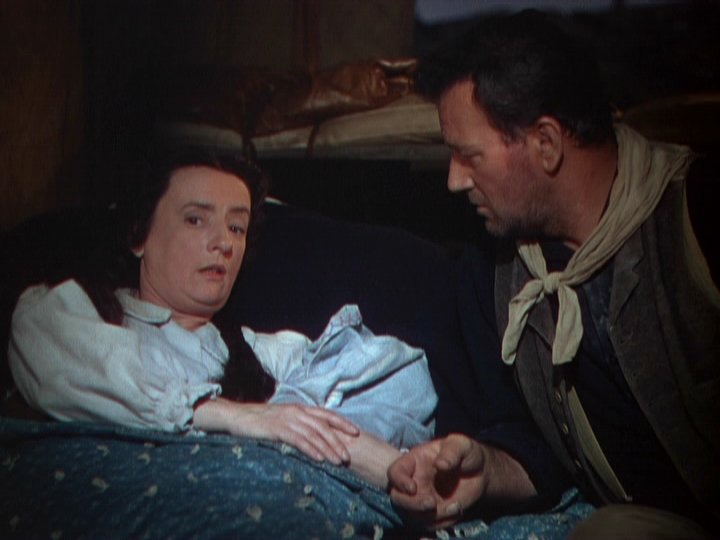
If the 1960s became the age of the Beautiful British Actor, in the 1950s it was the Americans who seemed to line up dazzling male beauties, one after the other--Marlon Brando, James Dean, Montgomery Clift, Rock Hudson, Burt Lancaster. Tony Curtis could hold his own in the looks department against any of them, so much so that he has a prosthetic on his nose in this movie in an attempt to damp his appeal. How well that works (basically, it doesn't) can be judged from the still above. But Curtis's amazing looks help believability late in the film, when a lonely, frustrated grass widow takes one look at him, chains and all, and starts fixing his supper.

In terms of camera work, the film isn't very engaging. The images themselves are often beautiful (and won an Oscar for cinematographer Sam Leavitt) it's just that the film language tends to be pedestrian. Example: a long and very well-played monologue, delivered in bed by an ailing Tony to the grass widow. About midway through his speech the camera tracks back to an overhead shot, and lingers there, and oh look it is lit like a CHURCH, just like CONFESSION, and then descends again. You get a lot of stuff like that. Subtlety was in no way Kramer's strong suit.

Guiding actors, on the other hand, was. Kramer films are full of good acting. Here Curtis holds his own against all odds, even to a passable Southern accent. (He concentrates on the vowels and all but ignores the consonants, and so avoids that exaggerated drawl that kills many imitation Southern accents.) He gets the best character arc in the movie, but in the end it is an open question whether Joker has come anywhere close to overcoming his prejudice. Where Curtis succeeds is in showing how this convict is able to move beyond a criminal's strongest trait, his absolute selfishness.

A general Curtis postscript: Last year I read his 1993 autobiography, cowritten with the excellent biographer Barry Paris. It is a strange book indeed. Curtis vaults beyond arrogance, into a territory where your self-love is so enveloping you have no idea how you sound to other people. (For instance, when Curtis describes how he decided to quit visiting his pathetic, institutionalized schizophrenic younger brother.) The frank selfishness is so consistent that after a while, amazingly, it gets to be kind of endearing. The man lets it all hang out. And once you have read the book, it isn't surprising that The Defiant Ones has something in common with other great Curtis performances in Sweet Smell of Success and The Boston Strangler. He isn't afraid to be disliked, which the Siren would call a mark of any real actor, as opposed to a matinee idol. It is a shame that Curtis's career, with a few bright exceptions, petered out in the 60s in a series of silly farces--jobs taken in part to make child support payments for his six kids from various marriages.

Chủ Nhật, 24 tháng 9, 2006

The Gym Class School of Film Criticism

Like most bloggers, the Siren likes to look at other blogs. A while back she discovered Libertas. The writers there do not exactly share her own political philosophy, but it's healthy to read opposing opinions, and they cover a lot of old movies, so the Siren still checks in every once in a while.

There are times when the Siren simply disagrees with Libertas (you can see her objecting in the comments section to this post on The Searchers), times when she thinks hmm, interesting and other times when she's just flummoxed. Like this post on Flags of Our Fathers. The film hasn't been released yet, so blog editor Jason Apuzzo is critiquing the trailer, which strikes the Siren as a mighty perilous approach. Trailers are the reason she went to The Crying Game expecting The Informer, for example, and thought the worst thing that could happen in Million-Dollar Baby was that Hilary Swank might lose the big fight. Anyway, here is the trailer. Please do take a look before you continue.

What did you see? The Siren saw a preview for a movie about some very brave soldiers, who saw some bad things during a terrible and hard-fought battle, came home and found themselves catapulted into unexpected fame, were dragooned into war-bond drives they found embarrassing and crass, and wound up wracked with self-doubt because they didn't consider themselves heroic in comparison to the men killed in battle.


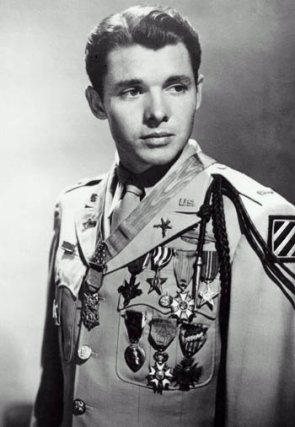
The Audie Murphy story in triplicate, in other words.


What she did not see was a commentary on the Iraq war, the insinuation that World War II was unjust or that the men who raised the flag on Iwo Jima were frauds or war criminals.

What the hell? That trailer is nothing. You want a cynical, politicized WW II movie, the Siren'll give you a cynical, politicized WW II movie. How about Attack, the 1956 film that shows a soldier dying as horrible a combat death as you've ever seen--and dying that way, mind you, due to the cowardice of an American officer promoted solely because of his rich daddy's connections. (The Siren is convinced that sequence must have influenced Steven Spielberg when he was creating one of Saving Private Ryan's most memorable death scenes--but the Siren also says Attack is the better movie.)

Or let's talk about a movie with enough derring-do to satisfy even Libertas, The Bridge on the River Kwai.
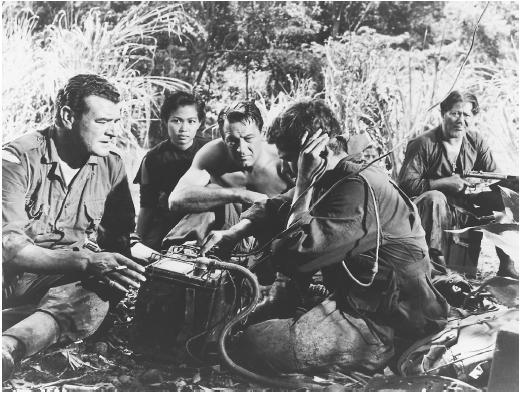
Even in that one, you want moral equivalence? Take a look at the none-too-subtle parallels between Sessue Hayakawa's camp commander and Alec Guinness's POW. And ruthlessness to spare, with Jack Hawkins as the British commando ready to sacrifice not only himself, but William Holden and every other man he brought with him. The Siren's favorite shot in that splendid movie shows the young women bearers recoiling from Hawkins--they know what he is, no matter what cause he's pursuing. The primary characters in Bridge are, with the qualified exception of Holden, utterly focused on winning their narrowly defined parts of the war game, to the point that they are barely thinking about the larger issues at stake. That is what happens in a war, Carl Foreman, Michael Wilson and David Lean are telling us.

Or how about The Best Years of Our Lives. Homer, the returning GI with hooks for hands, finds himself in a drugstore being queried by a customer who obviously never saw combat.

Customer: You got plenty of guts. It's terrible when you see a guy like you that had to sacrifice himself - and for what?
Homer: And for what? I don't getcha Mister?
Customer: ...We let ourselves get sold down the river. We were pushed into war.
Homer: Sure, by the Japs and the Nazis so we had...
Customer: No, the Germans and the Japs had nothing against us. They just wanted to fight the limeys and the reds. And they would have whipped 'em too, if we didn't get deceived into it by a bunch of radicals in Washington.
Homer: What are you talkin' about?
Customer: We fought the wrong people, that's all. (Pointing at his newspaper, with headlines: "SENATOR WARNS OF NEW WAR") Just read the facts, my friend. Find out for yourself why you had to lose your hands. And then go out and do something about it.


That customer says he is espousing "plain, old-fashioned Americanism." He's an accurate depiction of post-war sentiment in certain quarters. But if such a character pops up in Flags of Our Fathers, Mr. Apuzzo will probably have apoplexy.

The Siren adores Best Years, and without hesitation would cite it as the greatest celebration of true American values ever made. But part of its greatness lies in the filmmakers' willingness to include a character like that drugstore customer, or the people overheard making snide remarks about veterans flooding the job market. Conflict, you see. Nuance. Dramatic shading. A movie that has those qualities has a shot at greatness, or at least watchability. A movie that doesn't have them will be Little Tokyo, USA or at best Conan the Barbarian.

Why this bizarre insistence that any attempt to show any World War II leaders as less than stainless somehow represents an insidious left-wing all-American-wars-are-imperialist agenda? After seeing a trailer, for heaven's sake. Well, Mr. Apuzzo pretty much tells you what he is basing his assumptions on--screenwriter Paul Haggis. Haggis, you see, is a liberal, and that's enough: "My concern was that Haggis would try to smuggle his politics into Eastwood's Iwo Jima melodrama, and it appears that my concerns were justified."

There's a whopping big assumption in that sentence, that Haggis could somehow work in his agenda without Eastwood, a meticulous director and one tough hombre to boot, either noticing or saying "Hey Haggis, what is this pantywaist crap you're putting in my movie, punk?" But no matter. Haggis is vocally liberal, therefore he will always try to make a certain type of movie, even to the point of trying to hoodwink Eastwood, whose politics skew conservative.

The Siren calls this approach to evaluating a movie The Gym Class School of Film Criticism. Lance Mannion periodically tracks the flowering of this approach. The Gym Class School imagines art as a dodgeball game, with critics, cinephiles and Hollywood observers of various sorts as the self-appointed team captains. Actors, directors, screenwriters etc. are the potential Team Players. Death doesn't disqualify a player, in fact it can increase the squabbling when teams are selected. So it works something like:

Team Red Captain: I call Cecil B. DeMille.
Team Blue Captain: I call John Huston.
Red C: Sam Wood.
Blue C: Charlie Chaplin
Except, it rapidly deteriorates into:

Red C: John Ford.
Blue C: Says who? He was a New Dealer--
Red C: But then he went Republican. And he was always fervently anti-Communist. And then he--
Blue C: All right then, smartypants. Joseph Mankiewicz.
Red C: What?? Mankiewicz was a Republican!
Blue C: But he was a liberal Republican.
Red C: Then I call Frank Capra.

As biographical critique, it doesn't work very well. As film criticism, it doesn't work at all. Whose politics dominate a movie--the director, the actors, the screenwriter, the cinematographer, the best boy? And it is apparent to all but the most hidebound minds that an artist's politics may or may not have anything to do with his work. William Holden was a Republican, and two of the best movies he ever made were for a liberal director and a couple of blacklisted screenwriters. Flipping it around, if I know that Henry Fonda was a lifelong Democrat, that tells me exactly what about Advise and Consent, a film from a book by a noted conservative?

Gym class was a time of horror for the Siren, and she has no intention of revisiting it for Flags of Our Fathers or the next Gary Oldman flick. The Siren is not an optimist by nature, but she tries to give serious filmmakers (defined as those with some aspirations beyond the grosses) a fair shake with each new movie. You can get a great performance out of granite-ribbed reactionary Adolphe Menjou in the bitingly subversive Paths of Glory, or a beautiful elegy for the ruling class like The Leopard out of avowed Marxist Luchino Visconti. In the words of the great Fats Waller, one never knows, do one?

Thứ Sáu, 1 tháng 9, 2006

Anecdote of the Week


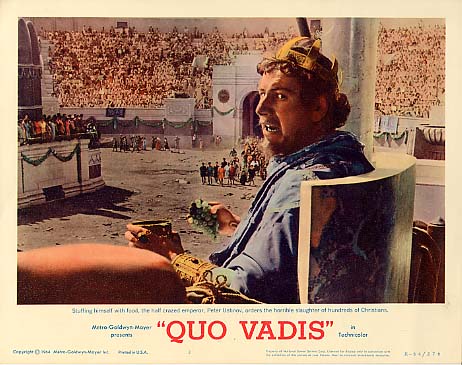
"The film was a great success all over the world and brought Peter a recognition that was not always to his liking. He was in New York for the opening and climbed into a cab, but before he could state his destination the driver enquired, 'Quo vadis, Mr. Ustinov?'"

--From Peter Ustinov: The Gift of Laughter, by John Miller.

Thứ Tư, 9 tháng 8, 2006

Knocked Up at the Movies

Did the Siren happen to mention she's knocked up? No? Oops. Well, she is, 29 weeks. It's a boy, due late October, nameless as of now. Film-oriented suggestions welcome. If your suggested name is chosen, we owe you a goat, or a sheep, your choice. (Lebanese tradition.)
So the Siren has been mulling this post for a while, but the pickings are mighty slim for the eras she usually covers. Thanks to the censors, pregnancy and childbirth were treated with a spectacular lack of realism during the Golden Age. The baby belly was either nonexistent or suggested by the heroine's adjusting her belt buckle a few notches. The Hays Code didn't specifically require this (so far as the Siren's research shows), so perhaps the tradition of padding the woman with a lace hanky and calling it a day was just the studios' reluctance to show a glamor gal waddling. The code did forbid childbirth scenes, however, so usually what you would get would be the pitter-patter of little feet talk between the (always married) couple, then a swift cut to a waiting room, or a cradle, or some such. On the rare occasions when pregnant women did appear on screen, they were from some other planet where seven months looks like two, a planet the Siren fervently wishes she were on right now.

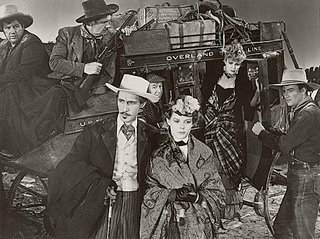
In the 1939 Stagecoach, for example, Louise Platt plays a genteel wife going to join her Army husband. The dialogue only lightly alludes to her pregnancy. She clutches a paisley shawl over a figure that looks quite slim, and she retains the gait of a Virginia belle. Try dismounting from a stagecoach late in your third trimester, and see if you are up to gracefully placing your hand in the hand of a John Carradine substitute. The more likely scenario is that you grab his forearm for dear life and lumber down those teetering little steps like a Saint Bernard with advanced arthritis. Even as a teen with no experience of pregnancy, either hers or anyone else's, the Siren saw Stagecoach and figured Platt's character was four months, tops. So it was a bit of a shock when Platt went into apparently full-term labor midway through the movie.

Gone with the Wind, made the same year, is comparatively realistic, with Melanie giving birth during the siege of Atlanta. Only vague silhouettes show, and there's no screaming, though Scarlett tells her to yell her head off if she wants. Afterward Melanie is extremely sick and weak--hemorrhage, maybe? You aren't told, nor do you have any idea why she's told not to have more babies and eventually dies in childbirth after ignoring the advice. When she tells Clark Gable she is expecting another child, her shawl is draped just like Platt's.
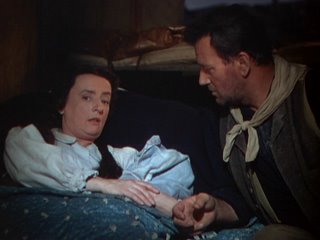
Puerperal fever? obstructed labor? Whatever the unidentified cause, plenty of women die in childbirth at the movies, often off-camera, as in the saddest scene in Goodbye, Mr. Chips (1939). If they do it on camera, they do it beatifically, like Melanie. In 3 Godfathers (1948), a John Ford that the Siren loves, Mildred Natwick (43 years old, and looking every day of it) is found in a wagon about to give birth, the fact that things are going badly conveyed by her gasping a lot and struggling to sit up. The men try to help the delivery, but she is a goner. Braids neat, face matte, clad in a miraculously clean white nightgown, she hands the baby over to John Wayne, Pedro Armendariz and Harry Carey Jr., and dies.

But the Siren is looking for pregnancy at the movies, and this is largely childbirth, and damned unlucky childbirth, at that. Well, there is Leave Her to Heaven, if you want an example of a woman who doesn't exactly sing the Magnificat upon hearing the happy news. As Gene Tierney's monstrous Ellen is put on a late-1940s version of bedrest, she becomes arguably even more insane than she was previously. Convinced that husband Cornel Wilde is developing too tight a bond with her sister Ruth (Jeanne Crain), Ellen decides to get rid of what is confining her to bed.
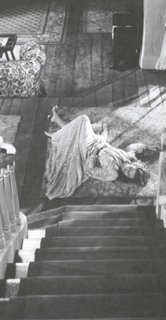
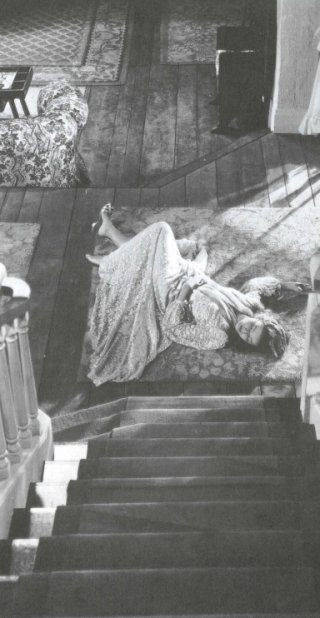
The big, indelible scene from John Stahl's movie has Tierney in a rowboat in the middle of the lake, calmly watching as her polio-crippled brother-in-law gets a cramp and drowns. But the Siren was also marked at an early age by the moment when Tierney gets herself un-pregnant. Wearing a beautiful negligee, with a belly the Siren would measure at about five days post-conception, Ellen walks to the top of the staircase. You see her, like a psychopathic Cinderella, carefully remove a slipper to be left as evidence at the top landing. Then, camera still focused on her feet, Ellen throws herself down the stairs and lands in an artful heap, nightgown still so clean Mildred Natwick would be proud. Do you suppose any women saw this and thought it would be a foolproof way to end an unwanted pregnancy? In reality, of course, it isn't nearly that easy to induce a miscarriage, although Ellen is having a touch-and-go pregnancy already.

Speaking of dangerous pregnancies--even the daring Miracle of Morgan's Creek (1944) didn't show the slightest bulge in pregnant Betty Hutton, despite the fact that she must be about three months before we cut to a later stage of her pregnancy. At that point they film her from behind, which is probably just as well. The miracle is (skip the rest of this paragraph if you don't want to know) that Hutton is pregnant with sextuplets.

Ha, ha, ha. The Siren has had twins. At three months she looked about five months. At five months people asked when she was due. At seven months she got into a cab and said, "68th and York," only to have the cabbie whip his head around and practically yodel, "New York Hospital????" The Siren reassured him that it was just a checkup. With six babies, Hutton's figure should have been bordering on the Wagnerian early on, but the movie is so funny you overlook Hutton's having the easiest pregnancy and delivery of higher-order multiples in recorded history.

By the late 1950s movie pregnancy was getting a touch more realistic. A Farewell to Arms, David O. Selznick's doomed swan song as a producer, has Jennifer Jones asking Rock Hudson to feel the baby kick. Jones looks more pregnant than Louise Platt, which is something, but she's still not a patch on the Siren's belly. Reportedly Jones' childbirth scene late in the movie is part of why Farewell tanked, as it is quite long and drawn out and there are a lot of close-ups of her face contorting. Even a few modern viewers squirm. But the decade had its big breakthrough in pregnancy depiction on television, where Lucille Ball dared to waddle. The scene where Ball gets stuck in an armchair still cracks up the Siren.

By 1962 you get The L-Shaped Room, where Leslie Caron's neighbor deduces she is pregnant because he can hear her throwing up through the walls of their cheesy rooming house. That movie holds up well in showing an unwed pregnancy, even going so far as to have Caron waffle about whether or not to have an abortion.

In 1995 the Siren saw a Hugh Grant vehicle called Nine Months, allegedly a comedy about pregnancy but in reality a platform for the most retro sex-role ideas imaginable. Despite being able to show a great deal more than you could prior to 1960, most movies showing pregnancy hew closely to the cliches, both cutesy, as in Look Who's Talking, or horrifying, as in the original Alien, in some ways an extended meditation on fear of childbirth.
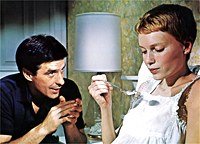
But during her last pregnancy, the Siren did finally see a movie with the nerve to depict pregnancy in all its inconvenience, mess and bizarreness--Rosemary's Baby. OK, that isn't as bad as it sounds. Bear with the Siren. Yes, birth is a beautiful thing, and the Siren knows how lucky she is. But the process of getting there can be difficult, psychologically as well as physically, and the Roman Polanski film is, oddly, more truthful in this regard that many "realistic" dramas.

Rosemary gets so much right about pregnancy. It shows the way people infantilize a pregnant woman--everyone from husband to doctor pats you on the head and tells you everything is normal, no matter how freaking weird you feel or what your body happens to be doing. The movie also shows how the advice comes at you from all directions, and how you feel obligated to at least try it all, even if the suggestion is coming from some gnomelike woman you've just met. And it also shows the crushing fear that something might go wrong, or worse, that something IS going wrong, and no one will listen to you. The movie even taps into the worst part, the irrational thought that jolts you awake at 2 a.m. as you try to find a comfortable position so you can fall back asleep--"What if I give birth to a monster?"

The cleverness is that for once, the fears are true. The revelation of Rosemary's baby was anticlimactic to the Siren. Now that's partly due to her recognizing all these cute elderly character actors from the past, like Aunt Bea's best friend chirping "Hail Satan!" But it was also because the really scary stuff had come before.

Something else you don't much see in movies is how pregnancy lowers your powers of recollection. Anyone else have a memorable image of pregnancy from movies past?

Thứ Bảy, 5 tháng 8, 2006

Mr. Campaspe Posts and Hosts


From an email invitation Mr. Campaspe has sent to the Siren family's nearest and dearest in the NYC area:

Next Thursday, Aug. 17, BAM is showing the movie Les Tontons Flingueurs. Little known in the U.S., Les Tontons is a masterpiece of such magnitude that it is any cinephile's duty to disseminate it to the world. In the Michelin rating system--based on how far one should travel to experience an event--the movie deserves the maximum 3 stars. Yes, ladies and gentlemen, at last, a movie that is worth a trip to Brooklyn.

To convey how good the movie is, suffice it to say it is the best one by Georges Lautner, surpassing even his series with Belmondo, or his Barbouzes. Les Tontons' dialogue was written by Michel Audiard, who spoke only street French. ("French people drive me crazy," he once said, "but since I don't speak any other language, I have no choice but to converse with them.") So he put all his genius into becoming the poet of spoken French, creating many immortal quotations for the second half of the 20th century. He it is who gave the conclusive definition of a gentleman (someone who can describe Sophia Loren without using his hands.)

The cast reads like a proposal to create a pantheon of movie comics: Bernard Blier, Lino Ventura, Claude Rich, Jean Lefebvre, and Francis Blanche.

Hilarious, witty, ruthless in its social description but genial in its handling of political situations, this movie goes so deep into Frenchness that it reaches the core of the human spirit. In these sorry times, it will restore your faith in the ability of humanity to overcome our idiots, while making clear the amount of work required.

And it is unavailable in the U.S.!

* * * * *

The Siren had never heard of this movie before her husband began evangelizing about it, but it is worth apparently not only the journey, but the cost of hiring a babysitter for the evening. If any of her patient readers are around next week, by all means, check it out.


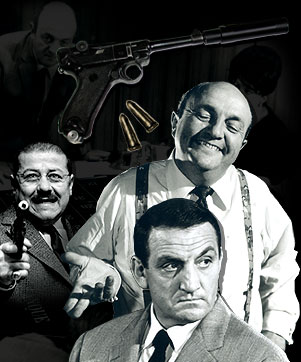
Above, left to right, Francis Blanche, Lino Ventura and Bernard Blier in Les Tontons Flingueurs. Middle, Michel Audiard.

Thứ Năm, 20 tháng 7, 2006

Voices of the Screen

Time Warner took pity on our DSL connection about two weeks ago, but there is no television at the Siren's house, a situation she will probably rectify soon. So as events unfold in Lebanon, all she has are voices, from the BBC news service and on bad phone connnections. We have friends and relatives there. I was married in this hotel, six years ago. Everyone we love is safe, so far. It is hard to concentrate on blogging or anything else. It will be another couple of weeks before we get a TV, and I suppose that has its advantages at the moment. The images on my computer are bad enough. For once, I don't want to see the pictures moving.

In times like these, distraction is probably as good as it gets. During the first Gulf War I read all of Bruce Catton's Army of the Potomac trilogy, blocking out one set of hostilities with the echoes of another. I am at the point now where any war reading is out of the question, and without movies on a screen what I have are voices in my head, lines and scenes I can replay. I suppose I take it for granted that people who read my blog miss the Golden Age of movies as I do. We talk about old stars, directors, the incredible beauty of black-and-white, the snap of the dialogue, but so far we haven't discussed voices.

Early talkies did the human voice no favors, hitting the squeaky high notes with a frequency that gelded male stars and made female ones sound like Kewpie dolls. Once technicians got the sound more under control, though, performers began to stand out on the basis of their voices. Vaguely aristocratic tones like that of Ronald Colman were especially coveted. You strove for that mid-Atlantic accent, meaning not Delaware and Pennsylvania but somewhere in the middle of the ocean, between England and the former colonies. Eventually individuality blossomed, and the full spectrum of American accents was heard. The Siren thinks you hear a much wider variety of dialects in 1930s movies than you do in modern ones (notwithstanding, however, the ghastly parody that stood in for most black dialect, and the way Asian and some other foreign speaking patterns were mocked).

Anyway, all this got the Siren thinking about her favorite screen voices. And she started thinking about criteria. Is it sheer beauty that makes a great screen voice? is it enough to be memorable, even if the voice screeches like a rusty hinge?

Well, beauty counts for a lot with the Siren, so most of her list is easy on the ears. Many of them were stage-trained voices, that particular discipline seeming to bring out the best in a speaking voice.

I am not putting these voices in any particular order, save to list my favorite of all time, Orson Welles. The Siren sees some eyes rolling. Well yes, it is quite dreary, his being a genius all the time, as ex-wife Rita Hayworth is said to have sniped. And his voice may be cheapened a bit for those who had to listen to his Paul Masson spots in childhood. But his narration for The Magnificent Ambersons is an intrinsic part of that film's greatness. His voice focuses as deeply as the camera, with a similar interplay of light and dark. The Siren can, at will, turn on a recording in her head, hear him speaking the first lines, and be enveloped by that atmosphere once more: "The magnificence of the Ambersons began in 1873. Their splendor lasted throughout all the years that saw their midland town spread and darken into a city..."

There never was and never could be another voice to give the climactic lines their sense of waste and inevitability, turning the much-anticipated fate of the Ambersons into the loss we all suffered when the great god Aut O'Mobile first took us for a ride. The bitterness and regret is there, but so is the gallows humor. We brought this on ourselves, as surely as George Minafer ever did:

Something had happened, a thing which, years ago, had been the eagerest hope of many, many good citizens of the town, and now it had come at last. George Amberson Minafer had got his comeuppance. He got it three times filled, and running over. But those who had so longed for it were not there to see it, and they never knew it. Those who were still living had forgotten all about it, and all about him.


The faint tone of mockery was seldom absent from the voice of Welles, whether he was discussing the relative merits of Swiss and Italian civilization or growling at an unlikely gypsy, "Come on, read my future for me." It's as much a part of the voice's allure as its baritone register. Gifted with an instrument that could (and often did) shout down the biggest-screen house, Welles was most effective when quiet--when a friendship ends with two words ("Sure we're speaking, Jedediah. You're fired") or a offhand observation to a bank examiner carries the weight of an entire failed life ("If I hadn't been born rich, I might have been a really great man").

So much for Mount Everest. Let's look at some other peaks.

Sydney Greenstreet. A delicious purr of evil, demonstrating that a slight touch of the effeminate can be as sinister as any macho growl.

Claude Rains. The stage-trained Rains had one of the most beautiful voices in the history of movies, able to convey sympathy in Now Voyager or gleeful malevolence in The Adventures of Robin Hood.

Peter Ustinov, Audrey Hepburn and George Sanders. "'Her English is too good,' he said. 'That clearly indicates that she is foreign.'" All three of these performers, possessed of exotic backgrounds, wound up speaking more aristocratic English than any Windsor. (Impossible to imagine any of these three locking the jaw and strangling consonants the way the royals do.) Ustinov, British-born son of a German father and a Russian mother, had occasional quavers that became part of his comic effect. The Dutch-raised Hepburn made her tendency to overarticulate a strength when she played comedy. Example: her somber, nun-at-vespers intonation of "It was as close to heaven as one could get on Long Island," in Sabrina. The artists at Disney managed to draw what a voice sounds like when the studio had the Russian-born Sanders give voice to a scheming, indolent tiger late in his career, in The Jungle Book.

William Powell and Jean Arthur. Two superb light comedians, both with voices that could have been grating, but used to marvelous effect. Powell showed that an unapologetically American accent could still be elegant. Arthur frequently played women frantically trying to maintain dignity in an absurd situation. Physically, she wasn't a flutterer. It was her voice that betrayed her, cracking slightly as she tried to gain control.

Charles Boyer and Marlene Dietrich. The Continental accent, married to a naturally resonant speaking tone. Forever thrilling and (to borrow a line from Clive James) forever calling Americans across the sea to a place so sophisticated that people have sex with the lights on.

Robert Mitchum. Enough about the eyes. That silky voice seemed to veil just as much depravity as those heavy lids.

James Cagney. Pure New York, a rapid-fire delivery that suited the slang of the time like no other.

Charles Laughton. One of the most versatile voices the movies ever had.

Irene Dunne. Dunne, possessed of a very high-toned and vaguely Southern speaking manner, often swallowed words, and some of her best deliveries are sotto voce, as in The Awful Truth: "Well, I mean, if you didn't feel that way you do, things wouldn't be the way they are, would they? I mean, things could be the same if things were different."

Margaret Sullavan. Sullavan's marvelous hint of a rasp helped show the inner strength of doomed characters like the ones in Back Street or Three Comrades.