Hiển thị các bài đăng có nhãn Gone with the Wind. Hiển thị tất cả bài đăng

Thứ Hai, 9 tháng 11, 2009

Anecdote of the Week: An Admirable Vocabulary


She regarded Gable as lazy, not too bright, and an unresponsive performer (though she was always laudatory about his kindness and good manners to her). She could not understand how he could leave the set promptly each day at six p.m. as though he held an office job. She seldom left the studio until eight or nine at night and worked six, often seven days a week. "What are you fucking about for?" she would complain to Gable and Fleming when Gable took time out to rest. Gable admired his leading lady's vocabulary, as did Fleming, but otherwise he was a bit put off by her intellect and her dedication to work. Nonetheless he took it upon himself to teach her the game of backgammon. She proceeded to beat him each time they played.

--from Vivien Leigh by Anne Edwards

The Siren was interviewed by Lou Lumenick for an article in Sunday's New York Post, about the 70th Anniversary Blu-Ray Edition of Sex Kittens Go to College. No? You say you don't remember Clark Gable's smokin' rendition of "I Got a Gal, Miss Mamie Is Her Name"?

Oh all right, I'll stop now. Here's the link to interviews goddess Eva Marie Saint. At length. About movies and acting--not gossip. Drop everything for this one.

Glenn Kenny continues his series on Manny Farber's Top Ten Films of 1951 with The Thing from Another World.

Sheila O'Malley, never a woman to shirk a challenge, goes after The Birth of a Nation.

T. Sutpen at If Charlie Parker Was a Gunslinger posts a series of World War II Red Army photographs. Posed or not, some of them are extraordinary.

Peter Nelhaus on 5 Against the House, part of the Film Noir boxed set from Sony that everyone, in diabolical concert, is trying to force the Siren to buy. And check out Peter's nifty bit of screen-grab detective work.

Finally, David Cairns' epic post on the very, very great Vertigo, complete with beautiful screen caps, clips and a fine discussion in comments.

Update: As promised in comments, Sam Wood shoots Belle's bosom, but it's a Breen Office bust:


The scene became something of a jinx, requiring multiple tries, like the opening scene with the Tarleton boys (Selznick sent out several memos reminding everybody that they weren't the Tarleton twins, as in the novel). One of those failures came when the boys' hair photographed bright orange, like a couple of Heat Misers went courtin' Miss Scarlett. Unfortunately I don't have a shot of that one.

Finally, jokes aside, Anagramsci is promising a King Vidor series, which gladdens the Siren's heart.

Hat tip for new banner: Mrs. Thalberg.

Thứ Bảy, 22 tháng 9, 2007

Bette Meets 90-Take Willie

(The Siren returns from hibernation to join in Goatdog's William Wyler Blogathon. Please follow the links at his place for more on the great, yet curiously underappreciated Wyler.)


She was difficult in the same way that I was difficult. She wanted the best.--William Wyler at the American Film Institute tribute to Bette Davis


It was 1931. Bette Davis was 23 and still new on the Universal lot, scrambling for parts like the other starlets. William Wyler was 29, "not a very good director" by his own admission and struggling to prove he deserved his break despite the (justified) perception that he owed his job to being Carl Laemmle's relative. Davis was auditioning for a part in A House Divided and had hurriedly put on the only size 8 dress she could find. The dress was cut low, and when Davis walked by, Wyler remarked in a voice that carried to every corner of the crowded soundstage, "What do you think of these dames who show their tits and think they can get jobs?" The humiliated actress didn't get the role, which went instead to future flameout Helen Chandler.

So when Wyler, now contracted to Samuel Goldwyn and on his first loan-out to Warner Brothers, showed up to film Jezebel, Davis reminded him of his taunt--and the irony, now plain, that he had made the remark about an actress more willing than any in Hollywood to forego sex appeal when the character required it. Wyler searched his memory for the incident and drew a nice tidy blank, but he apologized to Davis and said he had been having a hard time in those days.

As filming began Davis must have known about Wyler's reputation for repeating takes until the actor was a nervous wreck. Henry Fonda was warned by Humphrey Bogart, who'd made Dead End with Wyler the year before, "Jesus, don't touch it. Don't go in there." But Wyler also had a string of excellent movies under his belt, having guided fine performances from a hopeless alcoholic (John Barrymore in Counsellor at Law), an actress in the twilight of her career (Ruth Chatterton in Dodsworth) and even an actress whose chief qualifications at the time were dazzling beauty and a bed shared with a prominent producer (Merle Oberon in These Three). Davis knew her own self-discipline and fine talent, and she made her bet on Wyler.

Besides, the attraction between actress and director was already evident.

Although Jezebel is often described as a sop to appease Davis after she didn't get Scarlett O'Hara, the Siren's research indicates this isn't the case. The play (produced in 1933, three years before Margaret Mitchell's novel was published) was purchased for Bette Davis by Warner Brothers in 1937, while David O. Selznick was still actively searching for a Scarlett and no decision had been made as to casting. Selznick saw Jezebel , no doubt accurately, as the Warners' way of cashing in on the anticipation surrounding Gone with the Wind and was furious. So in fact, according to GWTW historian William Pratt, Jezebel (which was released in March 1938, eight months before Selznick ever met Vivien Leigh) was the factor that put a period to any chance Davis had at the part. Davis herself always denied the "consolation prize" idea, but in her sunset years she loved to intimate she had come close to Scarlett. Alas, that isn't true either--she was never very high in the running. As early as 1937, when Selznick was working out distribution deals, he rejected an offer from Warner Brothers that was contingent on casting Errol Flynn and Bette Davis and told friends that he would cast Katharine Hepburn as Scarlett before he would consider Davis.

Despite its being forever linked with GWTW, Jezebel is its own animal, a movie just as concerned with the fate of a strong-willed woman in a rigid society, but more harshly realistic about the ways society revenges itself. As a girl the Siren much preferred Scarlett to Jezebel's Julie Marsden. She hated the way Julie is humiliated, not merely in the excruciating ball sequence, but also when she is coldly rejected in favor of the vacuous Margaret Lindsay (a perfectly cast actress whom Davis couldn't stand in real life). Ashley makes his sexual attraction to Scarlett quite clear, but once Henry Fonda rejects Julie, it as though he never loved her at all. Later in life the Siren came to see that Jezebel--while it cannot compare with GWTW's vast historical canvas, indelible characters and peerless production values--is the more biting social commentary.

That may seem impossible, given that Wyler's pictures generally affirm rather than challenge social convention, helping to explain the appeal to Oscar voters as well as the films' rejection by those who prefer "termite art." You can read Jezebel as a straightforward women's tale of the comeuppance of a first-rate scheming bitch, and no doubt that is the tale Wyler and Davis thought they were filming. The movie approves of her treatment, audiences then approved of it and audiences today usually do as well. Witness the reviews that refer to the character as "Jezebel," instead of her name, and speak of her "deserved" humiliation at the Olympus Ball. But director and actress, through their careful attention to Julie's character, create something more complicated. Together Wyler and Davis show us an intelligent and headstrong woman who can exert her will only in petty, useless acts of rebellion. Then they show Julie stripped of her autonomy, first in part and then completely.

True to its stage roots the movie has three acts, well-summarized by Nick Davis as The Dress, The Duel and The Disease. Julie Marsden is engaged to Preston Dillard (Fonda) and happily stamping her size-five riding boots all over him. She loves Pres but, with few other outlets for her restless energy, she amuses herself by constantly testing his love. Infuriated by his refusal to leave a board meeting to attend a ballgown fitting with her, Julie rejects her regulation white dress in favor of a vivid red one that is being prepared for the town's most notorious courtesan. (As the town in question is New Orleans, we must be talking about one hell of a whore.) This is a beautifully set-up scene, Julie on a dais and surrounded on three sides by mirrors. Aunt Belle (Faye Bainter, showing why Stinky Lulu has anointed Wyler the Patron Saint of Best Supporting Actresses) and the dressmaker form a Greek chorus of warning and disapproval. (The Siren pauses to ask why, in the 1930s, dresses symbolizing wanton behavior always had some sort of swaying fringe to them. Was it hearkening back to the more sexually liberated 20s?) At first Pres refuses to take his scarlet-clad woman to the ball, then, stung by Julie's suggestion that he is afraid to defend her, he escorts her and sees to it that she is shamed in front of everyone she knows.

According to Davis, Jezebel's script gave the Olympus Ball short shrift and the production manager allotted a half-day to shoot it. Wyler took five days and turned it into the best scene in the film. It is, in effect, a drawn-out death scene, in which you watch the death of Fonda's love for Davis, the death of the old, confident Julie who is certain of her man's love, and the death of Julie's place in society. It is stunningly filmed but wrenching to watch, as they join a full dance floor only to have the other couples leave it, until gradually they are the only ones dancing. The formation is as old as time--the woman in the center, those condemning her forming an unbreakable circle, and the man Julie loves dragging her into the middle to extend her agonies just that much longer. As brilliant as the camerawork is, the Siren finds the scene just about unbearable. Not until MASH, as Sally Kellerman hit the ground in a vain attempt to cover herself, would the Siren encounter a scene that showed such soul-deep humiliation of a woman.

Pres leaves for the north and Julie shuts herself away on her plantation, Halcyon, only emerging to ride her thoroughbred horse in a way that risks breaking her neck each time. Comes word that Pres has returned. Julie, seeing her chance at last, dons the white dress she had rejected a year before and greets Pres, sure of her welcome. "I'm kneelin' to ya, Pres," she croons, sinking to the floor in an unmistakable evocation of a bridal dress being removed on a wedding night. And the Siren always wants to scream, "Get up! get up! don't DO that!" It's almost as lacerating as the ball, because the audience knows what Julie does not--Pres has come back with a Yankee bride. Before Pres can tell her, in comes Amy (Lindsay), Aunt Belle in tow. And here you can see Wyler's hand, because the Davis of Of Human Bondage or Dangerous might have flung her emotions all over the set. Instead, she keeps her eyes focused on Fonda and speaks two words without much emphasis, yet they snap out like her riding crop: "Your wife?" And then you see her denial turn to coiled, deliberate fury, directed at Amy with the politeness Southern women always muster best for those whom they truly hate.

Julie, desperate to win back Pres, begins to manipulate her old beau Buck (an unusually animated George Brent) into provoking Amy at every turn. Pres's brother, Ted, staying at the plantation for plot reasons that remain murky to the Siren, gets more and more hot under the collar until finally he challenges Buck to a duel, which Buck does not survive. Despite the fact that a belatedly remorseful Julie tried to stop the duel, she is blamed by everyone, including the loving Aunt Belle, who delivers the title line in unforgettable fashion: "I'm thinkin' of a woman called Jezebel, who did evil in the sight of God." Act two is over.

Before everyone can leave Halcyon in the same manner Julie once cleared out the Olympus Ball, Act Three is upon us--yellow fever results in quarantine. Julie responds in classic Southern-hostess fashion, telling the guests who now hate her guts, "Ladies and gentlemen, my home is yours, as always." Just in case we didn't realize that yellow fever was serious business in antebellum New Orleans, we get a series of intertitles screaming, "YELLOW JACK!" Ah, how the Siren loves intertitles. Pres hears of his brother's duel and for once it is the nominal hero who swoons dead away. But of course, the leading man can't just faint like a sissy so we learn Pres has come down with the dreaded yellow fever. Julie, suddenly (and, to the Siren, suspiciously) fired with noble purpose, persuades Amy to let her go with Pres to the island where yellow fever victims are being warehoused. The movie ends with Julie cradling Pres's head in her lap, as a simple wagon takes them down to the wharf and an uncertain fate. The swelling music and noble expressions want us to think Julie is choosing redemption through almost certain death. The Siren would much rather think Julie has no plans to die--she believes she's going to nurse Pres through his illness, and she's angling for another chance to hold her man.

So, let's talk about "90-take Willie" and how he directed his actors. The standard image of Wyler is of a director shooting take after take, and when the frustrated actor shrieks "what do you want from me?" he responds with something along the lines of "I want you to do it better." But the image of a rather inarticulate, ESL director doesn't quite play. From an early point Wyler chose his own subjects and his own writers, and he always chose adult stories, frequently from well-known literary sources, and scripts by the best writers in Hollywood. That doesn't suggest a man incapable of telling an actor precisely what he wanted. Wyler reportedly believed that repeating a scene broke down an actor's defenses and unlocked new approaches, but that doesn't mean he never had meaningful discourse with his actors. This fine tribute, by director Josh Becker, repeats a story about Henry Fonda enduring 40 takes of a scene on Jezebel. But Fonda himself recalled it somewhat differently, in an interview in Mike Steen's Hollywood Speaks:

I guess it's rather well known that there are actors who didn't like Wyler, just like there are actors who didn't like Ford or Fritz Lang, etc., because Wyler was known to want to shoot a lot of takes. You know, fifty takes and that kind of thing...I had a very good experience. Wyler and I got along famously. We're still friends. He never took fifty takes, though he might have taken thirty! But it was never without a reason. I've worked with John Stahl [on Immortal Sergeant] who was a director who would take it over and over again without telling you why. It was as though he was saying "If they're going to give me actors like this, what are you going to do?" You know? But with Wyler, every time he did it again he gave you something to think about. He'd say, "This time in the middle the scene react to a mosquito bite." These inventions would just come to him. He was rehearsing with film really! And that wasn't bad because I like rehearsals. So it was a good experience with Wyler, and I liked it very much.

Bette Davis later said that the moment when she began to trust Wyler's direction completely came when he forced her to watch dailies of a scene in Jezebel where she was coming down a staircase. He had shot the scene some thirty times, annoying the living daylights out of her. But when she saw the rushes, she realized that one take had "captured a fleeting, devil-may-care expression" on her face that was perfect for Julie. After that, she endured the takes. And like Fonda, she claimed that Wyler did make suggestions: "He'd remain silent, take after take after take, then when I was exhausted, he'd give a suggestion that would turn the whole scene around and make it live." She also said he "never asked you to make a move that wasn't logical. If you told you to go to a window, there was a reason for it."

With the auteur theory has come the persistent critical notion that directing actors is somehow a minor talent--that it is better to be Fritz Lang, insisting that everyone hit those chalk marks, driving people to near-breakdowns and consequently seldom having the same leading actor twice, than to be William Wyler, with your name attached to many great performances but (allegedly) not to any one overarching vision of film. The Siren says it's a fine thing to be either one.

There is a book to be written about William Wyler and Bette Davis. The story has the arc of a perfect women's picture. There's that inauspicious first meeting. There's the new meeting years later, on the set of the movie that would win Davis her second Oscar (and the first she truly deserved). Move through the director and star having a torrid extra-marital affair, carried on in the days of studio "morals clauses," when adultery came with the very real risk of ruined careers. Then Davis having an abortion during the filming of the even greater The Letter, and never telling Wyler. Continue with Davis' tale of how her single, highhanded act destroyed their chance for marriage. Then the last film together, where conflict reaches a level than ensures they never work together again. Finally, a meeting on Wyler's set much later in life, where Davis claimed, "I still saw that old gleam in his eye..."

Yes, a good story. But not as good as the movies they made together.

(Material on Davis and Wyler's personal relationship comes primarily from I'd Love to Kiss You: Conversations with Bette Davis, by Whitney Stine. Other sources include A. Scott Berg's Goldwyn and David O. Selznick's Hollywood by Ronald Haver.)

Thứ Bảy, 3 tháng 2, 2007

Arrowsmith (1931)

Arrowsmith (1931) is a fine example of the fact that, auteurism notwithstanding, you can't judge a film by its pedigree. This one, based on Sinclair Lewis's Pulitzer-winning book, had John Ford directing, Sidney Howard writing the screenplay, Samuel Goldwyn producing and a cast that included Ronald Colman, Helen Hayes, Richard Bennett and Myrna Loy. And it's still basically an interesting failure, proof positive that they were making dull Oscar-bait almost as soon as the awards were started.

Reviewers even at the time complained that Colman was, at forty, too old for the title part. That didn't bother the Siren so much, since practically everybody in a old-time Hollywood movie is usually too old for their parts. (The Dead End "Kids"? West Side Story?) Far more serious a drawback is that he was British down to his very garters, and here he is supposed to be an archetypal Midwesterner. As Stephen Murray of Culturedose.net points out here, the actor's chief characteristic was that he was debonair. Ronald Colman was undoubtedly debonair when he was flossing his teeth. Arrowsmith isn't debonair, he needs to be fresh and achingly earnest--someone like Lew Ayres, perhaps.

The movie's biggest problem, however, is that while Howard would do a superb job of compressing a long novel eight years later for Gone with the Wind, here what you get is a bunch of people talk, talk, talking through a series of disjointed scenes. Nobody simply acts in Arrowsmith, not without discussing the ethical and philosophical implications at great length. Yet simple human motivation remains murky. The movie lurches from one plot point to another, never giving you a good bead on Colman's Martin Arrowsmith, a high-minded doctor. He proposes to nurse Helen Hayes the day he meets her, and as if that isn't enough, in the next scene is giving up his dreams of being a medical researcher to be a GP out in the middle of nowhere, because he will need to support her. "You will be back," his mentor tells him, or rather "You veel bee back," as this mentor is Middle European (aren't they all?). And indeed Arrowsmith does come back, after his special serum cures some South Dakotan cows.

Now Arrowsmith is movin' on up, to a deluxe research facility in the sky and some of the best visuals in the movie, courtesy of Ford and cinematographer Ray June. The look of the New York office is superb and Ford, so brilliant with outdoor sequences, here uses Richard Day's sets beautifully. There's a vertigo-inducing shot of the Chrysler Building from the ground up, as Colman and Hayes try to reassure themselves that they feel at home in this vast, bustling city. A short scene later Arrowsmith emerges from the elevator and walks along the grand swoop of the office, the black-and-white constrasts and vastness of the place emphasizing him as one cog in a very, very large machine.

But Arrowsmith doesn't entirely fit in this grand place, as indeed he does not fit precisely anywhere. He develops another serum, this time for humans, and goes down to the British West Indies to test it during a plague outbreak. There is a great deal of talk about the primacy of science over mere human feelings, which in practice means he's going to give the serum to half the islanders, but not the other half. In the movie, this is clearly seen as unsentimental devotion to science and the greater good. Goatdog has a great review of Arrowsmith that includes an excellent discussion of the medical ethics then and now. Even so, a modern viewer, horrified, is likely to recall the Tuskegee experiment. Ironic, because one of the movie's virtues is the character of Oliver Marchand (Clarence Brooks), a black doctor played entirely as a devoted, dignified professional, with no shuffling, "humor" or degrading dialect added.

In her autobiography, Myrna Loy described the way Ford handled her appearance late in the movie, as Arrowsmith is inoculating the natives. You see the islanders lined up as the doctor sees them, just a series of arms one after another, until the camera lights on Loy's fair-skinned arm. The camera follows Arrowsmith's startled gaze up to that gorgeous face, and the attraction is apparent from that moment forward. That's fortunate, because while a good look at Myrna Loy is always most welcome, she has very little to do here. Goatdog also has an excellent exegesis of Loy's brief role as sexual temptation for the saintly doctor. Post-Code re-releases cut her role to almost nothing. I believe the version I saw restored most of her scenes, but you still have to be hip to 1930s innuendo to figure out what passes between her and Arrowsmith.

Ford had made more than 70 movies at this point, but Arrowsmith marks only the very beginning of his greatness. A lot of Ford's preoccupations are already well in place: The loner fighting society, yet searching for a place in it, too. The sacrifice of home comforts for the sake of a larger good. Man vs. Nature. The film seems to grow more visually sophisticated as it progresses, though the Siren has no idea if it was shot in sequence. The superb, Metropolis-like views of New York give way to the the Caribbean island and the most beautifully shot scenes in the movie, as a misty, Defoe-like procession of biers and mourners continually moves past the doorway of Arrowsmith and his wife. Later, there's an extraordinary shot of a doomed Helen Hayes sinking into a cane-back chair to smoke a cigarette, as light slants through a shutter and around her hair. Here Ford is already working out his vocabulary, and despite its many flaws, that is the best reason to see Arrowsmith.
(Cross-posted at NewCritics.)

Thứ Tư, 9 tháng 8, 2006

Knocked Up at the Movies

Did the Siren happen to mention she's knocked up? No? Oops. Well, she is, 29 weeks. It's a boy, due late October, nameless as of now. Film-oriented suggestions welcome. If your suggested name is chosen, we owe you a goat, or a sheep, your choice. (Lebanese tradition.)

So the Siren has been mulling this post for a while, but the pickings are mighty slim for the eras she usually covers. Thanks to the censors, pregnancy and childbirth were treated with a spectacular lack of realism during the Golden Age. The baby belly was either nonexistent or suggested by the heroine's adjusting her belt buckle a few notches. The Hays Code didn't specifically require this (so far as the Siren's research shows), so perhaps the tradition of padding the woman with a lace hanky and calling it a day was just the studios' reluctance to show a glamor gal waddling. The code did forbid childbirth scenes, however, so usually what you would get would be the pitter-patter of little feet talk between the (always married) couple, then a swift cut to a waiting room, or a cradle, or some such. On the rare occasions when pregnant women did appear on screen, they were from some other planet where seven months looks like two, a planet the Siren fervently wishes she were on right now.

In the 1939 Stagecoach, for example, Louise Platt plays a genteel wife going to join her Army husband. The dialogue only lightly alludes to her pregnancy. She clutches a paisley shawl over a figure that looks quite slim, and she retains the gait of a Virginia belle. Try dismounting from a stagecoach late in your third trimester, and see if you are up to gracefully placing your hand in the hand of a John Carradine substitute. The more likely scenario is that you grab his forearm for dear life and lumber down those teetering little steps like a Saint Bernard with advanced arthritis. Even as a teen with no experience of pregnancy, either hers or anyone else's, the Siren saw Stagecoach and figured Platt's character was four months, tops. So it was a bit of a shock when Platt went into apparently full-term labor midway through the movie.

Gone with the Wind, made the same year, is comparatively realistic, with Melanie giving birth during the siege of Atlanta. Only vague silhouettes show, and there's no screaming, though Scarlett tells her to yell her head off if she wants. Afterward Melanie is extremely sick and weak--hemorrhage, maybe? You aren't told, nor do you have any idea why she's told not to have more babies and eventually dies in childbirth after ignoring the advice. When she tells Clark Gable she is expecting another child, her shawl is draped just like Platt's.

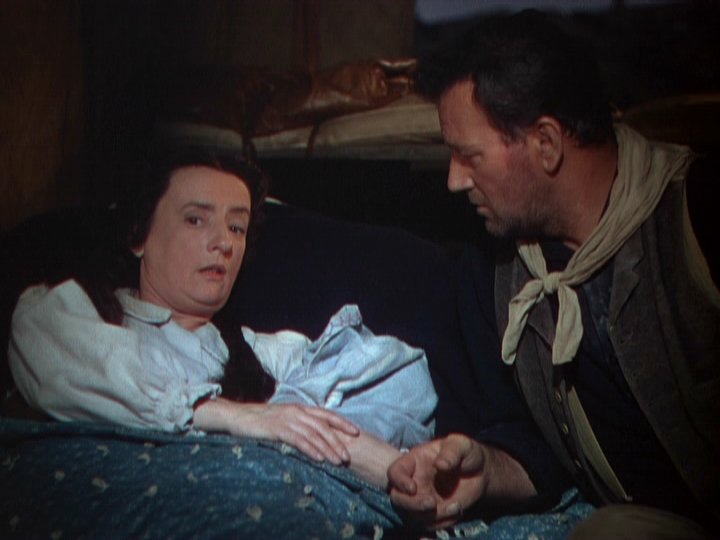
Puerperal fever? obstructed labor? Whatever the unidentified cause, plenty of women die in childbirth at the movies, often off-camera, as in the saddest scene in Goodbye, Mr. Chips (1939). If they do it on camera, they do it beatifically, like Melanie. In 3 Godfathers (1948), a John Ford that the Siren loves, Mildred Natwick (43 years old, and looking every day of it) is found in a wagon about to give birth, the fact that things are going badly conveyed by her gasping a lot and struggling to sit up. The men try to help the delivery, but she is a goner. Braids neat, face matte, clad in a miraculously clean white nightgown, she hands the baby over to John Wayne, Pedro Armendariz and Harry Carey Jr., and dies.

But the Siren is looking for pregnancy at the movies, and this is largely childbirth, and damned unlucky childbirth, at that. Well, there is Leave Her to Heaven, if you want an example of a woman who doesn't exactly sing the Magnificat upon hearing the happy news. As Gene Tierney's monstrous Ellen is put on a late-1940s version of bedrest, she becomes arguably even more insane than she was previously. Convinced that husband Cornel Wilde is developing too tight a bond with her sister Ruth (Jeanne Crain), Ellen decides to get rid of what is confining her to bed.

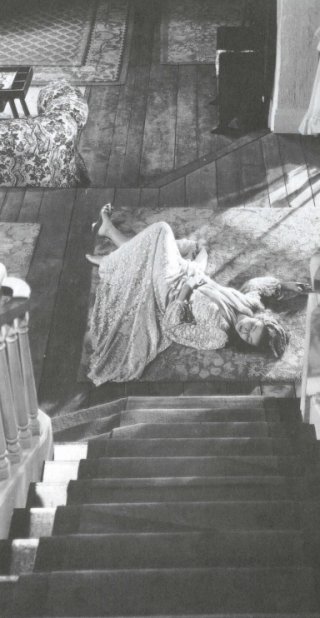
The big, indelible scene from John Stahl's movie has Tierney in a rowboat in the middle of the lake, calmly watching as her polio-crippled brother-in-law gets a cramp and drowns. But the Siren was also marked at an early age by the moment when Tierney gets herself un-pregnant. Wearing a beautiful negligee, with a belly the Siren would measure at about five days post-conception, Ellen walks to the top of the staircase. You see her, like a psychopathic Cinderella, carefully remove a slipper to be left as evidence at the top landing. Then, camera still focused on her feet, Ellen throws herself down the stairs and lands in an artful heap, nightgown still so clean Mildred Natwick would be proud. Do you suppose any women saw this and thought it would be a foolproof way to end an unwanted pregnancy? In reality, of course, it isn't nearly that easy to induce a miscarriage, although Ellen is having a touch-and-go pregnancy already.

Speaking of dangerous pregnancies--even the daring Miracle of Morgan's Creek (1944) didn't show the slightest bulge in pregnant Betty Hutton, despite the fact that she must be about three months before we cut to a later stage of her pregnancy. At that point they film her from behind, which is probably just as well. The miracle is (skip the rest of this paragraph if you don't want to know) that Hutton is pregnant with sextuplets.

Ha, ha, ha. The Siren has had twins. At three months she looked about five months. At five months people asked when she was due. At seven months she got into a cab and said, "68th and York," only to have the cabbie whip his head around and practically yodel, "New York Hospital????" The Siren reassured him that it was just a checkup. With six babies, Hutton's figure should have been bordering on the Wagnerian early on, but the movie is so funny you overlook Hutton's having the easiest pregnancy and delivery of higher-order multiples in recorded history.

By the late 1950s movie pregnancy was getting a touch more realistic. A Farewell to Arms, David O. Selznick's doomed swan song as a producer, has Jennifer Jones asking Rock Hudson to feel the baby kick. Jones looks more pregnant than Louise Platt, which is something, but she's still not a patch on the Siren's belly. Reportedly Jones' childbirth scene late in the movie is part of why Farewell tanked, as it is quite long and drawn out and there are a lot of close-ups of her face contorting. Even a few modern viewers squirm. But the decade had its big breakthrough in pregnancy depiction on television, where Lucille Ball dared to waddle. The scene where Ball gets stuck in an armchair still cracks up the Siren.

By 1962 you get The L-Shaped Room, where Leslie Caron's neighbor deduces she is pregnant because he can hear her throwing up through the walls of their cheesy rooming house. That movie holds up well in showing an unwed pregnancy, even going so far as to have Caron waffle about whether or not to have an abortion.

In 1995 the Siren saw a Hugh Grant vehicle called Nine Months, allegedly a comedy about pregnancy but in reality a platform for the most retro sex-role ideas imaginable. Despite being able to show a great deal more than you could prior to 1960, most movies showing pregnancy hew closely to the cliches, both cutesy, as in Look Who's Talking, or horrifying, as in the original Alien, in some ways an extended meditation on fear of childbirth.

But during her last pregnancy, the Siren did finally see a movie with the nerve to depict pregnancy in all its inconvenience, mess and bizarreness--Rosemary's Baby. OK, that isn't as bad as it sounds. Bear with the Siren. Yes, birth is a beautiful thing, and the Siren knows how lucky she is. But the process of getting there can be difficult, psychologically as well as physically, and the Roman Polanski film is, oddly, more truthful in this regard that many "realistic" dramas.

Rosemary gets so much right about pregnancy. It shows the way people infantilize a pregnant woman--everyone from husband to doctor pats you on the head and tells you everything is normal, no matter how freaking weird you feel or what your body happens to be doing. The movie also shows how the advice comes at you from all directions, and how you feel obligated to at least try it all, even if the suggestion is coming from some gnomelike woman you've just met. And it also shows the crushing fear that something might go wrong, or worse, that something IS going wrong, and no one will listen to you. The movie even taps into the worst part, the irrational thought that jolts you awake at 2 a.m. as you try to find a comfortable position so you can fall back asleep--"What if I give birth to a monster?"

The cleverness is that for once, the fears are true. The revelation of Rosemary's baby was anticlimactic to the Siren. Now that's partly due to her recognizing all these cute elderly character actors from the past, like Aunt Bea's best friend chirping "Hail Satan!" But it was also because the really scary stuff had come before.

Something else you don't much see in movies is how pregnancy lowers your powers of recollection. Anyone else have a memorable image of pregnancy from movies past?

Thứ Tư, 7 tháng 12, 2005


Miriam Hopkins at the peak of her career. Behold the face of the woman who once drove John Gilbert to shoot a bullet over her head. (He suspected her of cheating on him, and he was probably right.) Her reaction was to take the gun away from him.

By the way, if you haven't visited Lance Mannion's site lately, you should know that he has his own thoughts on Gone with the Wind, starting here, continuing here and ending here. Lance is always a treat to read, and the comment threads at his place are lively and informative, so do check it out. Posted by Picasa

Thứ Năm, 24 tháng 11, 2005

Tear Down the Draperies: Gone with the Wind

Over at The News Blog there was a thread recently on a circulating meme of "10 Movies I Hate." Steve Gilliard's number one was Gone with the Wind. Here's his pungent take:
1) Gone with the Wind
Everything to hate in one movie. Best scene...Atlanta burning to the fucking ground. Getting upset about that would be like getting upset about the destruction of Berlin in 1945. Even Birth of a Nation is less offensive because it's up front in its racism.
The Siren has a movie-trivia quibble here, described in a sidebar below. But Mr. Gilliard's post prompts her to write up some deeper, long-simmering thoughts about this movie. She doesn't share his hatred for the movie. That doesn't mean she dismisses his point.

Gone with the Wind's virtues include an indelible love story, two leads at the absolute peak of their good looks and acting ability, a fabulous supporting cast and, perhaps above all, matchless beauty. (The names of production designer William Cameron Menzies and cinematographer Ernest Haller should be as familiar to GWTW lovers as that of David O. Selznick.) The sweep of the movie is so epic that the Siren has talked to several perfectly alert people who swore there were battle scenes in it (there aren't).

But...the politics. The view of history.

Oy, as we used to say back home in Birmingham.

The Siren is from Alabama. She hasn't lived there for many years, but her roots in the South go back about 200 years on either side of her family tree, and that's serious Southern. It stays with you, which is why Truman Capote and Tennessee Williams could leave to live here, there, everywhere and anywhere but the South and still be identifiably Southern to anyone with two eyes and a pulse. Gone with the Wind embodies the mythology of my native region like no other book or movie. Love it or hate it, the one thing you ain't gonna do is ignore it.

The Siren read the book at about age 11 and saw the movie that same year. For years, I loved book and movie without reservation. My Christmas present one year was a copy of Scarlett Fever by William Pratt and Herb Bridges, a big compendium of all things GWTW. Rhett was my romantic ideal, Melanie my pattern of ladyhood, but Scarlett was my heroine. Ashley did lead her on terribly, I was convinced of that. (Still am.) And look at how she got men to do things for her. Look at how hard she worked, how brave she was. Look at all her gorgeous dresses.

And look at how she suffered! Look at how the South suffered! That rat Sherman. Those carpetbaggers. Everybody insisting on making the war all about slavery, when we knew it was about states' rights. Slavery was terrible, but slaves were an investment, and they were treated a lot better than Northern factory workers.

Incredible, isn't it? The Siren was raised in a dedicated pro-civil-rights household, daughter of two of the proudest liberal Democrats you ever saw. They loved Kennedy and loathed Wallace. They sneered at the Southern strategy. My mother still likes to boast that she hated Nixon before Nixon-hating was cool: "Watergate. Ha! I hated the man while he was vice president." They voted for McGovern. (One old friend, told this piece of information, responded, "Well, I guess those two votes in Alabama had to come from somewhere.")

All that good solid upbringing, and I still believed all the myths. And the depressing thing about GWTW, and what makes it--I choose the adjective carefully--pernicious to this day, is that there are an astonishing number of people out there who still believe its dishonest view of history. Check out the IMDB boards. Start a conversation at your local bar. You'll still find someone, and possibly a lot of someones, bringing up the hoary lies.

The Siren says enough with the apologetics. The movie is racist. Not misguided, not dated, RACIST.

It is racist in big ways, as it shows the "good Negros" sticking around to serve their former owners. The bad ones run off. They ride around Atlanta in fancy clothes or congregate in Shantytown until Ashley and Rhett ride in with the (delicately unnamed) Klan and clear it out. Yes, the great stuntman Yakima Canutt played the white man who attacks Scarlett. His accomplice, played by Blue Washington, is black, and the raid is a lynching party. Defend that if you like.

It is racist in small ways, as the late Butterfly McQueen could have told you. Check out the scene where Melanie is feeding the returning Confederate soldiers. McQueen was talked into cutting a watermelon in the background. She stayed pissed off about it to her dying day.

Even people too sophisticated to take much stock in GWTW's mythology will defend certain of the assumptions behind it, such as the idea that most or even many slaves were well-treated, or better off in any sense than Northern workers. They weren't. Life expectancy for a black slave in the antebellum South was about 21, almost exactly half that of a white person. Life expectancy for a Northern white was higher than for a Southern one.

Sure, the war was about state's rights. And economic factors. And which state's right was uppermost in the minds of those who ran the South? And, whether those who fought owned a slave or not, what was the economy of the South based upon?

It is true that Hattie McDaniel's Mammy is the soul of the movie. The monologue she delivers to Melanie after the death of Rhett and Scarlett's daughter is a moment of utter heartbreak. But Mammy is defined only through her devotion to the white folks. She has personality aplenty, but no existence outside of those she serves. Some people argue that Mammy has a great deal more life and individuality than most black characters in mainstream movies up to that time. Even if you grant that point, and the Siren cites the 1934 Imitation of Life as one counterexample, Mammy was perceived by many blacks even at that time as an insult. McDaniel spent the rest of her life fending off accusations of betrayal. "I'd rather play a maid than be one," she supposedly said. McDaniel did a beautiful job with what she had, but what the GWTW script gave her was a stereotype recognizable even in 1939.

Then there's William Tecumseh Sherman. The Siren has spent many nights downing measures with friends and debating the wisdom of that long-ago march to the sea. Militarily, it worked. It also gave white Southerners a sense of victimhood that for some persists to this day. If there is an afterlife, the Siren wonders if General Sherman has found the time to reflect that maybe giving the South a grievance for the ages wasn't such a hot idea.

Remembering the movie's opening epigraph, the Siren is somewhat amazed Mr. Gilliard made it through to the siege of Atlanta:
There was a land of Cavaliers and Cotton Fields called the Old South...Here in this pretty world Gallantry took its last bow...Here was the last ever to be seen of Knights and their Ladies Fair, of Master and of Slave...Look for it only in books, for it is no more than a dream remembered. A Civilization gone with the wind...
It's depressing that in 2005 one must still point out to some people that all the gallantry in the world can't pretty up what the South was doing. But the Siren saw GWTW again in a movie theater about five years ago, and she will see it again. Her "dream remembered" is the grand-style moviemaking that reached its apogee in 1939. Scarlett is still a first-class scheming hussy, and the Siren still loves her for it.

If you ever came with her to Alabama, the Siren could take you to the cemetery where many of her forebears are buried. Some of them were Civil War veterans. They sure as hell weren't fighting for Lincoln. For many reasons, some sentimental, some historical, the Siren does not choose to believe that they were anything other than brave in the battles they fought. But sentiment doesn't blind her, and neither does Gone with the Wind, not anymore. As one Union veteran wrote twenty-five years after the battle of Gettysburg, "The men who won the victory there were eternally right, and the men who were defeated were eternally wrong."

The Siren's All-Time Movie Trivia Pet Peeve


Atlanta does not burn in Gone with the Wind.


Got that?

Atlanta burned in real life--AFTER Scarlett fled the city. Scarlett left about two and a half months before Sherman burned the place.

Listen to the dialogue. Rhett makes it clear that the city's depot area is in flames, burned by the Confederates who don't want Sherman to gain access to the munitions stored there.

Still don't believe me? Believe David O. Selznick. He was famous for his memos, and this one was a list of don'ts directed at the publicity team (quoted in Scarlett Fever by William Pratt and Herb Bridges). The capital letters and italics are Selznick's:

Most importantly, DON'T refer to the BURNING OF ATLANTA as such. The scene in the picture is not the burning of Atlanta but rather the burning of certain buildings containing war materials. The city in general was not touched by these fires!

Carry on. Posted by Picasa

Thứ Năm, 9 tháng 6, 2005

Perfume at the Movies I

I came late to my love for perfume. Movies I fell in love with long ago. A couple of years ago I started collecting perfume references in movies. There aren't as many as you might think. Most screenwriters and directors have barely scratched the dramatic possibilities with fragrance. Possibly that's because it is something the audience must imagine; possibly it's because some people (poor, lost souls) don't quite get the fascination of perfume.

Take Hitchcock's film of Rebecca, and the famous scene where Joan Fontaine explores her predecessor's bedroom. We scan the dressing table and find - no scent bottles! A painful oversight. Of course the beautiful, evil Rebecca de Winter must have worn perfume, and expensive stuff too, I'll bet. Do you suppose Mrs. Danvers stole the bottles so she could be reminded of her beloved Rebecca? Maybe. I think, however, that this was one detail Hitchcock (or his set decorator) just neglected. As Wile E. Coyote once said, "Even a genius can have an off day."

Still, some filmmakers have used perfume in plots and dialogue in creative ways. So my next few posts will be devoted to my (far from complete) run-down of perfume's role in some film and film-related moments.This section is called

Don't Try This at Home

Dangerous Stunt One: Easy Riders, Raging Bulls by Peter Biskind

The creative folks aren't the only ones in the movie business given to odd behavior. This story concerns the first meeting between director William Friedkin and Charles Bluhdorn, head of the Gulf + Western conglomerate, which owned Paramount Studios at the time. The reasons I am opening with this one will be obvious once you've read the quote.

Friedkin, who had never met Bluhdorn, was the first one to arrive at his suite in the Essex House. Bluhdorn opened the door, leaned over and sniffed Friedkin's neck, asking, "Friedkin, vat's dat shit you're verink?
"Guerlain."
"Guerlain? Come here!"
He led Friedkin to his bathroom, where he had every aftershave in the world, including a cut glass Baccarat bottle of Guerlain. He opened it up, saying, "Dis is vat I do to Guerlain," and poured it on his shoes.
"That was my introduction to Charlie Bluhdorn, and he never got any saner as long as I knew him," Friedkin recalls.


The first time I read this anecdote, I was horrified. After yesterday's cataclysmic announcement from the house of Guerlain (scroll down) my sympathies are entirely with Bluhdorn. Perhaps he was clairvoyant.

Dangerous Stunt Two: Gone with the Wind, 1939
Remember the famous scene where Scarlett gargles with Eau de Cologne to keep Rhett from noticing the brandy on her breath? As a Scarlett-obsessed preteen I tried this, minus the initial brandy. I do NOT recommend it. And please, remember, it didn't even work; Rhett caught on almost as soon as he arrived.

Dangerous Stunt Three: Dinner at Eight, 1938
Scent overkill in the heat of the moment. Jean Harlow hears her paramour is about to arrive, picks up what must be the world's largest atomizer, pulls out the two-foot-long bulb sprayer and sprays, sprays, sprays all over herself, her negligee and her platinum blonde 'do. Unless your man's got a cold, I think this maneuver is best left to the pros like Jean. (Harlow wore Mitsouko, by the way.)

Dangerous Stunt Four: Life Is a Banquet, by Rosalind Russell and Chris Chase
Yet another example of why wearing perfume solely to attract a man is an exercise in futility. It was 1936, and Russell was filming Under Two Flags with British heartthrob Ronald Colman. They had come to a love scene set at a desert oasis. After some trouble learning to dismount a camel in a manner that looked suitably passionate, Russell found herself having a problem with her two-legged costar:

He wouldn't kiss me on the mouth. Between takes I'd go in and swallow half a bottle of Listerine and spray myself with perfume. It started to get late. Finally the director said, 'Maybe we'll just have to put this off until
tomorrow morning.'

Oh my God, I thought, I won't sleep. By now I'm reeking of Arpege and mouthwash, and I'm desperate. I finally just grabbed Ronnie, clung to him, would not let him go, and kissed him until he was purple in the face and the director was yelling, 'Cut! Cut! Cut!'


What Russell didn't realize that was that an off-center kiss looks better on camera than a full-on smackeroo, and the director was using a dissolve. The camera wasn't even on the couple for most of the shot. But, as Russell put it, "all the time they're shooting the camels and the sunrise, [Colman's] had this maniacal female clutching him to her fevered lips."

"He was very nice about it," she added.