Thứ Hai, 8 tháng 4, 2013

In Memoriam: Annette Funicello, 1942-2013


"She's the perfect girl next door, she doesn't have a bad bone in her body. She's the sweetest girl I know, and nothing's ever changed."
—Frankie Avalon

"Even sitting in a wheelchair, life does not have to be perfect to be wonderful."
—Annette Funicello


The Siren isn't much for 1960s beach movies, but she always feels a pang when a truly sweet soul has passed on.

(Both quotes from Swingin' Chicks of the 60s.)

Thứ Sáu, 5 tháng 4, 2013

In Memoriam: Roger Ebert, 1942-2013


As certain critics age, they seem to drag around years of bad movies like ankle chains. They remind me of Gothic heros, betrayed lovers convinced virtue never existed at all. Once long ago these critics were hurt by a movie, oh yes, many movies, and now they say to each sweet young prospect, "You cannot deceive me! I know what you are!"


Roger Ebert wrote some of the most bitingly funny pans of all time, but he never went that route. He was writing raves right up to the end. Each movie held the possibility of love. He was a true romantic.


Here's how I recall an old "Tonight Show" with Jay Leno where Ebert appeared with Gene Siskel. Like many other people, I grew up with those two bickering in the balcony. Leno had the bright idea of putting soundproof headphones on one critic, so the other could tell the audience what he really thought of his partner. Ebert went first with the headphones. He put them on, paused a second, and with a grin of delight said, "Mozart!" And his hand started beating out a little conducting session.


Leno asked Siskel, so what do you really think of this guy? And Siskel replied calmly, "First of all, I'm a much better critic than he is." The audience roared. Leno cracked up. Even with headphones on, it should have been obvious to Ebert that something was up.


Except he was still conducting. I'm not even sure he turned his head. He was listening to Mozart. Art mattered to him.


Many film writers owe a debt to Ebert. Mine comes from what must have been a 1983 "At the Movies" broadcast. He and Siskel were doing a rundown on the Academy Awards, one of those "If We Picked the Winners" shows.


I don't remember Siskel's choice (although it might have been E.T.). But Ebert chose Tootsie. "It's an almost perfect comedy," he said. Gandhi was going to win, he predicted, "but which movie do you think you'll still want to see in 20 years?"


My kid mind reeled. I'd seen Gandhi, and I'd seen Tootsie. I loved Tootsie, but it was about Dustin Hoffman in drag. Gandhi had Ben Kingsley. Bald Ben Kingsley. With an accent. Bald Ben Kingsley getting assassinated. Gandhi was--OK, it was stuffy. But it was serious. That's what wins Oscars. Right?


In roundabout fashion, Roger Ebert had introduced me to the notion of white elephant art, years before I ever heard the name Manny Farber. He'd also planted the idea that if you had a blast watching a movie, that alone meant it was worth some serious thought.


I haven't watched Gandhi since 1982. Tootsie I've seen several times. Think I'll watch it this weekend.


Rest in peace, Mr. Ebert. You were right about many things.


Thứ Tư, 3 tháng 4, 2013

Rat Pack Rashomon

The Siren has not forgotten her more-patient-than-ever readers, truly she hasn't. It's just that lately her life resembles this:


But she will never abandon her little corner of the Web. (Here the Siren wants everyone to remember the Alamo—specifically, Laurence Harvey making sure the sun catches his ruffles just right.)


Where else can the Siren blather on about Mary Astor's invention of pan-chromatic makeup and Vera Zorina in I Was an Adventuress? It's just that when the irresistible force of life meets the immovable object of work, something's gotta give, something's gotta give, something's gotta give.

Which brings us to this post, involving a man who did rather a good version of that song.


The Siren has been reading The Richard Burton Diaries. You could say, in fact, that the Siren has been obsessing over the Burton diaries. Her only reading time is on the subway, the dadgum thing weighs almost as much as her six-year-old, and yet the Siren lugs it back and forth because she does not want to let it go. The Diaries made her want to revisit some Burton movies (the good ones)—maybe even try out Burton as Trotsky because damn, the part about filming that one is funny. The whole book is delightful—very sad in some ways, but a marvelous picture of a restless, fiercely intelligent mind.

And lord have mercy, how he gossips. Evidently the only person who read it while he was writing it was Elizabeth Taylor, and so he feared no backlash. (Not even from her.) If the Siren tells you that this is, no lie, the only book she's ever read in which someone had a bad word to say about Audrey Hepburn, you'll get the general idea. It's weirdly enhanced by the most maniacal footnotes the Siren has ever encountered, via Professor Chris Williams. Par exemple: if the Burtons stay "at the Plaza Athénée," you get a note elaborating: "Hotel Plaza Athénée, Avenue Montaigne, Paris." The Siren at this point loves Williams almost as much as Burton.

The Siren adores how Burton chronicles his incredibly voracious reading habits in great detail, and she was immediately caught by his acerbic dissection of a certain nostalgic passage in David Niven's The Moon's a Balloon. The two sections, side by side, give a mirror-image view of Hollywood glamour, the Rat Pack, Sinatra, Bogart, and especially Burton and Niven themselves.

But they are quite, quite different. So, we'll give Niv the first word.


It was the 4th of July and Bogart had taken what Niven says was the highly unusual step of inviting women aboard his celebrated yacht, the Santana. That meant David Niven brought along his wife Hjordis (possibly the most universally disliked Hollywood spouse of that or any era, but that's a whole other post, at least). So Lauren Bacall (I do not call the goddess Miss Bacall "Betty" as I have never been introduced) came along to keep Hjordis company. So Bacall had her hands full. As Niven tells it,

We dropped anchor in Cherry Cove and Frank Sinatra moore alongside us in a chartered motor cruiser with several beautiful girls and a small piano. After dinner, with Jimmy Van Heusen accompanying him, Sinatra began to sing. He sang all night.

There were many yachts in Cherry Cove that weekend, and by two in the morning, under a full moon, Santana was surrounded by an audience sitting in dozens and dinghies and rubber tenders of every shape and size.

Frank sang as only he can, with his monumental talent and exquisite phrasing undimmed by a bottle of Jack Daniels on top of the piano.

He sang till the dew came down heavily and the boys in the listening fleet fetched blankets for their girls' shoulders. He sang till the moon and the stars paled in the predawn sky. Only then did he stop and only then did the awed and grateful audience peddle silently home.


Now we shall let Burton have his say.

I read David Niven's autobiography yesterday in one sitting. It is very funny though not very well written and is, like all actors' biographies, very anecdotal and full of "and then Mike Todd called me and said 'Get your ass over here'" etc. He describes one scene on Bogart's yacht which is not what happened at all as I was there. He describes Sinatra singing all through the night on a motor yacht with a lot of other yachts around 'awe-struck' he says. Frankie did sing all through the night it's true and a lot of people sat around in boats and and got drunk it's true but Bogie and I went out lobster-potting with Dumbum [Bogart's Danish crewman, according to the every-ready Prof. Williams] while Frankie was singing kept on making cracks about Betty [Bacall] sitting on Sinatra's feet etc. and Frankie got really pissed off with Bogie and David Niv who describes himself as bewitched all through the night was trying to set fire to the Santana at one point because nobody could stop Francis from going on and on and on. I was drinking 'boiler-makers' with Bogie Rye Whiskey with canned beer chasers so the night is pretty vague but I seem to remember a girl having a fight with her husband or boy friend in a rowing dinghy and being thrown in the water by her irate mate. I don't know why but I would guess that she wanted to stay and listen to Frankie and he wanted to go. And Bogie and Frankie nearly came to blows next day about the singing the night before and I drove Betty home because she was so angry with Bogie's cracks about Frankie's singing. At the time Frankie was out of work and was peculiarly vulnerable and Bogie was unnecessarily cruel. But any way it is not at all like Niv's description.


So, the Siren asks the same question as in Kurosawa's great movie: out of these, which is believable?

Thứ Ba, 12 tháng 3, 2013

The SLIFR Poll: It's Not a Comeback, It's a Return


The Siren, as you may have guessed, is having a hard time trying to write about anything in depth at the moment. But here comes Dennis Cozzalio, our old friend from Sergio Leone and the Infield Fly Rule, with another quiz: MISS JEAN BRODIE’S MODESTLY MAGNIFICENT, MATRIARCHALLY MANIPULATIVE SPRINGTIME-FOR-MUSSOLINI MOVIE QUIZ. This one had a lot of noir and pre-Code questions that were irresistible to the Siren, not to mention the title reference to something that's ONLY one of the Siren's favorite films of all time. (Dennis, you rogue, was that deliberate? A Brodie-signal, like a bat-signal only 100 times better?) 

So here we are. Time for some fun! As usual, to avoid one of her spells, the Siren went with the first answer that popped into her fevered brain. If you want to take the quiz, drop by SLIFR and have at it. And the Siren doffs her cloche to friend Tony Dayoub, who reminded her of the quiz by posting his own answers at Cinema Viewfinder.
1) The classic movie moment everyone loves except me is:
The diner scene in Five Easy Pieces. Perhaps the Siren's retail days gave her too much experience with too many boors. Oh, you're picking on an overworked, underpaid, middle-aged waitress. Vive la révolution!


2) Favorite line of dialogue from a film noir
"I don't mind if you don't like my manners. I don't like them myself. They're pretty bad. I grieve over them on long winter evenings."

3) Second favorite Hal Ashby film
Harold and Maude. (The Siren's favorite is Shampoo, one of the best movies of the 70s; she's naming it even though Warren Beatty evidently had a great deal to do with the finished film.)


4) Describe the moment when you first realized movies were directed as opposed to simply pieced together anonymously.
As she's said before, the Siren's father and his regard for John Ford had her realizing this early on; also, the fact that the name "Busby Berkeley" meant big wonderful chorus numbers.

5) Favorite film book
City of Nets, still.

6) Diana Sands or Vonetta McGee?
Pass.

7) Most egregious gap in your viewing of films made in the past 10 years
The Lord of the Rings, I suppose.


8) Favorite line of dialogue from a comedy
"You can't fool me. There ain't no Sanity Clause."

9) Second favorite Lloyd Bacon film
As of last week's James Cagney triple feature at the Film Forum, without hesitation the Siren cites Picture Snatcher. (Favorite is 42nd Street, bien sûr.)

10) Richard Burton or Roger Livesey?
The most painful answer in the bunch, because the Siren has been immersed in Burton's diaries, and they are nonstop joy, fascination and delight. But the Siren cannot live without I Know Where I'm Going!. Livesey.

11) Is there a movie you staunchly refuse to consider seeing? If so, why?
Lots, but first thought is A Serbian Film. (The Siren strongly advises her gentlest readers not even to Google that one if they don't know it.) Because why would I? The people who boast about how they can sit through anything, do they believe someone greets you at the Pearly Gates to say "Dude, you made it through Cannibal Holocaust! Here's your door prize!" The Siren considers hard-core images of degradation and sadism to be brain pollution. Not to mention a colossal waste of her precious time on earth, considering she just looked at Lloyd Bacon's filmography and realized she's got dozens left.


12) Favorite filmmaker collaboration
The Siren goes with her first thought: Bette Davis and William Wyler.

13) Most recently viewed movie on DVD/Blu-ray/theatrical?
Blu-Ray: The Navigator. Theatrical (not for work): Picture Snatcher.

14) Favorite line of dialogue from a horror movie
"I never drink...wine."

15) Second favorite Oliver Stone film
Born on the Fourth of July. (No. 1: Platoon.)

16) Eva Mendes or Raquel Welch?
Haven't seen Ms Mendes in much, but the Siren suspects she'd pick Welch in any case.

17) Favorite religious satire
Viridiana.

18) Best Internet movie argument? (question contributed by Tom Block)
The Sight and Sound list was good for some fun and games.


19) Most pointless Internet movie argument? (question contributed by Tom Block)
Anything in which the words "Lena Dunham" appear. The Siren signed off forever when someone on Twitter chimed in with, "Jean Renoir had a famous artist parent too." Good grief, enough already. Let's talk about Lloyd Bacon!

20) Charles McGraw or Robert Ryan?
McGraw is one fabulously cool customer, but come on--Ryan.

21) Favorite line of dialogue from a western
"Plantin' and readin', plantin' and readin'. Fill a man full o' lead, stick him in the ground an' then read words on him. Why, when you've killed a man, why try to read the Lord in as a partner on the job?"


22) Second favorite Roy Del Ruth film
Employees' Entrance. (No. 1 is Blessed Event.)

23) Relatively unknown film or filmmaker you’d most eagerly proselytize for
The Siren is passing on this one only because hell, that's her whole blog, right there.

24) Ewan McGregor or Gerard Butler?
Ewan McGregor.

25) Is there such a thing as a perfect movie?
Intellectually, no. Emotionally, sure there is.

26) Favorite movie location you’ve most recently had the occasion to actually visit
A few blocks from the Siren's front door, where they were filming The Amazing Spider-Man 2. Oh joy.

27) Second favorite Delmer Daves film
Probably Susan Slade. (Favorite is A Summer Place, although a whimsical argument could be made that Max Steiner is the auteur there.)

28) Name the one DVD commentary you wish you could hear that, for whatever reason, doesn't actually exist
Billy Wilder on any of his greats.

29) Gloria Grahame or Marie Windsor?
Love Ms Windsor, but Gloria Grahame.

30) Name a filmmaker who never really lived up to the potential suggested by their early acclaim or success
Isn't it a shame that Howard Hawks never managed to top Scarface? KIDDING. The Siren points to her sidebar to reiterate that one good movie, for her, is enough. But because she re-watched Force of Evil recently, the Siren will name Abraham Polonsky as a filmmaker thwarted by the tenor of his times.


31) Is there a movie-based disagreement serious enough that it might cause you to reevaluate the basis of a romantic relationship or a friendship?
Whenever she's asked this question, the Siren likes to point out that she married a man who dislikes John Ford. Her dissent-tolerance is pretty well established.

Thứ Hai, 11 tháng 3, 2013

Anecdote of the Week: Buster Keaton Confronts Disaster (and Joe Schenck)


From an interview with Buster Keaton in Sight and Sound, Winter 1965/66:

My original situation in [Steamboat Bill, Jr.] was a flood. But my so-called producer on that film was Joe Schenck...Schenck was supposed to be my producer but he never knew when or what I was shooting. He just turned me loose.

Well, the publicity man on Steamboat Bill goes to Schenck and he says: 'He can't do a flood sequence because we have floods every year and too many people are lost. It's too painful to get laughs with.' So Schenck told me, 'You can't do a flood.' I said, 'That's funny, since it seems to me that Chaplin during World War One made a picture called Shoulder Arms, which was the biggest money-maker he'd made at that time. You can't get a bigger disaster than that, and yet he made his biggest laughing picture out of it.' He said, 'Oh, that's different.' I don't know why it was different. I asked if it was all right to make it a cyclone, and he agreed that was better. Now he didn't know it, but there are four times more people killed in the United States by hurricanes and cyclones than by floods. But it was all right as long as he didn't find that out, and so I went ahead with my technical man and did the cyclone.'

Thứ Ba, 19 tháng 2, 2013

Gentlemen, Mary Pickford Doesn't Need Your Advice

In 1912, Mary Pickford, age 20, was working at Biograph Studios. D.W. Griffith was casting a short movie called The Sands of Dee.

Pickford wanted the lead and, since "abundant hair was a requisite," she thought she had a pretty good shot.


But, as she tells it in her 1955 autobiography Sunshine and Shadow, recently Griffith had also asked Pickford to wear a grass skirt in Man's Genesis. She'd refused to do any such hussy-ish thing as flashing her bare legs and feet to the paying public. Newcomer Mae Marsh, who immediately prior to Biograph had been working a counter at Bullock's Department Store, donned the grass get-up.

Perhaps Pickford's qualms strike you as quaintly Victorian. The Siren offers a reminder that in her heyday, Mary Pickford had a mind as shrewd as any ever to hit Hollywood:


You can see a clip of Man's Genesis here, although you may want to mute the sarcastic commentary. Musketeers of Pig Alley, it ain't. The upshot was that a wrathful Griffith gave Marsh The Sands of Dee as a rebuke to all who would refuse to sport grass skirts whenever Genius asked them to do so.

Pickford was peeved, as was Blanche Sweet's grandma, who fumed, "I don't see how she can possibly play the part. The girl hasn't any hair." But, for now, the joke was on them; Pickford admitted that Marsh was wonderful in Sands of Dee.

The future Queen of the Movies donned a hairshirt, so to speak: "If a little girl fresh from a department store could give a performance as good or better than any of us of who had spent years mastering our technique, then pictures were not for me."

She decided to go back to the theater. In this she was encouraged by the recollection of an encounter with the author of her breakout play, The Warrens of Virginia. She'd just started at Biograph, and William de Mille hadn't exactly been happy for her.


Unbeknownst to Pickford, de Mille also had written a letter to the legendary producer David Belasco, lamenting the young actress' career path to that point:

...Do you remember that little girl, Mary Pickford, who played Betty in The Warrens of Virginia? I met her again a few weeks ago and the poor kid is actually thinking of taking up moving pictures seriously. She says she can make a fairly good living at it, but it does seem a shame. After all she can't be more than sixteen or seventeen and I remember what faith you had in her future; that appealing personality of hers would go a long way in the theater, and now she's throwing her whole career in the ash-can and burying herself in a cheap form of amusement which hasn't a single point that I can see to recommend it. There will never be any real money in those galloping tintypes and certainly no one can expect them to develop into anything which could, by the wildest stretch of imagination, be called art.

I pleaded with her not to waste her professional life and the opportunity the stage gives her to be known to thousands of people, but she's rather a stubborn little thing for such a youngster.

So I suppose we'll have to say goodbye to little Mary Pickford. She'll never be heard from again, and I feel terribly sorry for her...

Pickford told her Biograph boss adios. Griffith responded in accents of doom: "Do you suppose for one minute that any self-respecting theatrical producer will take you now after spending three years in motion pictures?"

Mary Pickford retorted that next year, she'd be on Broadway in a Belasco production.


The theater season didn't start for a few months, so she remained at Biograph, where she was not under contract. One can deduce from Griffith's subsequent conduct that he was miffed. He'd just hired two promising sisters, Lillian and Dorothy Gish, whom Mary had known previously and introduced to him. In the perpetual way of bosses, Griffith played the newcomers against his recalcitrant star. He began one day of shooting with the gallant sally, "Pickford, why don't you get a nice costume like Gish's?" He ordered them upstairs to swap dresses. They knew what was going on, of course, and Lillian told Pickford that it was all right, she liked Mary's dress better anyway.

Once back on the set, though, Mary's blood was up: "It's too bad, Mr. Griffith, that you can't get a good performance without trying to come between two friends."

"That stung," wrote Pickford. Griffith called her a baby. Pickford yelled back, "Mr. Griffith, I don't like the way you direct and I never have. If you were a real director you wouldn't have to try to turn me against Lillian to get a good scene. Why don't you think of a more honest way of directing me?"

Griffith called her "a half-pint" and gave her a shove. Pickford tripped and wound up on the floor, calling him a "disgrace to the South" and "to the North as well." Griffith tried to help her up, she waved him off and stormed to her dressing room, where she began packing in a suitcase-banging manner calculated to be heard all over the set.

Griffith gathered his cast and crew and stood outside Pickford's door, leading them in a rendition of "So Long, Mary." She melted, they made up.

But she still left, immediately after making The New York Hat, the most successful thing she did for Griffith. You see, Mary had already lined up a new gig...with David Belasco.


One of Pickford's first actions after returning to Belasco, who had a hard-nosed reputation in his own right, was to negotiate a $25-a-week raise from her Biograph salary. That gave her $200 a week, a fortune in those days. (Years later Samuel Goldwyn remarked that "it took longer to make one of Mary's contracts than it did one of Mary's pictures.")

1913 found her starring on Broadway in Belasco's The Good Little Devil. It was a hit. Opening night in Philadelphia, Griffith was in the front row.


Little more than a decade later, in 1924, D.W. Griffith's increasingly mismanaged finances caused him to break ties with United Artists, the company he'd founded with Pickford, Charlie Chaplin and Douglas Fairbanks just five years before. United Artists spent the next decades establishing itself as the Pearl White of movie studios, seemingly always in some sort of peril; but Pickford sold her stock in 1956 for $3 million.


To return to 1913; Pickford had done precisely what she said she would. Problem was, she didn't like acting in plays. Or, rather, she discovered she loved film acting more: "the novelty, the adventure, from day to day, into unknown areas of pantomime and photography." Back she went to Hollywood, and signed with Famous Players-Lasky. The following year, the massive success of Tess of the Storm Country cemented Mary Pickford as the first superstar. As Scott Eyman put it, "Her public--indeed, the whole world--loved her as no actress will ever be loved again."

William C. de Mille kept his lower-case "d" but followed brother Cecil B. D. to Hollywood, where he directed more than 50 films (most of them, aside from Miss Lulu Bett, now lost).

In 1929, the man who in 1909 told David Belasco that no one could expect these "galloping tintypes" to develop into art co-hosted the inaugural awards ceremony for an outfit calling itself the Academy of Motion Picture Arts and Sciences. The other host was Douglas Fairbanks, Mary's second husband.


The following year, de Mille hosted solo, and presented the Best Actress Oscar to Mary Pickford, for Coquette.

Thứ Tư, 13 tháng 2, 2013

Anecdote of the Week: Runaway Romance, Hollywood Style


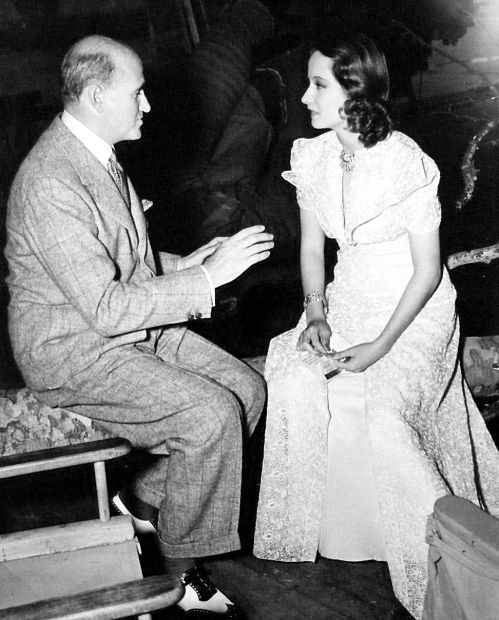
From The Moon's a Balloon, by David Niven, the story of a cross-country trip that begins after a tryst in the St. Regis Hotel in New York. The Great Big Star was, as you probably know, Merle Oberon.


By the autumn of 1936, I was very much involved with a GBS (Great Big Star)...The GBS was gorgeous and quite adventurous.

'Let's not fly back to California--let's take the sleeper to Detroit--buy a Ford and drive it out.'


She bought the car--I drove and the first night we spent together in Chicago.

She disguised her well-known face with a black wig and dark glasses and called herself Mrs. Thompson. In the lobby nobody recognized her. Though it was highly unlikely that anyone would recognize me, I went along with the game and called myself Mr. Thompson.

The desk clerk handed GBS a telegram, 'For you, Mrs. Thompson.' I was mystified.

'How could that happen?' I said.


'I promised Jock Lawrence I'd tell him exactly where we'll be all the way across in case the studio needs me urgently, then I can hop a plane.'


She opened the envelope--'TELL NIVEN CALL GOLDWYN IMMEDIATELY    JOCK.'

'Forget it,' said the GBS. 'Call him tomorrow--it's too late now.' We went to bed.


The next night we spent in Cedar Rapids, Iowa.

'Telegram for you, Mrs. Thompson,' said the desk clerk.

TELL NIVEN CALL ME TONIGHT WITHOUT FAIL    GOLDWYN.

We didn't want the idyll spoiled even though the new signature gave me an eerie feeling of impending doom.


In North Platte, Nebraska, the wording was crisper--

ASK NIVEN WHAT HE THINKS HE'S DOING HAVE HIM CALL TONIGHT OR ELSE    GOLDWYN.

Still we pressed happily on across the country, and the telegrams became more alarming at each step. The one at the Grand Canyon was very unattractive indeed--


TELL NIVEN HE'S FIRED    GOLDWYN.


The GBS was made of stern stuff--'He can't do that,' she said, 'and anyway he wants me for two more pictures. We'll call him when we get to California--not before.'


I was so besotted by the GBS that I even managed to enjoy the rest of the trip except when we turned off the main road in the middle of New Mexico and got stuck in the desert at sunset.


Finally, the ten-day trip ended and we crossed the State Line into California. From a motel in Needles, with great apprehension, I called Goldwyn.

'Do you know what you're doing, you stupid son of a bitch?' he yelled. 'You're doing about a hundred and thirty-five years in jail. Ever heard of the Mann Act and taking women across State Lines for immoral purposes? Think what Winchell would do to that girl, too, if he got the story--you're through I tell you...you're...'

His voice was pitched even higher than usual. The GBS leaned across the bedside table and grabbed the phone out of my hand.


'Sam, darling,' she purred, 'I've had a simply gorgeous time so don't be angry with David...I'll explain it all to you when we get back tomorrow...' She motioned me to go out of the room and finished her conversation alone. When she found me later, she said, 'Sam's sweet really, everything's okay again, you've been reinstated.'