Hiển thị các bài đăng có nhãn King Vidor. Hiển thị tất cả bài đăng

Thứ Hai, 20 tháng 1, 2014

King Vidor, The Crowd, and the Dragon


(This is a disgracefully belated entry for the Film History Blogathon. The Siren's post, on 1928, would have been part of the 1927-1938 section, hosted by Ruth at Silver Screenings. For the years 1915-1926, your hostess is Fritzi at Movies, Silently; and 1939-1950 can be found at Aurora's place, Once Upon a Screen. Please click through to those host blogs to find a plethora of wonderful, and prompt, blog entries on many aspects of film history.)


Death is a good career move, goes an old movie joke that the Siren has never found funny. It was never less true than it was for silent film, which died after a brief illness. Probably it was younger than Marilyn Monroe, although like many another cinema great, the birth date’s hard to pin down.

Some early deaths do enshrine a legend; some even elevate a talent that might have burned out. Silent film died and stayed buried. If you were still around, and your name wasn’t Charlie Chaplin, you didn’t get much time to mourn. Pull up your socks and deal, that was the only way to survive. Who knows how many faceless names in the credits were walking around, not with mike fright, but mike shock.


As is common when talking about a life cut off in its prime, the Siren starts with the wake. King Vidor, in his 1953 autobiography A Tree Is a Tree, paints a scene that’s both gallows-funny and tragic.

We had no movieola in the first days of sound, and during the editing of Hallelujah [1929] I saw a cutter literally go beserk at his inability to get the job done properly. The walls of his cutting room were lined with multitudes of shiny film cans containing the mass of sound and picture tracks. Returning from a projection room after many hours of labor he discovered that the scene was still out of synchronization and let fly with a reel against the solid wall of cans. This precipitated an avalanche of thousands of feet of loose film that engulfed the two of us. The hysterical cutter fell on the floor sobbing helplessly. I unwound him from the tangled maze and drove him home to the care of his wife. He remained in bed a week before he could again undertake the task of editing the film.

Vidor was a spiritual, contemplative person infrequently given to flashes of temperament. But he was also worn out and, probably, worried to death. “I felt that by this mechanical advance the movies were losing a beautiful impressionistic quality that would be hard to replace in the technique of the new medium,” he wrote about having to add dialogue to a craps-game scene in Hallelujah. “In the light of experience,” he adds hastily, “I have since changed my mind, but the forced transition saddened me for quite some time.”

Who can blame him. One year before, even as sound invaded, the silents were still at their peak. That’s a fact endlessly repeated, and yet it’s one of those things that always give the Siren a jolt, like Orson Welles’ age when he made Citizen Kane, or Gone With the Wind’s inflation-adjusted gross. Look at the silents that opened in 1928. Contemplate their technical bravado, their thematic originality, their vivid acting: Street Angel. The Cameraman. The Circus. The Italian Straw Hat. Laugh, Clown, Laugh. Underground. The Passion of Joan of Arc. The Wind.


One of those 1928 films, The Crowd, is not only the Siren’s favorite silent, but one of her favorite films, period. A Tree Is a Tree goes into this film’s conception, the casting, the camerawork. Vidor quotes the rave reviews with poignant pride. The Crowd tells the story of John Sims, who’s raised to believe great things await him, and then they never arrive. John moves to Manhattan (where else for a striver?) but he never strikes it rich, never climbs the ladder at work or anywhere else. He meets a nice girl, they marry and have a family. Their joys become fewer and the hardships harder, until a blow lands that many couldn’t recover from. John’s one act of heroism is simply deciding to carry on, a moment that only the small boy who shares it with him will ever truly appreciate.

“Daring” means a number of different things these days. Sometimes it’s used as a synonym for “impenetrable,” but in American film it’s often something to do with taste. Is it cynical, is it dark, will it make Grandma stomp out of the theater to ask the manager if his mother knows he’s showing this filth.


The Crowd is its own kind of daring, due mostly to King Vidor, but in some measure also to Irving Thalberg. Some people say Thalberg was only and always a middlebrow purveyor of quality Oscar-bait. Vidor — who can’t be said to have idealized his producer — would not have agreed.

His movie The Big Parade was still packing cinemas, and the director found himself buttonholed by Thalberg and asked what his next project would be.

I really hadn’t an idea ready, but one came to me in the emergency. “Well, I suppose the average fellow walks through life and see quite a lot of drama taking place around him. Objectively life is like a battle, isn’t it?” While I groped, Thalberg was smiling.

“Why didn’t you mention this before?” he asked.

“Never thought of it before,” I confessed.

“Have you got a title.”

“Perhaps One of the Mob.”

Thalberg showed immediate enthusiasm. “That a wonderful title, One of the Mob. How long will it take you to write it?”

“Two or three days.”

“If you need any help, let me know.”

“Thanks,” I said, and we parted.

Now this is the way I believe a film should begin.


“MGM,” Thalberg once told Vidor about an idea that wasn't The Crowd, “can certainly afford a few experimental projects,” although as Erich von Stroheim would have pointed out, Thalberg’s indulgence of artists did have its limits. Accordingly Thalberg soon rejected the title One of the Mob as too suggestive of a proletarian tract, and The Crowd emerged. Vidor and Thalberg wanted a “documentary flavor” and an unknown actor as John seemed the ideal way to get it. The search was fruitless until one day a man brushed by Vidor, a man with a face that looked familiar not because the director had seen it before, but because it was a face you could never pick out of a crowd, or a mob, or (in this case) a lot full of extras. Vidor gave the man his card and told him to call for a chance at a part. The man never called, and Vidor couldn’t remember the name. Finally the director went to the rosters of extras and lit on the words that wouldn’t stick in his brain: James Murray. The extra hadn’t called Vidor because he thought the director wasn’t serious about the job.


Vidor cast Eleanor Boardman, his wife at the time, as Mary Sims, and put her in plain clothes and minimal makeup that diminished her considerable beauty. Murray turned out to be a difficult person, fated to meet a bad end due to alcoholism and sheer cussedness. The cinematographer was Henry Sharp, who also did Duck Soup, It’s a Gift and was active through the 1930s; but this was his peak.


Fired up by what he called “directors of vision” from Europe — he names Murnau, du Pont, Lang and Lubitsch — Vidor put everything into filming. He describes the movie’s most famous shot, where the camera scales a vast office building, sweeps through a window and swoops over hundreds of desks until at last it discovers John Sims, bored out of his mind.

A scene was made in New York City at the entrance of the Equitable Life Insurance building at lunch hour. The camera started its upward swing and when the screen was filled with nothing but windows, we managed an imperceptible dissolve to a scale model in the studio. The miniature was placed flat on the floor with the camera rolling horizontally over it. In the selected window was placed an enlargement of a single frame of the previously photographed interior view. As the camera moved close to the window another smooth dissolve was made to the interior scene of the immense office. The desks occupied a complete, bare stage and the illusion was accomplished by using the stage walls and floor, without constructing a special set. To move the camera down to Murray, an overhead wire trolley was rigged with a moving camera platform slung beneath it. The counterbalanced camera crane or boom had not yet been designed and built, but the results we achieved were identical with those of today.

So breathtaking is this scene that 13 years later, when Orson Welles and Gregg Toland moved a camera up a building, seemingly through a skylight, and down to Dorothy Comingore drunk at a table in a deserted club, the effect was still thrilling. It was thrilling almost 20 years after that, when Billy Wilder’s camera in The Apartment crawled up another tower to find Jack Lemmon at his desk at Consolidated Life of New York. Wilder never hesitated to credit Vidor.


Vidor, in 1953, still loved to talk about the technique behind The Crowd.

In a scene where the nervous husband paces the floor of the hospital corridor during the delivery of his first child, we wanted to give the impression that many husbands were also going through the same suspense and agony. We wanted a tremendously long hospital corridor stretching, as it seemed, to infinity. Cedric Gibbons, head of the art department at MGM, designed and constructed a corridor in forced perspective, with each receding door becoming smaller and smaller. We even considered putting midget husbands outside these miniature doors, finally decided to keep the mob of anxious husbands in the foreground of the shot.

“Midget husbands.” That’s ridiculous, but it’s also symbolic, isn’t it, of how passionate these artists were about getting every part of the movie right.

For scenes of the sidewalks of New York, we designed a pushcart perambulator carrying what appeared to be inoffensive packing boxes. Inside the hollowed-out boxes there was room for one small sized cameraman and one silent camera. We pushed this contraption from the Bowery to Times Square and no one ever detected our subterfuge.

This was precisely the kind of shot that would suddenly become problematic a short time later. The obstacles of shooting with sound were swiftly dealt with, but imagine going from a camera in a glorified baby carriage, to a camera enclosed in a soundproof booth.

John and Mary take a first date to Coney Island, that Cote d’Azur for the working stiff, happily mingling with the teeming, entertain-me masses. (Whatever happened to that spinning-plate thing, where people sit, link arms and try not to get hurled off? The world lost a great metaphor when that ride went away.) Later, when his daughter is critically injured, John stumbles out of his apartment building and into the street, pleading with the masses not to make so much noise. As the people keep streaming past him, John is admonished by a cop, in an intertitle of perfect callousness and truth: “Get inside! The world can’t stop because your baby is sick!”


But much of the film takes place in their small apartment, through the frustrations of daily life. John plays his ukelele and dreams up slogans; it is evident early on that he’s a dreamer, not an achiever. He buys his wife an umbrella (an umbrella!) as a token of affection, then can’t seem to keep himself from yelling at her when she opens it in the house. Everything in the apartment breaks, and there’s a squabble to go with each mishap. Boardman’s best moment is when she’s staring at the door after her heedless, cranky husband has slammed out, and she remembers (with zero intertitles) that she had, somehow, forgotten to tell him she’s pregnant.

And there’s the end, the unforgettable end, where John goes with his family to see a clown in a theater, and as Vidor says, “the camera moved back and up to lose him in the crowd as it had found him. In the course of the narrative he had not made a million dollars, nor committed a heinous crime, but he had managed to find joy in the face of adversity.”


King Vidor made two other films in 1928, The Patsy and the dazzling Show People, both with Marion Davies. Once Show People was done he decided that since he’d made three films set in France (The Big Parade, Bardelys the Magnificent and La Boheme) it was time to see the country in real life. He and Eleanor Boardman met F. Scott Fitzgerald on the boat going over, and in Paris they all hung out at Fitzgerald’s apartment, watching Zelda demonstrate the steps she was learning in ballet class. Vidor met James Joyce, who refused to make eye contact in order to conceal his failing vision, and Ernest Hemingway, as that writer strode out of a bookstore with his baby son tucked under one arm.

Then, abruptly, it was time to come home.

One day as I sat alone near the Place de L’Opera, a copy of Variety arrested my attention. Emblazoned across the front page in bold type was the headline: PIX INDUSTRY GOES 100% FOR SOUND. I had been away for only two months, but during that brief period a major transition had taken place in the motion-picture industry...I knew I could no longer sit complacently at sidewalk cafes. The dragon of sound must be met head-on, and conquered.

Vidor went on to make many more good movies, some of them great. Memoirs are tricky as memories are tricky. The Siren believes the anecdote she started with, the one about trying to synchronize the sound for Hallelujah. And she has zero factual backup for what’s she about to say, so take this as the fantasy it almost certainly is. But every time she reads that story, the Siren wonders if perhaps — just perhaps — the nameless cutter was a polite fiction, and the man who threw that reel against a wall of film was King Vidor himself.




Thứ Bảy, 8 tháng 9, 2012

Anecdote of the Week: "The Girl in the Black Tights"


Some big parties going on for the past couple of weeks and the Siren's best hats were all being re-blocked, so she didn't go. Thursday night TCM, in the slyest bit of counter-programming the Siren has seen in some time, ran an entire evening of Mack Sennett shorts.

Now if this doesn't prove to one and all that Turner Classic Movies is the greatest damn channel in the history of channels, television, or people named Turner, the Siren doesn't know what will. The Siren's been seeing Sennett shorts mined for years for "quaint" clips meant to poke fun at the primitive nature of early cinema. And here he was, lovingly restored, respectfully introduced by Ben Mankiewicz, and being shown in prime time.

The Siren has been having one of those months where she's all, "Gosh, my movie viewing is feeling so, so, well--current" so this was perfect. And who should jump out at her during these shorts? Not Chester Conklin or Raymond Griffith or the Keystone Kops or Chaplin or Arbuckle, but Mabel Normand.

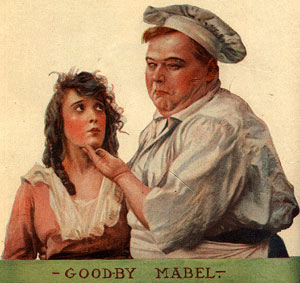
Normand was a known quantity; the Siren loves Mickey and He Did and He Didn't and Tillie's Punctured Romance and many others. Sitting down with the Sennett films that put her on the map was fascinating, though. Normand was utterly fresh and natural on camera. Through more than two hours of viewing the Siren never saw her mug.


John Barrymore told Mary Astor, "Think! the camera is a mind-reader." And what Sennett's camera saw in Normand was unaffected charm. It's a charm that, oddly, doesn't read much in stills at all. What a Normand photograph shows you is a pretty woman with a cute smile. You have to watch her in motion to understand why she bewitched so many, including Chaplin and of course Sennett himself.


The short that captivated the Siren was this one, for reasons that will become clear. The Water Nymph is cute, but not sidesplitting; it's famous mostly for Normand's bathing-suit scene, which according to Ben Mank inaugurated the immortal Sennett Bathing Beauties. But look at Normand earlier, laughing behind her hand at her pompous suitor. It could easily play as mean, even bitchy; Mabel's mockery seems to come from a place of pure joy, not a hint of malice in it.

It's hard to watch Normand without some small spot in the back of your mind cringing away from what fate had in store for her. (It's even harder when she's playing opposite frequent costar Roscoe Arbuckle.) The Siren has read, and mightily enjoyed, Sidney D. Kirkpatrick's A Cast of Killers, about the William Desmond Taylor murder that started Mabel's slide. For those who don't know the book, it is based on King Vidor's unpublished papers.

Toward the end of his life, Vidor became fascinated with this unsolved Hollywood killing, and he wanted to make a movie about it. The book casts Vidor, delightfully, as a sort of Hollywood Jessica Fletcher, running around talking to the silent stars and film people still alive and trying to piece the story together. In the end he comes up with a culprit, one that's revealed in a scene that plays as tragedy, although Vidor's solution absolutely hasn't convinced a lot of the case's devotees. All the Siren can say is that whether or not Vidor had the right perp, it plays. (The case has spawned a whole school of theorizing, Taylorology, which seems to be the perfect hobby for people who find Kennedy conspiracy research to be boringly uncomplicated.)

Normand's in A Cast of Killers, of course, as lovable in that book as she was everywhere else. When it was published in 1986 there was talk of making it into a movie, which still hasn't happened. Certain of the Siren's far-flung correspondents have told her they believe the movie will never happen; that even today, there are those who want to bury the story. The Siren isn't plugged-in enough to say, but the fact that the book has never been filmed is a pity. The Siren adores King Vidor, and the idea of raising his profile with the general public appeals enormously to her.

Vidor would be hard to cast. Normand would be harder.


As the Siren recalls, A Cast of Killers doesn't tell the following tale from Vidor's autobiography, A Tree Is a Tree. Kirkpatrick probably was wise enough to know he couldn't equal it.

In 1931, Vidor and Laurence Stallings were at Vidor's home, working on a screenplay about Billy the Kid. The two men were dressed in tennis whites and bright sweaters, but when they received a summons to meet with Irving Thalberg, they dropped everything and didn't bother to change into anything more sober. They joined Thalberg in his limousine, along with legendary MGM executive Eddie Mannix (whose fearsome reputation has its own school of conspiracy thought). The men discussed Billy's bloody career for a while, when Vidor realized that this wasn't an aimless joyride, they had a destination.

Suddenly the car made a turn to the right and came to an abrupt halt. Quite a crowd was gathered on the sidewalk, and a number of dark limousines, similar to ours, were parked ahead of us. The doorman who stepped up to our car wore white gloves and a dark suit. I realized that we had stopped at the main entrance of a funeral parlo. Apparently we were late for a funeral!

Whose funeral? I wondered.

I was obliged to step out to permit egress for Thalberg and Mannix.

As I started to get back into the car and sit out the funeral service with Stallings, a strong hand gripped my arm.

"Aren't you coming inside?" It was director Marshall Neilan.

"Marshall," I said, "look how we're dressed."

"That's not important. They'll be expecting you."

Who'll be expecting us? I wondered.

Stallings, with the inquisitive soul of a journalist, had started to work his way out of the car. We must have made a pretty picture, two men in white flannels and bright sweaters, as we entered the crowded chapel.

"Who's dead?" I asked Larry in a whisper.

"Let's find out," he replied.

Inside there was another sober-faced gentleman, Lew Cody. This famous actor was a convivial man-about town, and I had never seen him in any mood except a light-hearted one. But Lew showed no surprise at our inappropriate attire and soberly showed us to two seats next to Thalberg and Mannix. A flower-draped casket reposed impressively before us. An organ played gently in the proper mood.

I didn't dare speak. Finally I pantomimed to Mannix to give me pencil and paper. On the back of an envelope I wrote: "Who is it?"

Mannix took the pencil and answered: "Mabel Normand. Don't you read the papers?"

Mabel Normand! I was shocked. It is true that I hadn't read a newspaper in several days. Beautiful, lithe-figured Mabel Normand. When I had been a young ticket-taker in the Texas nickelodeon, Mabel Normand had been my dream girl. I remembered her, black tights covering her body, as she walked to the end of the board and dived gracefully to the water below. I had known her as the Biograph Girl and as the star of dozens of Mack Sennett comedies. Marshall Neilan had directed her first full-length film, Mickey. Lew Cody had been married to her.

Thalberg leaned toward me across Mannix.

"Too many murders," he whispered.

Had she been murdered? I was stunned.

"The public won't accept it," he added and I suddenly realized he was talking about Billy the Kid.

I nodded temporary agreement, but I was pursuing another line of thought. I had begun to recognize faces. There was Marie Dressler of the large, expressive visage. She was never one for subtlety in comedy, nor was she subtle in grief. Ben Turpin was weeping unashamedly. The big face of gigantic Mack Swain of Gold Rush fame was marked with tears. Charlie Chaplin, Mack Sennett, Chester Conklin, Hank Mann, Buster Keaton, Harry Langdon--all fellow workers of hers--were crying. I was fascinated by their faces. These funny faces had made people roar with laughter the world over. Now they were distroted by grief into another, yet equally ridiculous, grimace. These good people, who had not achieved fame by subtlety in facial expression, expressed sorrow in the same open manner; tears flowed plentifully over tragic countenances.

In due time good words were recited from a good book, and the service was over. We watched as the casket moved down the aisle toward the chapel entrance and the brutality of the sunlight beyond.

Presently the four of us were back in the limousine, whose windshield now bore a sticker with the word "Funeral" on it.

As the procession moved slowly along Figueroa Street, Thalberg instructed our driver to turn out at the intersection. With this quick maneuver we left the line of dark cars and headed back toward Culver City and the studio. When the driver stopped briefly to tear the telltale sticker from the windshield, Thalberg resumed our discussion of Billy the Kid.

"Was Sheriff Pat Garrett his friend during the time of the last five murders?" he asked. I couldn't answer. I was still thinking of the girl in the black tights on the end of the diving board...

The car passed again through the studio gates. As we stepped out on the narrow walk, Thalberg bounded up the steel steps to his office. At the top, he turned back. "I'll call you," he said.

The story conference was at an end.


*****

David Cairns knows the story-conference anecdote, and has written about what the tale tells us about Thalberg. (And he also loves A Cast of Killers.)

There are some haunting photos of the dramatis personae of the Taylor case at the site Looking for Mabel, including a photo of a locket she gave Taylor.

Chris Edwards of Silent Volume has a fine tribute to Mabel's Busy Day here.

Further to Mae Clarke, who got a shout-out in my John Gilbert post, here is Robert Avrech with a tribute to Cagney and Clarke in Lady Killer.


Thứ Ba, 10 tháng 7, 2012

Gilbert Talks: Fast Workers (1933) and Downstairs (1932)


There was nothing wrong with John Gilbert's voice.

We know that, but let's start there anyway, as even a few recent articles about The Artist, by people who should know better, reference the old story: John Gilbert, the romantic star of silents, was cursed with a voice that didn't match his masculine sex appeal, a voice that killed his career.

All you have to do to know this received film history is bogus is watch Queen Christina from 1933, the one sound effort from Gilbert still in wide circulation. He's hampered by bad hair, but he sounds fine. His speech is in the same register as that of Ronald Colman or Errol Flynn. Gilbert didn't have their nifty accents, but his slightly flat vowels aren't an irritant and could have been easily remedied. When sound came in, Mary Astor's Midwestern intonations were cured by coaching from her then-lover, John Barrymore.

Admittedly, it's hard to know much about His Glorious Night, Gilbert's first full-length talkie (the first released, that is; he made another, equally ill-fated one before that, Redemption). The Siren doesn't know a soul who's seen it, save John McElwee. He calls Gilbert's voice "more than adequate" and reminds us that the film that supposedly made Gilbert a laughingstock also turned a tidy profit. There's a tiny clip on YouTube where Gilbert does sound a bit effete, but that's mostly a function of the atrocious dialogue. In Singin' in the Rain, if you recall, it's Gene Kelly cooing "I love you, I love you, I love you"--like that Youtube clip--that gets 'em rolling in the aisles as much as Lena Lamont's henhouse screech. But Kelly's voice is no problem for the talkies; even Singin' didn't sign on for the whole myth.

Someone needs to spring His Glorious Night from whatever archival holding pen it's occupying, so we can hear for ourselves. The Siren's willing to bet that Gilbert doesn't sound bad, not even bad enough to support the old rumor that a vengeful Louis B. Mayer, who by all accounts couldn't stand Gilbert, ordered the MGM technicians to use trebles, and trebles only.


These thoughts were retrieved from the attic trunk of the Siren's mind a few weeks ago, because the bottom half of her double bill with Imogen Smith was Fast Workers from 1933, starring John Gilbert, and directed by an uncredited Tod Browning. Off screen Gilbert was miserable, drinking heavily, eking out the last of his MGM contract like a prisoner making hash marks on the wall, but you wouldn't know it. He moves with the same assurance he had in his silents.

The fast workers are construction men, blessed with well-paid jobs while unemployment's at 25%. The men relish their privilege, none more than Gunner Smith (Gilbert), whom we first see in the early morning as he's changing from evening clothes to work duds in the back seat of a car. As you watch him take off his shirt with swift precision, you know it's at least the second, possibly even the third or fourth time he's disrobed in as many hours.

Gunner ambles onto the worker's base platform high above the streets and pow, the rhythm jazzes right up. In any group of friends there's always such a creature, the easy leader, granted that unelected status by looks, charm, and above all confidence. When the guys go out for drinks, Gunner's status is even more evident. He half-sits on a barstool, marking out his next conquest and grinning that devilish grin, and his coworkers are happy just to watch him operate.

It isn't a female-friendly world, to say the least; Gunner's entire off-duty life is devoted not only to getting laid, but to making sure that his best friend Bucker Reilly (Robert Armstrong) avoids any con jobs from cheap skirts. The preventative is simple and diabolical: Gunner sleeps with Bucker's crushes himself. Problem solved. No, seriously, that's what the man believes; Gilbert plays it exactly as though he's doing his pal a favor. But then Bucker falls genuinely in love with Mary, played by Mae Clarke with a great mix of tough-tootsie grifting and fragile romantic desire. Mary has already been around the block with Gunner, you see...


Tod Browning, coming off the worst disappointment of his career with the failure of Freaks, was no happier about Fast Workers than Gilbert, and had his name taken off the picture. Probably the script wasn't a good temperamental fit; the goings-on are not so much strange as sordid. There's a definite Browning feel to the best bits, though, such as a dizzy scene on a girder that's been tampered with. The rear projection used for the street below the skyscraper is marvelous. And there's a minor subplot involving baby pigeons that would have fit just fine in Freaks.

It's a lowdown lurid little movie that would have done Warner Brothers proud, and how it landed at MGM I'll never know. Seeing MGM stamped on Fast Workers is like discovering your Sunday school teacher looks great in a swimsuit.

Now the Siren has seen Queen Christina (at least eight times, if you insist on a tally) so she knew Gilbert's voice wasn't a problem. But she'd gathered that his other talkies were, by and large, unworthy of him. On the Siren's shelves is Dark Star, Leatrice Gilbert Fountain's biography of her father, and even Fountain didn't like Fast Workers. By the time the credits rolled, the Siren was a bit worked up herself, having discovered that she couldn't have been more misinformed if she'd gone to take the waters in Casablanca. "This is one of his lousy, career-destroying talkies?" she demanded, rhetorically of course, no one was arguing with her, least of all Imogen. "This is Gilbert on the skids? What?"

Imogen highly recommended Downstairs, which Gilbert conceived and co-wrote as well as starred in--but it isn't on DVD. Damnit. (Although Fast Workers is.) A little bit of digging, and the Siren had it (gone now, alas).

Downstairs, directed by Monta Bell and set in what Lubitsch might have called Vienna, Hollywood, is a comedy of manners about the servants and their employer problem. Confession: The Siren's addicted to Downton Abbey, despite some things that bother her no end, such as when Bates, the butler, decides he must nobly protect the good name of his lordship. Thomas, the scheming footman, he's got the logical attitude: Take these ludicrously overprivileged layabouts for all you can get. If that thought has crossed your mind while watching Downton Abbey, rejoice; here's John Gilbert as Karl the chaffeur.


Karl is the anti-est of antiheros, so amoral he could take Thomas down to his shirt studs, and the movie knows it shouldn't be on his side, and yet it is. Just watch dependably stolid Paul Lukas, as Albert the butler, sternly warn Karl not to betray the lady of the house (Olga Baclanova) after she's been diddling some schmo in town. Karl can barely conceal his contempt as he agrees to maintain the family secrets. Gilbert keeps eye contact and almost imperceptibly shakes off the butler's honorable handclasp. Then, again in a tiny gesture, he wipes the bridge of his nose, as though Albert's crawled up there.

Ah, the Gilbert nose. By rights it should be as immortal as John Barrymore's, and the nose gets a major workout in Downstairs. He's peering down it at whoever he's conning, he's tilting it slightly skyward as he contemplates his next scheme. Baclanova seals her doom when she goes to meet her lover and almost shuts the door on the nose. You don't do that to the Gilbert profile. His look as he pulls back is not fury, resentment or humiliation; it's cool, deliberate vengefulness.

Karl calibrates his behavior to the desires of every mark, and they're all marks to Karl. Seducing the cook, for example, he doesn't bother with subtlety. Told he has flour on his ass ("your whatchamacallit," the cook says coyly), Karl sticks it out at her and says, "Get it off, will you?"


But Karl's real target is Albert's wife Anna (Virginia Bruce). He takes her to a nearby inn for a spot of seduction. Off-duty and sure of his goal, Karl rattles the dishes when he stubs out a cigarette. Legs splayed and chair tilted back, Karl looks at Anna like a cat wondering if the mouse should be the main course or saved for later, like a chocolate with coffee.

Gilbert wrote himself a complicated, nasty, but undeniably sexy part. Downstairs forces us to admit that sexy counts far more than most people like to admit. It's deliciously clear that upright Albert is hopeless in bed. If showing Anna the real facts of life were Karl's only sin, he could take the "anti" off hero. Alas, Karl really is a louse, shown by his brutal cruelty to the dimwitted, lovestruck cook. But he's also probably the one taste of good lovemaking she'll ever get. Downstairs is cynical enough to suggest maybe the cook didn't do so badly by the bargain.

Gilbert was proud of Downstairs, and it got him a few good reviews as well as the hand of Virginia Bruce, whom he married after filming. But any reprieve was temporary. Soon he was losing the lead in Red Dust to Clark Gable and seething through the making of Fast Workers.

Fountain's book tries to solve the puzzle of why her father became sound's most notorious casualty. She goes through Gilbert's feud with Mayer and the question of whether MGM deliberately sank its troublesome, expensive star. Fountain believes the story that Gilbert, left at the altar by love of his life Greta Garbo, knocked Mayer flat when the mogul quipped gallantly, "Why don't you just fuck her and forget about it?" She quotes His Glorious Night reviews and notes that no one mentions the voice; she smacks down an old yarn about Gilbert attending the premiere and leaving in shame before the lights came up. (There was no big premiere, and he was in Europe when the film came out.)

Fountain tracks the voice sniping to about 1930, when it took off in the press, whether fueled by the MGM brass, or just gossips smelling blood, she can't say. Such was the power of the legend that one of the most poignant quotes comes from Clarence Brown, who directed Gilbert in the gorgeous Flesh and the Devil: "As time went by, I'd hear occasional mentions of Jack's high piping voice, and the way audiences roared at the sound of it, and damned if I didn't find myself repeating them one day. Can you believe that? Me, of all people, repeating those stories. And I knew better, Leatrice, I knew better."

Dark Star is a touching book, a loving daughter's attempt at resurrection, and while Fountain doesn't excise Gilbert's drinking, she's reluctant to attribute much to it. But colleagues were blunt: Gilbert was an alcoholic, one who "became more argumentative and belligerent with each drink," wrote Colleen Moore. (Moore spoke from experience; her first husband was an alcoholic.) The Siren told Robert Avrech, who holds a special love for silents and early talkies, that she was writing about Gilbert. Robert wrote back:

The more I read about him the more I'm convinced that he was an emotional child, impulsive, impossibly romantic, and tragically self-destructive. Going to war against L.B. Mayer is sheer madness. I admire Downstairs tremendously. His playing against type was courageous, but certainly not what his audience wanted.

And of course his voice was fine.


History comes with hard-set myths, and more than once the Siren's hit her head on some Hollywood cement. At least the lie about Jack Gilbert's squeak is all but dead. When the Siren took to Twitter, after seeing Fast Workers, to say that Gilbert sounded good, nearly a dozen people instantly tweeted back that of course he did.

Thank goodness. The canard diminishes even Gilbert's silent performances, if new audiences look at him--so graceful, varied and heartbreakingly sincere in The Big Parade, to cite only one--and imagine the intertitles spoken in an incongruous high tenor. If the voice myth gets a stake through its heart, perhaps Gilbert's good talkies can get more attention, too, putting paid to the idea espoused by David Thomson, that "Gilbert had always been a coarse actor," and sound simply emphasized that.

Some silent stars survived to see their fame renewed. Louise Brooks wrote about Pabst for the New Yorker, Buster Keaton became a hero to cinephiles worldwide. It makes the stories of the ones who didn't live that long all the sadder. Gilbert died in 1936, his talkies already enshrined as the thing that did him in, turned him into a man who didn't sound manly.

On a now-defunct chatboard some dreamy-eyed chatter once started a thread thus: "If you could go back in time and give an artist one present--and one only--who would you pick, and what would you give the person?" The Siren answered that she'd bring Franz Schubert some penicillin. But suppose she had to go back empty-handed, and could deliver only a line. She could do a lot worse than, "Mr. Gilbert, Fast Workers is a good movie."


Thứ Tư, 18 tháng 4, 2012

You're Much Too Modest

It is a complicated business, and we are very insecure, we actors. We all feel--and fear--we are going to be found out at any moment. Someone is going to point and say, 'You are really not very good, are you?'
--Julie Christie

The Siren, as she's often said, likes and admires actors, more perhaps than some of the profession's members like themselves. Like all artists, the good ones usually have an accurate sense of their own work. But over her years of obsessive reading, the Siren has seen cases where something throws off the radar.

Not always, of course. Katharine Hepburn rued the reception of Sylvia Scarlet but was clear-headed enough to tell people, much later, that the film was simply ahead of its time. Peter Ustinov acknowledged the reverence accorded Lola Montes, but added in Dear Me that "there were precious few signs of this destiny during filming." Joan Fontaine had a lousy time making Rebecca but has said more than once that she knows it will always be her most celebrated role. Others, like Barbara Stanwyck, were too coolly professional to run down their own work.

Now and again, though, you'll come across an actor dismissing something that was good to great. The Siren is fascinated by these instances, not from smug hindsight, but because it goes against the common perception of stars as egomaniacs. You can speculate about the reasons, beyond genuine variance in taste, why an actor might be too hard on his own work. Maybe the actor hated making the movie. Maybe the movie was a box-office bomb, and the actor figured the public and the critics at the time were the best judge. Maybe the movie didn't fit with the image the actor wanted to project. Some, like Norma Shearer, never warmed to a great film (in her case, The Women, an unhappy experience for her) and instead venerated a lesser one; Shearer was fond of her performance in Romeo and Juliet, an opinion not widely shared these days.

And sometimes the actor just had, or learned to have, contempt for the entire business.

Here's a small collection, then, of actors being more critical of themselves and their movies than the Siren, and in most cases plenty of others, would say is warranted.


According to the reference books which consider it worthwhile collating such trivia, I have made about seventy films. Glancing down the list, I find I made things like Action in Arabia, Lured, and The Scarlet Coat. I can only assume that I was paid handsomely for them, but I am at a complete loss as to what action there was in Arabia, or who was lured where, and why. As to the scarlet coat, did I wear it, and if not who did?

George Sanders, in Memoirs of a Professional Cad, shrugging off Lured, an excellent thriller from the great Douglas Sirk that features our man George at his rakish best. The other two the Siren hasn't seen. The Scarlet Coat--a drama about Benedict Arnold in which Sanders, by some dreadful misjudgment, was NOT cast as the infamous traitor--was directed by John Sturges, and the Siren is willing to bet it's better than the actor says. Action in Arabia--well, he may have us there, but look at the synopsis and tell me you're not intrigued.


The worst picture, bar none, that I ever made.

Mary Pickford's tribute to Rosita in Sunshine and Shadow. While the collaboration with Ernst Lubitsch seems to have been happy at the time, Pickford later claimed the film gave her no end of trouble. She carried a grudge against Rosita for the rest of her life, not including it in the films she later handed over for preservation. It was extremely well-reviewed, however, and Scott Eyman has good words for it in his Lubitsch bio. The Siren hasn't seen Rosita (hard to track down) but come on, it's Lubitsch. How bad can it be?


She was in the middle of complaining about what a piece of crap the film was, and how lucky Rita Hayworth was because she turned it down…

Ava Gardner encounters Farley Granger in Rome during the filming of The Barefoot Contessa, as told in Granger's Include Me Out. Gardner, bless her, had little good to say about her entire career, as can be seen in her famous interview with Rex Reed. True, not everyone feels the love for The Barefoot Contessa, but the Siren has some heavyweights on her side.


You liked that?

Bette Davis' incredulous response to Whitney Stine's praise for Beyond the Forest. Davis spent years telling everyone the picture stank. The Siren says this King Vidor is a lot better than Duel in the Sun. Molly Haskell called it Davis' "wildest and most uncompromising film;' Kim Morgan admires it, too.


Kitsch.

In Maximilian Schell's documentary, that's Marlene Dietrich's word for most of her Hollywood work, including the glorious execution scene in Josef von Sternberg's Dishonored and, if memory serves, The Blue Angel. Whether or not Dietrich, at that point in her life, truly believed it was all mostly kitsch is an open question, but say it she did, with the full force of the German pronunciation.


Movies bore me, especially my own.

Robert Mitchum discusses his career. In contrast to Dietrich, the Siren believes Mitchum meant this, to the extent that he ever meant anything he said. Although Mitchum always did have good things to say about The Night of the Hunter. Which brings us to...


I played in the movie, which was about the battle between good and evil. Parts of the film were excellent, but it was not fully sustained because Mr. Laughton did not want to 'ruin' Robert Mitchum's image by having him a play a thoroughly wicked man. In the earlier days of films, it would have been considered a triumph to play evil convincingly.

That, along with a terse paragraph about Charles Laughton's admiration for D.W. Griffith, constitutes Lillian Gish's entire tribute to The Night of the Hunter in The Movies, Mr. Griffith and Me. She did express similar thoughts to her director during filming, but Laughton biographer Simon Callow maintains that Laughton's allusion to Mitchum's image was basically a joke. Gish's curt assessment, and weird critique of Mitchum's seductively chilling work, may have owed something to dissatisfaction with her billing. The Bad and the Beautiful: Hollywood in the Fifties quotes her agent as saying that when Gish saw the movie poster, with only Mitchum and Shelley Winters advertised, she "blew her top."


Ridiculous. I made the picture because I couldn't afford a suspension--not with a daughter, a husband and a household to support.

Maureen O'Hara's verdict on Sinbad the Sailor, maybe not a pinnacle of art but an absolutely corking movie the Siren has adored since childhood. For the record, O'Hara is delightful in it. O'Hara also disliked Forbidden Street, another one the Siren thought quite fine. This Land Is Mine gets passing reference in two sentences, neither of which mention the director. Then again, good movies that actors neglect in their memoirs could be a whole different post. E.g.…


The four pictures I made at Warner Brothers were not great pictures, but they were very good pictures and excellent entertainment. In their category I do not see their like being as well made today.
The Siren's perennial crush, Basil Rathbone, gives backhanded praise to Tovarich, Captain Blood, The Adventures of Robin Hood, and The Dawn Patrol. Those four movies, all of them lovable and three of them eternal classics, take up just under two (2) pages of Rathbone's charmingly off-topic autobiography. Rathbone allows as how Errol Flynn was "monstrously lazy and self-indulgent," albeit genial, and Olivia de Havilland was very pretty. On the other hand, you do get quite a bit about Rathbone's dogs.


For its time, Side Street was a good-looking, well-made film that was not able to rise above the banality of its story.

Farley Granger again. The Siren says Granger, a smart man, underrated this excellent Anthony Mann noir. At least Granger gave himself credit for Strangers on a Train and Senso. Another actor with the same last name was much more cutting about his own career.


I've never done a film that I'm proud of.

Stewart Granger's oft-quoted line wasn't strictly true, as he did admit liking a few roles, such as Saraband for Dead Lovers, but he never thought much of his own abilities.


I don't want to be a silly temptress. I cannot see any sense in getting dressed up and doing nothing but tempting men in pictures.

Greta Garbo. Of course. When the Siren first encountered that remark she thought Garbo kind of had a point, until she found out the star was talking about the splendid Flesh and the Devil.


Mediocre.

Montgomery Clift's summation of his work as Matt Garth in Red River. He was no huge fan of the overall film, either, particularly the end, and on that aspect he has some critical company. But when Clift watched it in a cinema, he knew Red River would make him a star. And so, according to biographer Patricia Bosworth, Clift went on one last pre-fame drinking binge, applying himself to the task with such intensity that he wound up in a New Orleans jail.


A crock of shit.

Humphrey Bogart offers his opinion of Billy Wilder's beloved Sabrina to a reporter on set. If he ever revised that evaluation, the Siren has not located where.


I did things like Shampoo and Heaven Can Wait. I don't know what those films were about. The women I played in them were not very empowered.

Julie Christie. We can debate Heaven Can Wait--the Siren enjoys it--but surely most of us hope she's changed her mind about Shampoo.


The picture was a big hit in spite of my wooden performance. I have only kept one review during my life. It is of Dodsworth and appeared in the Detroit Free Press. 'In this picture we were privileged to see the great Samuel Goldwyn's latest discovery--all we can say about this actor? Is that he is tall, dark and not the slightest bit handsome.' It has the place of honor in my lavatory.

Thanks to William Wyler's unvarnished manner and multiple takes, David Niven hated making Dodsworth. But he's very good, better than he was as Edgar Linton in Wuthering Heights, during which shoot William Wyler made Niven equally miserable a few years later.


There was the first of several visits to Italy to act for various aspiring Fellinis and Antonionis, among them Dario Argento, in Profondo Rosso, a.k.a. Deep Red; Deep Red Hatchet Murders; Dripping Deep Red; The Hatchet Murders and (why?) The Sabre Tooth Tiger. It could be said that there is often a connection between the absence of quality in a film and the number of its aliases.

David Hemmings on one of his more famous movies, from his 2004 memoirs. The Siren adds that when Glenn Kenny encountered Hemmings in Toronto just after 9/11, the actor was not so harsh.


Well, that wasn't much.
Joan Bennett, overheard as she left a 1981 tribute screening of The Reckless Moment. Given the present-day reputation of Max Ophuls' film, and Bennett's superlative performance, this is probably the biggest jaw-dropper of the bunch. It was not an opinion Bennett reached only in crotchety old age; Brian Kellow's biography records her saying years before that The Reckless Moment was "nothing exceptional…not like The Woman in the Window or Scarlet Street." Argento fans can also take note of Kellow's observation, about Suspiria's later cult status, that "it is unlikely that Joan knew or cared."

Thứ Ba, 30 tháng 11, 2010

Five Big Yearnings

The Siren doesn’t usually post about the truly random movie thoughts constantly flitting around her brain, but she’s been pondering this all weekend and wanted to hear what her patient readers had to say. It’s prompted by looking at the schedule for Fritz Lang in Hollywood, an incredible series scheduled for the Film Forum in January/February 2011. Now the Siren has Lang on the brain anyway, what with For the Love of Film (Noir) working to preserve a remake of a great Lang movie, and writing about the terrific House by the River at Fandor--available here, and no firewall anymore. The Siren has a hell-or-high-water must-see series list that includes (but is not limited to) The Secret Beyond the Door, You and Me, Beyond a Reasonable Doubt (Joan!) and An American Guerrilla in the Philippines, none of which she’s seen yet. But there’s also Moonfleet, which she saw again recently on a very good DVD, but yearns to see on a big screen.

So the Siren got to thinking. Of all the movies she’s already seen on DVD, TCM or VHS, which ones would she most like to see on a big screen in a great print?

Here are five. This list is just for starters, of course, but these are very serious yens. The fact that they’re all black and white is...interesting. And unplanned.


1. The Crowd. The Siren’s twins were about seven months old and still waking up in the middle of the night from time to time. The feed/change/settle routine for a total of two (2) babies usually equaled about 90 minutes of activity, and ended that morning at about 5 am. The Siren was in the habit of putting on TCM during this process. So she gets the last baby to sleep and is about to collapse back in bed, and goes back to the living room to turn off the TV. And noticed The Crowd was about to start. And thought, “Let’s take five minutes to see how this looks.” A little over 100 minutes later, it was time to get ready for work. And when the Siren, so sleepy she was swaying slightly on her feet, ran into an equally movie-mad colleague (we used to share custody of a VHS of Letter from an Unknown Woman), she chattered at him about The Crowd to the point where he put up both hands and said, “I have never seen you like this about a movie.”

Perhaps it isn’t the sort of quote people pick for an ad in Variety, but “So good mothers of infant twins choose it instead of sleep” is one hell of a recommendation.

The Crowd isn’t on DVD. Now the Siren is very, very cognizant of the special issues involved in preparing a good DVD release of a movie as old as The Crowd. She knows she whines a lot. But this isn’t merely the best silent movie the Siren has ever seen. Without hesitation she will name it as one of the greatest movies ever made in this country or anywhere else. So hearing that there is no Crowd on DVD is like planning a trip to MOMA, only to have them tell you that Starry Night has been stashed in the broom closet. Well, let’s hope Warner Brothers is on the case.

If, however, the Siren could see this one on screen, hand on heart, she promises to shut up already about the DVD.


2. The Long Voyage Home. You know who else wants to see this on a big screen? John Nolte of Big Hollywood. The Siren can’t remember his exact words, but the phrase “crawl over broken glass” may have occurred in there somewhere. Mr. Nolte’s love for John Ford, and appreciation for this lesser-known film, is one of those heartwarming instances of cross-aisle harmony that sustain us all in these partisan times. This is another that the Siren watched by chance on TCM, and the brilliance of Thomas Mitchell, the incredible tenderness and sympathy afforded these men doing a spirit-sucking and lonely job, and above all the deep-focus cinematography of Gregg Toland put her in traction. If John should be in town when this one comes on screen, in a gesture of Ford-loving solidarity the Siren will not only crawl with him to see it, she’ll buy his popcorn, as long as neither one of us brings up Obama. Or Jafar Panahi.

(The screen grab above is from a series posted at Six Martinis and the Seventh Art, always and forever one of the Siren's favorite stops on the Web.)


3. Love Affair. Because Christmas is coming, and the Siren yearns to see Charles Boyer give Irene Dunne her present.


4. The Fallen Idol. The Siren regards The Third Man with the same awestruck reverence as everyone else--more, even. There are, she suspects, not that many fans of the movie who went so far as to name their only daughter Alida. And yet, given a choice between Harry Lime and Baines larger than life, at the moment she’d pick Baines. “We ought to be very careful, Phil. 'Cause we make one another.” “I thought God made us." “Trouble is, we take a hand in the game.” This screened last year at Film Forum--while the Siren was in Paris.

(Gorgeous screen grab is from Coffee, Coffee, And More Coffee, where Peter Nelhaus is in the habit of posting coffee-drinking images from all kinds of movies. Patient readers should stop by and thank Peter for this dose of Michele Morgan.)


5. David Copperfield. David Ehrenstein, where are you? Are you still banging the drum for early George Cukor? Because the Siren is right there with you, and she’s never seen an adaptation of Charles Dickens (her favorite novelist) to surpass this one. Nor will there ever be a Micawber to equal W.C. Fields. And Karen shares the Siren’s love for Freddie Bartholomew.

In conclusion, speaking of movies that deserve restoration, big-screen unspooling, DVD cases with luxurious little booklets and just one whole hell of a lot more respect than they have received in the past, let’s talk about Julien Duvivier’s La Fin du Jour. The Siren mentioned that Dennis Cozzalio posted about it, but she didn’t do his splendid essay justice. It’s an elegant, deeply sympathetic and altogether marvelous piece of film criticism that will make you want to bite your arm off at the elbow in frustration if you haven’t seen this tantalizingly hard-to-find masterpiece. Really, please, go read it.