Thứ Sáu, 1 tháng 9, 2006

Anecdote of the Week


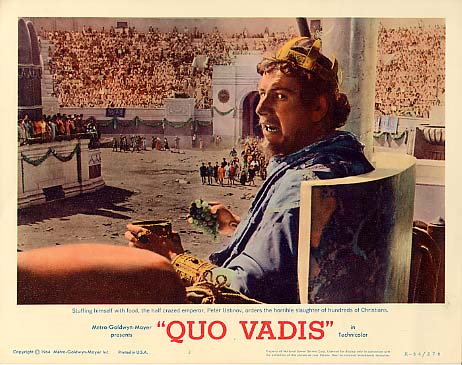
"The film was a great success all over the world and brought Peter a recognition that was not always to his liking. He was in New York for the opening and climbed into a cab, but before he could state his destination the driver enquired, 'Quo vadis, Mr. Ustinov?'"

--From Peter Ustinov: The Gift of Laughter, by John Miller.

Thứ Tư, 9 tháng 8, 2006

Knocked Up at the Movies

Did the Siren happen to mention she's knocked up? No? Oops. Well, she is, 29 weeks. It's a boy, due late October, nameless as of now. Film-oriented suggestions welcome. If your suggested name is chosen, we owe you a goat, or a sheep, your choice. (Lebanese tradition.)

So the Siren has been mulling this post for a while, but the pickings are mighty slim for the eras she usually covers. Thanks to the censors, pregnancy and childbirth were treated with a spectacular lack of realism during the Golden Age. The baby belly was either nonexistent or suggested by the heroine's adjusting her belt buckle a few notches. The Hays Code didn't specifically require this (so far as the Siren's research shows), so perhaps the tradition of padding the woman with a lace hanky and calling it a day was just the studios' reluctance to show a glamor gal waddling. The code did forbid childbirth scenes, however, so usually what you would get would be the pitter-patter of little feet talk between the (always married) couple, then a swift cut to a waiting room, or a cradle, or some such. On the rare occasions when pregnant women did appear on screen, they were from some other planet where seven months looks like two, a planet the Siren fervently wishes she were on right now.

In the 1939 Stagecoach, for example, Louise Platt plays a genteel wife going to join her Army husband. The dialogue only lightly alludes to her pregnancy. She clutches a paisley shawl over a figure that looks quite slim, and she retains the gait of a Virginia belle. Try dismounting from a stagecoach late in your third trimester, and see if you are up to gracefully placing your hand in the hand of a John Carradine substitute. The more likely scenario is that you grab his forearm for dear life and lumber down those teetering little steps like a Saint Bernard with advanced arthritis. Even as a teen with no experience of pregnancy, either hers or anyone else's, the Siren saw Stagecoach and figured Platt's character was four months, tops. So it was a bit of a shock when Platt went into apparently full-term labor midway through the movie.

Gone with the Wind, made the same year, is comparatively realistic, with Melanie giving birth during the siege of Atlanta. Only vague silhouettes show, and there's no screaming, though Scarlett tells her to yell her head off if she wants. Afterward Melanie is extremely sick and weak--hemorrhage, maybe? You aren't told, nor do you have any idea why she's told not to have more babies and eventually dies in childbirth after ignoring the advice. When she tells Clark Gable she is expecting another child, her shawl is draped just like Platt's.

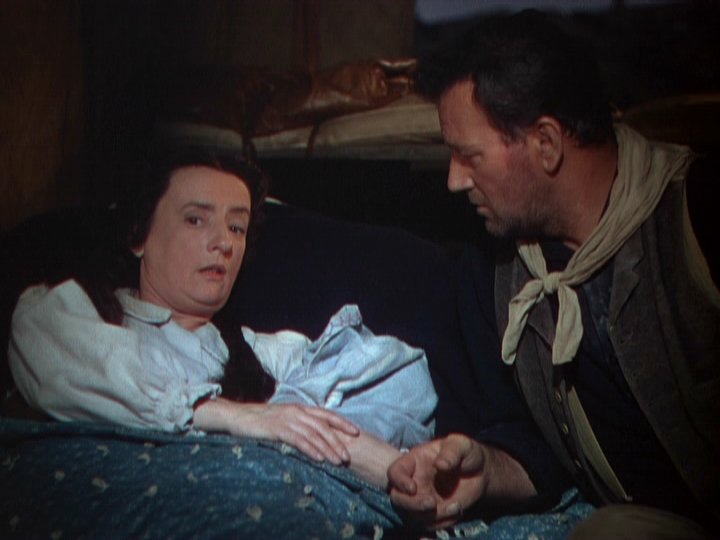
Puerperal fever? obstructed labor? Whatever the unidentified cause, plenty of women die in childbirth at the movies, often off-camera, as in the saddest scene in Goodbye, Mr. Chips (1939). If they do it on camera, they do it beatifically, like Melanie. In 3 Godfathers (1948), a John Ford that the Siren loves, Mildred Natwick (43 years old, and looking every day of it) is found in a wagon about to give birth, the fact that things are going badly conveyed by her gasping a lot and struggling to sit up. The men try to help the delivery, but she is a goner. Braids neat, face matte, clad in a miraculously clean white nightgown, she hands the baby over to John Wayne, Pedro Armendariz and Harry Carey Jr., and dies.

But the Siren is looking for pregnancy at the movies, and this is largely childbirth, and damned unlucky childbirth, at that. Well, there is Leave Her to Heaven, if you want an example of a woman who doesn't exactly sing the Magnificat upon hearing the happy news. As Gene Tierney's monstrous Ellen is put on a late-1940s version of bedrest, she becomes arguably even more insane than she was previously. Convinced that husband Cornel Wilde is developing too tight a bond with her sister Ruth (Jeanne Crain), Ellen decides to get rid of what is confining her to bed.

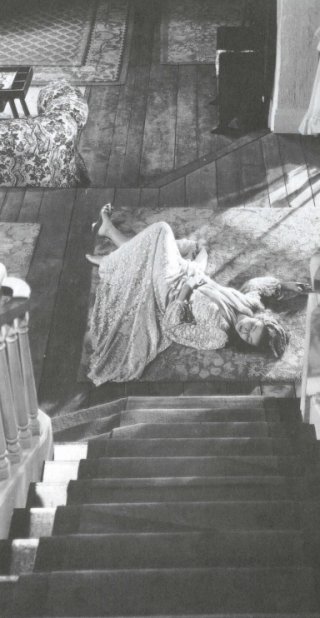
The big, indelible scene from John Stahl's movie has Tierney in a rowboat in the middle of the lake, calmly watching as her polio-crippled brother-in-law gets a cramp and drowns. But the Siren was also marked at an early age by the moment when Tierney gets herself un-pregnant. Wearing a beautiful negligee, with a belly the Siren would measure at about five days post-conception, Ellen walks to the top of the staircase. You see her, like a psychopathic Cinderella, carefully remove a slipper to be left as evidence at the top landing. Then, camera still focused on her feet, Ellen throws herself down the stairs and lands in an artful heap, nightgown still so clean Mildred Natwick would be proud. Do you suppose any women saw this and thought it would be a foolproof way to end an unwanted pregnancy? In reality, of course, it isn't nearly that easy to induce a miscarriage, although Ellen is having a touch-and-go pregnancy already.

Speaking of dangerous pregnancies--even the daring Miracle of Morgan's Creek (1944) didn't show the slightest bulge in pregnant Betty Hutton, despite the fact that she must be about three months before we cut to a later stage of her pregnancy. At that point they film her from behind, which is probably just as well. The miracle is (skip the rest of this paragraph if you don't want to know) that Hutton is pregnant with sextuplets.

Ha, ha, ha. The Siren has had twins. At three months she looked about five months. At five months people asked when she was due. At seven months she got into a cab and said, "68th and York," only to have the cabbie whip his head around and practically yodel, "New York Hospital????" The Siren reassured him that it was just a checkup. With six babies, Hutton's figure should have been bordering on the Wagnerian early on, but the movie is so funny you overlook Hutton's having the easiest pregnancy and delivery of higher-order multiples in recorded history.

By the late 1950s movie pregnancy was getting a touch more realistic. A Farewell to Arms, David O. Selznick's doomed swan song as a producer, has Jennifer Jones asking Rock Hudson to feel the baby kick. Jones looks more pregnant than Louise Platt, which is something, but she's still not a patch on the Siren's belly. Reportedly Jones' childbirth scene late in the movie is part of why Farewell tanked, as it is quite long and drawn out and there are a lot of close-ups of her face contorting. Even a few modern viewers squirm. But the decade had its big breakthrough in pregnancy depiction on television, where Lucille Ball dared to waddle. The scene where Ball gets stuck in an armchair still cracks up the Siren.

By 1962 you get The L-Shaped Room, where Leslie Caron's neighbor deduces she is pregnant because he can hear her throwing up through the walls of their cheesy rooming house. That movie holds up well in showing an unwed pregnancy, even going so far as to have Caron waffle about whether or not to have an abortion.

In 1995 the Siren saw a Hugh Grant vehicle called Nine Months, allegedly a comedy about pregnancy but in reality a platform for the most retro sex-role ideas imaginable. Despite being able to show a great deal more than you could prior to 1960, most movies showing pregnancy hew closely to the cliches, both cutesy, as in Look Who's Talking, or horrifying, as in the original Alien, in some ways an extended meditation on fear of childbirth.

But during her last pregnancy, the Siren did finally see a movie with the nerve to depict pregnancy in all its inconvenience, mess and bizarreness--Rosemary's Baby. OK, that isn't as bad as it sounds. Bear with the Siren. Yes, birth is a beautiful thing, and the Siren knows how lucky she is. But the process of getting there can be difficult, psychologically as well as physically, and the Roman Polanski film is, oddly, more truthful in this regard that many "realistic" dramas.

Rosemary gets so much right about pregnancy. It shows the way people infantilize a pregnant woman--everyone from husband to doctor pats you on the head and tells you everything is normal, no matter how freaking weird you feel or what your body happens to be doing. The movie also shows how the advice comes at you from all directions, and how you feel obligated to at least try it all, even if the suggestion is coming from some gnomelike woman you've just met. And it also shows the crushing fear that something might go wrong, or worse, that something IS going wrong, and no one will listen to you. The movie even taps into the worst part, the irrational thought that jolts you awake at 2 a.m. as you try to find a comfortable position so you can fall back asleep--"What if I give birth to a monster?"

The cleverness is that for once, the fears are true. The revelation of Rosemary's baby was anticlimactic to the Siren. Now that's partly due to her recognizing all these cute elderly character actors from the past, like Aunt Bea's best friend chirping "Hail Satan!" But it was also because the really scary stuff had come before.

Something else you don't much see in movies is how pregnancy lowers your powers of recollection. Anyone else have a memorable image of pregnancy from movies past?

Thứ Bảy, 5 tháng 8, 2006

Mr. Campaspe Posts and Hosts


From an email invitation Mr. Campaspe has sent to the Siren family's nearest and dearest in the NYC area:

Next Thursday, Aug. 17, BAM is showing the movie Les Tontons Flingueurs. Little known in the U.S., Les Tontons is a masterpiece of such magnitude that it is any cinephile's duty to disseminate it to the world. In the Michelin rating system--based on how far one should travel to experience an event--the movie deserves the maximum 3 stars. Yes, ladies and gentlemen, at last, a movie that is worth a trip to Brooklyn.

To convey how good the movie is, suffice it to say it is the best one by Georges Lautner, surpassing even his series with Belmondo, or his Barbouzes. Les Tontons' dialogue was written by Michel Audiard, who spoke only street French. ("French people drive me crazy," he once said, "but since I don't speak any other language, I have no choice but to converse with them.") So he put all his genius into becoming the poet of spoken French, creating many immortal quotations for the second half of the 20th century. He it is who gave the conclusive definition of a gentleman (someone who can describe Sophia Loren without using his hands.)

The cast reads like a proposal to create a pantheon of movie comics: Bernard Blier, Lino Ventura, Claude Rich, Jean Lefebvre, and Francis Blanche.

Hilarious, witty, ruthless in its social description but genial in its handling of political situations, this movie goes so deep into Frenchness that it reaches the core of the human spirit. In these sorry times, it will restore your faith in the ability of humanity to overcome our idiots, while making clear the amount of work required.

And it is unavailable in the U.S.!

* * * * *

The Siren had never heard of this movie before her husband began evangelizing about it, but it is worth apparently not only the journey, but the cost of hiring a babysitter for the evening. If any of her patient readers are around next week, by all means, check it out.


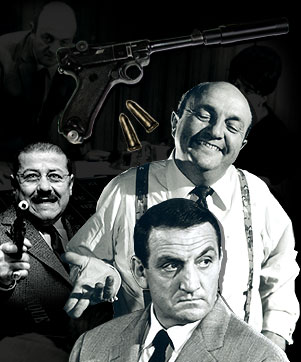
Above, left to right, Francis Blanche, Lino Ventura and Bernard Blier in Les Tontons Flingueurs. Middle, Michel Audiard.

Thứ Năm, 20 tháng 7, 2006

Voices of the Screen

Time Warner took pity on our DSL connection about two weeks ago, but there is no television at the Siren's house, a situation she will probably rectify soon. So as events unfold in Lebanon, all she has are voices, from the BBC news service and on bad phone connnections. We have friends and relatives there. I was married in this hotel, six years ago. Everyone we love is safe, so far. It is hard to concentrate on blogging or anything else. It will be another couple of weeks before we get a TV, and I suppose that has its advantages at the moment. The images on my computer are bad enough. For once, I don't want to see the pictures moving.

In times like these, distraction is probably as good as it gets. During the first Gulf War I read all of Bruce Catton's Army of the Potomac trilogy, blocking out one set of hostilities with the echoes of another. I am at the point now where any war reading is out of the question, and without movies on a screen what I have are voices in my head, lines and scenes I can replay. I suppose I take it for granted that people who read my blog miss the Golden Age of movies as I do. We talk about old stars, directors, the incredible beauty of black-and-white, the snap of the dialogue, but so far we haven't discussed voices.

Early talkies did the human voice no favors, hitting the squeaky high notes with a frequency that gelded male stars and made female ones sound like Kewpie dolls. Once technicians got the sound more under control, though, performers began to stand out on the basis of their voices. Vaguely aristocratic tones like that of Ronald Colman were especially coveted. You strove for that mid-Atlantic accent, meaning not Delaware and Pennsylvania but somewhere in the middle of the ocean, between England and the former colonies. Eventually individuality blossomed, and the full spectrum of American accents was heard. The Siren thinks you hear a much wider variety of dialects in 1930s movies than you do in modern ones (notwithstanding, however, the ghastly parody that stood in for most black dialect, and the way Asian and some other foreign speaking patterns were mocked).

Anyway, all this got the Siren thinking about her favorite screen voices. And she started thinking about criteria. Is it sheer beauty that makes a great screen voice? is it enough to be memorable, even if the voice screeches like a rusty hinge?

Well, beauty counts for a lot with the Siren, so most of her list is easy on the ears. Many of them were stage-trained voices, that particular discipline seeming to bring out the best in a speaking voice.

I am not putting these voices in any particular order, save to list my favorite of all time, Orson Welles. The Siren sees some eyes rolling. Well yes, it is quite dreary, his being a genius all the time, as ex-wife Rita Hayworth is said to have sniped. And his voice may be cheapened a bit for those who had to listen to his Paul Masson spots in childhood. But his narration for The Magnificent Ambersons is an intrinsic part of that film's greatness. His voice focuses as deeply as the camera, with a similar interplay of light and dark. The Siren can, at will, turn on a recording in her head, hear him speaking the first lines, and be enveloped by that atmosphere once more: "The magnificence of the Ambersons began in 1873. Their splendor lasted throughout all the years that saw their midland town spread and darken into a city..."

There never was and never could be another voice to give the climactic lines their sense of waste and inevitability, turning the much-anticipated fate of the Ambersons into the loss we all suffered when the great god Aut O'Mobile first took us for a ride. The bitterness and regret is there, but so is the gallows humor. We brought this on ourselves, as surely as George Minafer ever did:

Something had happened, a thing which, years ago, had been the eagerest hope of many, many good citizens of the town, and now it had come at last. George Amberson Minafer had got his comeuppance. He got it three times filled, and running over. But those who had so longed for it were not there to see it, and they never knew it. Those who were still living had forgotten all about it, and all about him.


The faint tone of mockery was seldom absent from the voice of Welles, whether he was discussing the relative merits of Swiss and Italian civilization or growling at an unlikely gypsy, "Come on, read my future for me." It's as much a part of the voice's allure as its baritone register. Gifted with an instrument that could (and often did) shout down the biggest-screen house, Welles was most effective when quiet--when a friendship ends with two words ("Sure we're speaking, Jedediah. You're fired") or a offhand observation to a bank examiner carries the weight of an entire failed life ("If I hadn't been born rich, I might have been a really great man").

So much for Mount Everest. Let's look at some other peaks.

Sydney Greenstreet. A delicious purr of evil, demonstrating that a slight touch of the effeminate can be as sinister as any macho growl.

Claude Rains. The stage-trained Rains had one of the most beautiful voices in the history of movies, able to convey sympathy in Now Voyager or gleeful malevolence in The Adventures of Robin Hood.

Peter Ustinov, Audrey Hepburn and George Sanders. "'Her English is too good,' he said. 'That clearly indicates that she is foreign.'" All three of these performers, possessed of exotic backgrounds, wound up speaking more aristocratic English than any Windsor. (Impossible to imagine any of these three locking the jaw and strangling consonants the way the royals do.) Ustinov, British-born son of a German father and a Russian mother, had occasional quavers that became part of his comic effect. The Dutch-raised Hepburn made her tendency to overarticulate a strength when she played comedy. Example: her somber, nun-at-vespers intonation of "It was as close to heaven as one could get on Long Island," in Sabrina. The artists at Disney managed to draw what a voice sounds like when the studio had the Russian-born Sanders give voice to a scheming, indolent tiger late in his career, in The Jungle Book.

William Powell and Jean Arthur. Two superb light comedians, both with voices that could have been grating, but used to marvelous effect. Powell showed that an unapologetically American accent could still be elegant. Arthur frequently played women frantically trying to maintain dignity in an absurd situation. Physically, she wasn't a flutterer. It was her voice that betrayed her, cracking slightly as she tried to gain control.

Charles Boyer and Marlene Dietrich. The Continental accent, married to a naturally resonant speaking tone. Forever thrilling and (to borrow a line from Clive James) forever calling Americans across the sea to a place so sophisticated that people have sex with the lights on.

Robert Mitchum. Enough about the eyes. That silky voice seemed to veil just as much depravity as those heavy lids.

James Cagney. Pure New York, a rapid-fire delivery that suited the slang of the time like no other.

Charles Laughton. One of the most versatile voices the movies ever had.

Irene Dunne. Dunne, possessed of a very high-toned and vaguely Southern speaking manner, often swallowed words, and some of her best deliveries are sotto voce, as in The Awful Truth: "Well, I mean, if you didn't feel that way you do, things wouldn't be the way they are, would they? I mean, things could be the same if things were different."

Margaret Sullavan. Sullavan's marvelous hint of a rasp helped show the inner strength of doomed characters like the ones in Back Street or Three Comrades.

Thứ Năm, 29 tháng 6, 2006

Lana

"Rises to the heights of mid-period Lana Turner," remarked Pauline Kael of an actress's performance.* It was in no way a compliment. Over the years Lana built and sustained a reputation as an actress whose personal life was far more compelling than any performance she ever gave. Like most Hollywood reputations, it was undeserved.

For such a lousy actress, Lana was in an awful lot of good movies, among them They Won't Forget (one of the most memorable bit roles of all time), Johnny Eager, Ziegfeld Girl, The Postman Always Rings Twice and The Three Musketeers, as well as some campy but entertaining ones, including Peyton Place, Portrait in Black and Madame X. And then there are two the Siren and others would call genuinely great, The Bad and the Beautiful and Imitation of Life.

Lana's longtime pal Ava Gardner has a shorter list of still-watchable films, and is enjoying something of a revival. The Siren doesn't begrudge that to Gardner, who was one hell of a character. But hey, Lana was a good-time gal too, even marrying Artie Shaw before Ava did. (Perhaps Lana and Ava's bond was shared suffering. Shaw doesn't seem to have been much of a catch, ungallantly referring to Lana as an "airhead" in a late-life interview. For their part, both actresses strongly implied Shaw's performance talent was only musical.)

Of course there is a huge history of actresses who break into films based solely on their magical looks. Lana's distinction was to get a break based on how she filled a sweater. As she walked across a street to her doom in They Won't Forget, who could concentrate on the foreshadowing? Lana's breasts seemed to move independently of Lana, as an awestruck Mervyn LeRoy noted.

As much as the Siren wants to believe in universal sisterhood, there is no denying that dazzling beauty can make a woman off-putting to her own sex. But from the beginning Lana didn't arouse that kind of hostility from other women, instead suggesting the sort of goddess who would still be kind to the ugly duckling. Women liked her.

They could see that in real and reel life, Lana knew her beauty was her best card. Instead of playing that hand with icy hauteur, like Hedy Lamarr, Lana suggested a cheerful, but slightly sad, resignation to the ephemeral nature of her good luck. Sure, one day I'll awaken as a crone, she seemed to say; but in the meantime, I'm having one hell of a good time. In Ziegfeld Girl, why would anyone really want her to settle down with James Stewart's whining character? She's the only one of the girls who really seems to use stardom for all it's worth. She gets the men, the jewels, the adulation, then throws off the misfortunes visited upon her by the Breen Office, rises from her bed and proudly walks off into eternity.

In The Postman Always Rings Twice, probably the peak of Lana's looks if not her talent, the power turns to desperation. See her clinging to John Garfield, throwing every bit of her allure at him like a spear. Can't he see, for God's sake? Lana knows, she knows she's never going to get more beautiful and she sure as hell isn't going to get any smarter. She has to get away from Cecil Kellaway (Flickhead is right, that casting was bizarre), and Garfield's feckless character is unfortunately the only way out. When what she wants is murder, even Lana has to put some muscle into it. The result is that Lana's scenes of persuasion with Garfield are not subtle, but they are entirely true to a woman actually having to work on a man for the first time, after years of having them roll over and play dead.

Vincente Minnelli said he wanted Lana, not Jennifer Jones, for Madame Bovary, but was told by the censors that Lana would bring too much blatant sexuality to the story of adultery. The director had to wait to work with her, but with The Bad and the Beautiful (1952), he got Lana's best performance:

Lana was at the height of her career, one of the top sex symbols in films. Those who made easy judgments said that in being manufactured into a personality, one very important cog had been left out: a consuming talent. This to me was unfair.

I agreed with John Houseman's assessment of Lana's acting ability. 'On a long curve, she's never been capable of sustaining a whole picture as an actress,' he told me. 'But on the short curve she's very good.'

My challenge was to make her portrayal a series of short curves.


"A series of short curves;" clearly he understood her as few directors did. Lana's character is an actress haunted by a dead, brilliant father. But the character is also terrified that she is all beauty and no talent, which must have cut pretty close. Lana nails every scene, but the Siren's favorite is the sequence where Kirk Douglas turns her into an actress in a bizarre historical epic (obviously meant to evoke Gone with the Wind in scope if not plot, David O. Selznick being a loose model for Douglas's character). Here you have Vincente Minnelli coaxing a performance out of an insecure beauty, who is playing an insecure beauty having a performance coaxed out of her. Years later in his memoirs, I Remember It Well, Minnelli said his trick was to blame everyone except Lana for any retake. Darling, you were wonderful, but the lights weren't right, the sound man messed up, etc. By the end Lana was probably convinced she was the most competent person on set. It shows.

Seven years later Douglas Sirk managed the same feat in Imitation of Life. Before we move on to that masterpiece, though, we have to have "the paragraph." That's what Turner and her only child, Cheryl Crane, always called the celebrated episode that landed them both in court and gave them gossip immortality. Any piece on Lana, you see, has to have a paragraph about the death of Johnny Stompanato.

You could write a book, and a whopping big book at that, about Worthless Paramours of the Hollywood Glamor Queens. Maybe the Siren will one day, if she decides her psyche is strong enough to take the strain. In any such book Johnny Stompanato would take pride of place, and that would be the only time he ever came out ahead without a woman propping him up. He was a smalltime hood parlaying his loud, coarse good looks into something of a gigolo sideline. Lana, whose string of husbands was described by John Updike as "the seven dwarfs," never did have much taste in men, but here her very sanity seems to have deserted her. Presumably steamy interludes with Stompanato were punctuated by terrifying beatings. One night the teenage Cheryl, hearing her mother cry out and thinking Lana was being murdered, rushed downstairs and grabbed a knife. That knife wound up in Stompanato, though the story of precisely how will probably never convince everyone. Every once in a while Turner Classic Movies runs footage of Lana at the inquest, and she's believable, all right. The Siren doesn't think for a moment that Cheryl was (or is) covering for Mom. But does anyone, let alone a hardened tough, actually run into a knife?

Anyway, end paragraph. Those wanting a rundown on the aftermath, and Cheryl's later relationship with her mom, which stayed pretty warm despite the late unpleasantness, should turn to the wonderful fansite Lana Turner Online.

The Siren always enjoyed Scorsese's tribute to Lana's Postman entrance with Cathy Moriarty in Raging Bull, since the later relationship with DeNiro vividly echos Lana/Stompanato. Even better is the restaurant scene in L.A. Confidential, although something doesn't ring quite true about the way the actress plays Lana. It seems closer to Lana's movie persona than what she may or may not have been like offscreen.

But by 1959, maybe it was hard to know the difference. Certainly the huge box office for Imitation of Life owed a lot to people thinking it was just that, as the plot has Lana's screen daughter Sandra Dee falling in love with mom's boyfriend. Lana's best moments, though, are early, before her character has become a walking hostess gown. The beach scene, where Lana's character of Lora Meredith first encounters Annie (Juanita Hall) and her daughter, is perfect. Check out Lana's reaction to hearing that the straight-haired, olive-complected little girl romping on the beach is Hall's daughter: surprise, then hasty erasure of that surprise, then gooey "understanding." You could put that clip in an online dictionary as a hyperlink from "well-meaning white."

In some ways the most difficult aspect of Turner's role is the early part of the movie, where Annie just sort of "naturally" slips into being a maid. Even in 1959, would the audience believe all black women automatically start bustling around a white woman's kitchen? Maybe not, but they sure believed the relief showed by Lana's character. She executes the pro forma protest at Annie's new role, but you see her relaxing more with each mundane task that her guest takes over. They are slipping into the roles society has laid out for them. Lana is far more comfortable having a black woman as a maid than sitting on a beach wondering why the woman's daughter looks white. The more Hall becomes a mammy figure, the more relaxed Lana gets.

Later, success brings a series of ever-more extravagant gowns, probably sanctioned by Lana herself since wardrobe approval was a glamor gal's most cherished privilege. They are perfect, though, for showing the encroaching artificiality of Lora Meredith's life. Lana's reactions get more stilted, as more and more Lora herself doesn't know when she's offstage and not playing a role she adapted long ago in a cold-water flat. As for Annie's daughter, played as an adult by Susan Kohner, Lana's understanding of her doesn't move beyond that first reaction on the beach--that is, not until the final moments of the film. Lana still doesn't know how to talk to the woman, but Kohner's stark grief has Lana really looking at her at last.

Any one of these movies would earn Lana a blog-a-thon, in the Siren's eyes. I haven't even touched on Lana as a sociology student (!!!) in love with gangster Johnny Eager, another role well worth checking out. And That Little Round-Headed Boy definitely has me wanting to see Somewhere I'll Find You, to check out Lana's comic timing.

*In case you want to know, Kael was talking about Candace Bergen in Carnal Knowledge.


Last night found the Siren ready to start throwing crockery, as her Internet connection is down for absolutely no good reason. She had forgotten that one of New York City's charms is definitely not Time Warner Cable. Please be patient, as the slobs at that company inform her they can't possibly send anyone for a few days. Mr. Campaspe has put up this post for her, but the Siren asks you to be patient with any roughness in the layout and the lack of links. She will come aboard as soon as possible to clean up and contribute to comments, but alas, it may be a while. Please share your thoughts on the piece anyway; it will give the Siren something to look forward to, aside from a long wait for the cable guy. See Flickhead, Coffee Coffee Coffee and That Little Round-Headed Boy (all listed on the sidebar) for more on the fabulous Lana.
Thứ Ba, 27 tháng 6, 2006

Second Look at Sandra

Greetings, patient readers! The Siren and brood have finally landed in Brooklyn and gotten re-hooked to the virtual world. Jet-lag finally shaken, the Siren is gearing up for June 29's Lana Turner tribute.

By way of prelude, I am re-posting a piece I wrote after Sandra Dee died, since few people probably saw it at the time. Sandra Dee leads into Lana because, of course, they co-starred in two movies, one messy but enjoyable (Portrait in Black) and one classic, Imitation of Life.

Re-reading this obit makes the Siren realize that sadness and indignation over the sorry trajectory of Dee's life meant she neglected the films a bit. Not much there to explain exactly why I have always been so fond of her. And I am not sure I can explain it, entirely. Some stars you just connect with on a level that has little to do with talent, though I do believe Dee had that.

"So sweet she caused cavities," sniped the writers of an otherwise highly sympathetic essay in The Bad and the Beautiful, an assessment the Siren finds consistent with most critics, but bizarrely unfair. The actress was not sweet, but rather serene. Most of Dee's movies had her as the calm, centered, preternaturally mature youngster surrounded by adults either ditzy (The Reluctant Debutante, Come September), preoccupied (Romanoff and Juliet, Gidget) or downright malevolent (Portrait in Black, A Summer Place).

She did arouse a protective instinct, with her doll-like face seeming to indicate that she needed to be sheltered from life in general and ravening, louche men in particular. As the movies unfolded you generally learned that Dee could take care of herself. Adults flailed around, plotting murder, getting divorced, trying to marry her off or lock her up. Sandra always turned out all right in the end. To a teenager, which I was when I discovered Dee's movies, Sandra's superiority to her elders is entirely in keeping with the way you perceive the world, and reassuring. Her life was considerably less so.

So anyway, slightly edited in hindsight, here's my re-posted piece on Sandra.


Sandra Dee died Feb. 20. A hard-luck story in death as in life, she died on the same day Hunter S. Thompson blew his brains out. Pity the priest of Gonzo, ran the snide asides, for having to share the obit page with Gidget. Mind you, it had been years since Thompson wrote anything that matched his early glories (his last piece to show much of the old brilliance was, ironically, an obituary--of Richard Nixon). In the end he was every bit the has-been Dee was, but despite his long decline, repellent personality and senseless check-out he received one thing she did not: respect.

Certain elements appear in the biography of a studio-system actress with appalling frequency. Dee's life had them all. Start, as we so often do, with the ghastly stage mother. Mary Douvan was shoving her daughter in front of cameras almost as soon as she noticed the little girl was beautiful. Dee's first modeling gig was for Girl Scouts Magazine. Impatient to start maximizing the Sandra returns, her mother started adding two years to the girl's age when she was four years old, and that lie kept going until Dee's career had long ended.

What with modeling jobs and parading the child before talent scouts, there was little time to notice the small personal details, like the fact that Mary's second husband was sexually abusing Sandra.

Some Hollywood victims of sexual abuse go flamboyantly to the bad, grabbing at alcohol or pills, flinging themselves at men only marginally better than their abusers. Dee, for her part, continued to be a good girl at home and on the set. Her success grew, as she tried to disappear. Anorexia began in adolescence and continued, off and on, until her death. In the 1990s Dee recalled days when all she ate was a head of lettuce.

Knowing Dee's background gives all those sunny movies some pronounced shadows. You start noticing how almost all her characters are trying so hard to please an older figure. The horrific mother in A Summer Place, for example, who forces Dee to submit to a gynecological exam--a rape, in effect--to see if she's still a virgin after a night with Troy Donahue. I wonder how Mary and Eugene Douvan felt watching that one in a darkened movie theater. To a viewer in 2005, the scene is mawkish hokum. Read about Dee's pathetic teenage years, and it becomes a shattering tragedy.

For those who love Imitation of Life, without question the best movie Dee ever made, the story of maid Juanita Hall and daughter Susan Kohner gives the movie its depth and sadness. Those two face the real agony of racial bigotry, while Lana Turner and Dee, as her daughter, deal only with the imitation problems of the wealthy and blonde. Yet Dee's performance deserves more consideration than that. Her confrontation with Turner, where she snaps at Turner to "stop acting" and asks for a little autonomy, echos every woman who ever looked at a neurotic, inadequate mother and decided, finally, to move on.

The year after Imitation's release Dee made Come September, met Bobby Darin on the set and later married him. Her film career began in 1957, and after 1963 it was all but over. The future held multiple miscarriages, probably linked to her eating disorder; one son, Dodd, born in 1961; a divorce from Darin in 1967; and his early death from congestive heart failure in 1973. Alcoholism followed as Dee became a near shut-in. She had never had much of a social life, anyway; people who form their parents' main source of income seldom do. "I've never had any friends," she said in 1959, "but it's like strawberry shortcake. If you've never had it, you don't miss it."

Dee, tied so tightly to Eisenhower's America as the ideal teen--the perfect date, the perfect daughter--found some acting jobs, but never could revive her career. The only thing that could put her back in the public eye was when Stockard Channing donned a blonde wig and held her up to derision with the song "Look at Me, I'm Sandra Dee" in Grease. Dee always said she thought it was funny.

You must excuse the Siren if she withholds her pity for Thompson and saves it for Sandra, whose troubles were far less of her own making.

Thứ Năm, 8 tháng 6, 2006

Paris and Hooligans

Greetings! At last the Siren manages to corral the computer and post some random thoughts from Paris. The city has had wonderful weather. We are going every day to the local park, which has a carousel the kids are obsessed with. At this point the price of all their rides adds up to several visits to EuroDisney, but when the sun is shining and you just watched your son smell roses and your daughter chase a pigeon right under a bench occupied by two canoodling, then very startled Parisians, you can't really get stingy with the Manege.

Twin-wrangling being what it is, the Siren hasn't done much moviegoing, but she did take in one film last week, Hooligans (or Green Street Hooligans, as it was called when released in the States last October). The Siren expected this to be a dark meditation on the nature of male violence, in the vein of Raging Bull perhaps, though she didn't expect that film's genius from relative novice director Lexi Alexander. It is something much odder, though--a sort of London-set Western. It embodies what the Siren considers the universal theme of Westerns, namely, "who's the man here?"

In this case, unfortunately, the evolving man is supposed to be delicate, ghost-eyed Elijah Wood, a good enough actor but about as physically potent as the Siren's aforementioned rose-sniffing three-year-old. So when, late in the movie, Wood gets clocked with a set of brass knuckles, and gets back on his feet, it is a bit of a strain on the old willing suspension of disbelief.

The movie concerns Wood, a Harvard-educated journalist who, via a series of wholly unbelievable events, becomes involved with a "firm," or gang of English soccer hooligans, and becomes a part of this testosterone-fueled band of brothers. Fused by the camaraderie of violence as well as incipient alcoholism, they run around London finding other firms to fight. Handsome Charlie Dunnam, a new face to the Siren, plays the leader of the Green Street firm, and has a strong presence and charisma in a role that requires some dizzying pace changes. In fact, all of the actors acquit themselves pretty well, even Wood, who makes you believe that he starts to enjoy all this fighting. (What you don't believe is that the firm doesn't end each engagement by wiping him off the pavement with a sponge.)

And the movie seems to give a fairly accurate picture of the world of the firms, or so the Siren assumes. She isn't very familiar with this scene, hasn't seen Alan Clarke's The Firm and holds a grudge against soccer anyway, since the French victory in the European Cup put a damper on her honeymoon. (Although she did get to see a police formation charge a group of particulary rowdy fans, so it added a bit of sociological interest.)

The main trouble with the movie is that it wants to romanticize the deep bonds between these men, while simultaneously condemning the waste and pain that are natural byproducts of spending your free time beating up people for a remarkably silly reason. Alexander wants the Green Street guys to be the hard-fighting, essentially decent Sons of Katie Elder, but the scene that rings most true to what these guys are really like plays more like something from Romper Stomper. It's a truly frightening moment, when the leader of another firm smashes a man's face repeatedly into a table, because the guy's girlfriend was laughing too loud.

All in all, not the greatest choice in cinematic outings, but it was playing close and at a time that worked well with jet lag and toddler bedtimes. The French subtitles added a lot, however, and I don't mean just the discovery that French doesn't have quite as many variations on a single four-letter word as English does. Now I know the French word for the English "grass" (or snitch), "mouchard." And "find out what's happening?" Mettre quelq'un au parfum. Another entry for my perfume at the movies series, alors!